

Greater Honeyguide vs Brown Babbler
Indicator indicator versus Turdoides plebejus
Play a quiz with Greater Honeyguide and Brown Babbler
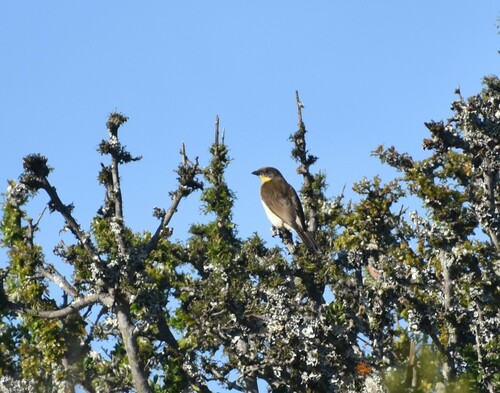 Greater Honeyguide
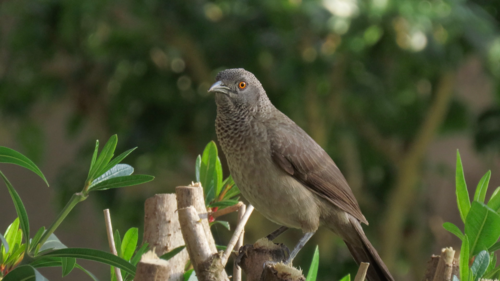 Brown Babbler
In short
The most reliable field mark to separate Greater Honeyguide from Brown Babbler is the presence of bold white tail patches and a contrasting yellow shoulder patch in the honeyguide, especially visible in flight or when perched with the tail spread. Juvenile honeyguides show olive-brown upperparts and a white rump, while babblers are more uniformly brown with a scaled head and white-streaked throat and breast. Structurally, honeyguides are smaller and slimmer with a shorter, paler bill (in males), while babblers are heavier, bulkier, and have a black bill. Both species can appear drab at a distance, but careful attention to tail, throat, and wing markings will separate them in most field views.
Identification tips
- White tail patches (all ages, especially in flight): Only Greater Honeyguide shows bold white patches on the sides of the tail, visible when perched with tail spread or in flight. Brown Babbler's tail is plain brown.
- Yellow shoulder patch (adult male honeyguide): Look for a yellow patch at the shoulder in male honeyguides; babblers never show yellow anywhere.
- Throat and breast pattern (adults): Brown Babbler has a white-streaked throat and breast and a scaled head, giving a streaky, patterned look. Honeyguide males have a solid black throat, females a duller blackish throat, and immatures a yellow throat and upper breast.
- Bill color and shape: Adult male honeyguide has a pink bill; female's is blackish. Brown Babbler always has a black bill, which is slightly heavier and more downcurved.
- Rump color (immatures): Immature honeyguides have a white rump, contrasting with olive-brown upperparts. Babblers are uniformly brown with no white rump.
- Body shape and size: Babblers are larger, heavier, and bulkier, with a more rounded, pot-bellied look. Honeyguides are slimmer and lighter.
- Wing color and pattern: Honeyguide wings are streaked whitish; babbler wings are bronze-brown and lack streaking.
- Eye color (adults vs juveniles): Adult babblers have yellow irises, while juveniles have brown. This is subtle but can help in close views; honeyguide eye color is not noted as distinctive.
- Group behavior: Babblers are almost always in noisy flocks; honeyguides are solitary or loosely associated, except at bee nests.
- Guiding behavior: Only honeyguides exhibit the unique behavior of actively leading humans to bee nests, often with specific calls and flight patterns.
- Vocalizations: Babblers are much noisier, with constant harsh chattering from groups. Honeyguides give solitary, wavering, chattering 'tya' notes, especially when guiding.
- Habitat context: Babblers prefer open woodland, scrub, and cultivated areas, often near water and in groups. Honeyguides are more likely near bee activity, woodland, or savanna, and are less likely to be seen in large groups.
- Sex differences: Only honeyguides show sexual dimorphism (male with pink bill and yellow shoulder patch); babblers are sexually monomorphic.
- Juvenile confusion: If you see a bird with a white rump and yellow throat, it's an immature honeyguide; a plain brown, less streaked bird in a flock is a juvenile babbler.
- Feeding behavior: Honeyguides may be seen near bee nests or feeding on wax; babblers forage on the ground or in low vegetation, rarely interacting with bees.
Size
Brown Babbler is noticeably larger and heavier, averaging 62.5 g (range 52–80 g) and 22–25 cm in length, compared to the Greater Honeyguide's 47 g and about 20 cm. Babblers look bulkier and heavier-bodied, often moving in loose, noisy groups, while honeyguides are slimmer and more solitary. The difference is most apparent when both are seen together, but even singly, the babbler's size and mass are distinctive if familiar with both.
Plumage
- Juvenile/immature birds: Greater Honeyguide immatures have olive-brown upperparts, a white rump, and a yellow throat and upper breast. These features are not found in Brown Babbler juveniles, which are plainer, browner, and lack the white rump or yellow tones, with brown irises instead of yellow.
- Adults: Male Greater Honeyguide shows a black throat, pink bill, yellow shoulder patch, bold white tail sides, and white underparts. Females are duller but still show white tail patches and a blackish bill. Brown Babbler adults are overall grey-brown with a scaled head, white-streaked throat and breast, bronze-brown wings, and a black bill; both sexes look alike. The babbler lacks any yellow or white rump/tail patches and has a more uniform brown appearance with a distinctive streaked throat and scaled crown.
- In flight: The honeyguide's white tail patches are diagnostic and visible in most views, especially when the bird fans or flicks its tail. Babblers have plain brown tails with no white, and their wings are bronze-brown without contrasting patches.
Behaviour
Greater Honeyguide is often solitary or in loose association with other honeyguides at bee nests, sometimes actively guiding humans with conspicuous, wavering flight and chattering calls. It may be seen perched quietly or flying purposefully between trees. Brown Babbler is highly social, usually in noisy, loose flocks that move through undergrowth or low trees, often foraging on or near the ground. Babblers are restless, frequently hopping and flicking wings and tails, and vocalizing constantly. Honeyguides are quieter and less conspicuous in their movements except when guiding.
Habitat
Both species can occur in overlapping regions from West Africa to Kenya, but their preferred habitats differ. Greater Honeyguide is associated with areas where wild bees nest—woodland, savanna, and sometimes near human settlements. Brown Babbler favors open woodland, scrub, and cultivated areas, often near water, and is more likely to be seen in groups in open or edge habitats. If you see a bird in a noisy flock in open scrub or farmland, it's more likely a babbler; a solitary bird near bee activity or guiding humans is likely a honeyguide.
Voice
Greater Honeyguide gives distinctive wavering, chattering 'tya' notes mixed with peeps or pipes, especially when guiding or agitated. Brown Babbler is much noisier overall, with a range of harsh, chattering, and scolding calls given almost constantly by the flock. If you hear a persistent, complex group chorus, it's likely babblers; a solitary, guiding chatter points to honeyguide.