

Motmot

Greater Green Leafbird vs Lesser Green Leafbird

Chloropsis sonnerati versus Chloropsis cyanopogon

Play a quiz with Greater Green Leafbird and Lesser Green Leafbird
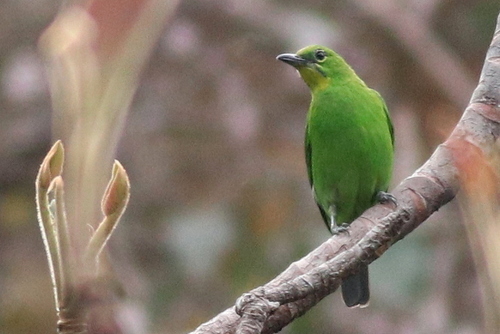
Greater Green Leafbird (Chloropsis sonnerati) Greater Green Leafbird
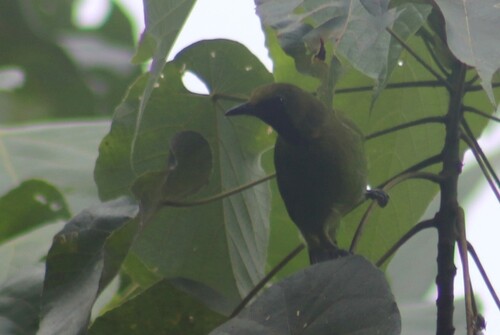
Lesser Green Leafbird (Chloropsis cyanopogon) Lesser Green Leafbird

Media

Loading…

In short

The most reliable field mark between Greater and Lesser Green Leafbird is the female's throat and eye ring: female Greater shows a yellow throat and yellow eye ring, while female Lesser lacks these features. For males, check the black throat patch: male Lesser Green Leafbird has a yellow border around the black throat, which is absent in male Greater. The Greater also has a noticeably more powerful beak. These differences are subtle at a distance, so focus on the throat and face details when possible. Structural differences, especially the bill, can help if plumage is obscured.

Identification tips

  1. Female throat and eye ring (most reliable for females): Female Greater Green Leafbird shows a yellow throat and yellow eye ring, while female Lesser Green Leafbird lacks both, having a plain green face and throat. This is the quickest way to separate females at close range.
  2. Male throat patch border: Male Lesser Green Leafbird has a black throat patch with a yellow border; male Greater Green Leafbird's black throat patch lacks any yellow edging. This is a key mark for adult males.
  3. Bill structure: The Greater Green Leafbird has a noticeably more powerful, robust beak compared to the Lesser. This is best judged when birds are side by side or with experience, but can be helpful if the head is clearly visible.
  4. Face pattern in females: Look for the combination of yellow throat and yellow eye ring in Greater females; Lesser females are more uniformly green in these areas.
  5. Plumage pitfalls: Both species are predominantly green, which can make them hard to separate at a glance. Always look for the subtle face and throat differences rather than relying on overall color.
  6. No distinctive juvenile/immature wing patterns: The notes do not describe any age-specific upperwing or flight pattern differences, so do not rely on these features for separation in the field.
  7. Habitat overlap: Both species occur in similar lowland forest habitats across Southeast Asia, so do not use habitat alone to identify them.
  8. Sexual dimorphism: Both species show differences between males and females, but the diagnostic marks (throat patch border in males, yellow throat/eye ring in females) are consistent within each sex.
  9. Distance and lighting: At a distance or in poor light, the subtle differences in throat and face may be hard to see. Try to get a good look at the head and throat area, especially in females.
  10. Mixed flocks: If you encounter mixed-species flocks, pay close attention to the head and throat details, as both species may be present together.
  11. Bill as a backup: If plumage marks are unclear, use bill size as a supporting clue—Greater's bill is more powerful, but this is subtle and may require experience.
  12. No voice cues: The notes do not provide vocal differences, so do not rely on calls or songs for separation.
  13. Seasonal variation: No seasonal plumage differences are described, so the key marks should be reliable year-round.
  14. Geographic range: Both species can be found in the same countries and habitats, so range does not help with identification.
  15. When in doubt: If the diagnostic throat or bill marks are not visible, it may not be possible to separate the species with certainty from a brief or poor view.

Size

Direct size comparison is not detailed in the provided notes, but the Greater Green Leafbird is implied to be more robust, especially in bill size, described as having a 'powerful beak.' This suggests a slightly bulkier impression compared to the Lesser, though overall body size may be similar in the field.

Plumage

For adult females, the Greater Green Leafbird stands out with a yellow throat and yellow eye ring, while the Lesser female lacks both, showing a more uniform green face and throat. In adult males, the key difference is in the throat patch: male Lesser Green Leafbird has a black throat patch edged with yellow, whereas male Greater lacks this yellow border, presenting a plain black throat patch. No age-specific (juvenile or immature) upperwing or flight pattern differences are described in the notes, so these marks are not available for separation. Both species otherwise share a generally green plumage, which can make quick views challenging.

Behaviour

Behavioral differences are not described in the provided notes. Both species are leafbirds and likely share similar foraging and perching behaviors, so do not rely on behavior for separation.

Habitat

Both species inhabit subtropical or tropical moist lowland forests, and their ranges overlap in Southeast Asia (Brunei, Indonesia, Malaysia, Myanmar, Singapore, and Thailand). Habitat alone is not a reliable separator, as both can be found in similar forest environments.

Submit a better description

Use the same sections as the comparison. Your text is published immediately.

The most reliable field mark between Greater and Lesser Green Leafbird is the female's throat and eye ring: female Greater shows a yellow throat and yellow eye ring, while female Lesser lacks these features. For males, check the black throat patch: male Lesser Green Leafbird has a yellow border around the black throat, which is absent in male Greater. The Greater also has a noticeably more powerful beak. These differences are subtle at a distance, so focus on the throat and face details when possible. Structural differences, especially the bill, can help if plumage is obscured.

  1. Female throat and eye ring (most reliable for females): Female Greater Green Leafbird shows a yellow throat and yellow eye ring, while female Lesser Green Leafbird lacks both, having a plain green face and throat. This is the quickest way to separate females at close range.
  2. Male throat patch border: Male Lesser Green Leafbird has a black throat patch with a yellow border; male Greater Green Leafbird's black throat patch lacks any yellow edging. This is a key mark for adult males.
  3. Bill structure: The Greater Green Leafbird has a noticeably more powerful, robust beak compared to the Lesser. This is best judged when birds are side by side or with experience, but can be helpful if the head is clearly visible.
  4. Face pattern in females: Look for the combination of yellow throat and yellow eye ring in Greater females; Lesser females are more uniformly green in these areas.
  5. Plumage pitfalls: Both species are predominantly green, which can make them hard to separate at a glance. Always look for the subtle face and throat differences rather than relying on overall color.
  6. No distinctive juvenile/immature wing patterns: The notes do not describe any age-specific upperwing or flight pattern differences, so do not rely on these features for separation in the field.
  7. Habitat overlap: Both species occur in similar lowland forest habitats across Southeast Asia, so do not use habitat alone to identify them.
  8. Sexual dimorphism: Both species show differences between males and females, but the diagnostic marks (throat patch border in males, yellow throat/eye ring in females) are consistent within each sex.
  9. Distance and lighting: At a distance or in poor light, the subtle differences in throat and face may be hard to see. Try to get a good look at the head and throat area, especially in females.
  10. Mixed flocks: If you encounter mixed-species flocks, pay close attention to the head and throat details, as both species may be present together.
  11. Bill as a backup: If plumage marks are unclear, use bill size as a supporting clue—Greater's bill is more powerful, but this is subtle and may require experience.
  12. No voice cues: The notes do not provide vocal differences, so do not rely on calls or songs for separation.
  13. Seasonal variation: No seasonal plumage differences are described, so the key marks should be reliable year-round.
  14. Geographic range: Both species can be found in the same countries and habitats, so range does not help with identification.
  15. When in doubt: If the diagnostic throat or bill marks are not visible, it may not be possible to separate the species with certainty from a brief or poor view.

Direct size comparison is not detailed in the provided notes, but the Greater Green Leafbird is implied to be more robust, especially in bill size, described as having a 'powerful beak.' This suggests a slightly bulkier impression compared to the Lesser, though overall body size may be similar in the field.

For adult females, the Greater Green Leafbird stands out with a yellow throat and yellow eye ring, while the Lesser female lacks both, showing a more uniform green face and throat. In adult males, the key difference is in the throat patch: male Lesser Green Leafbird has a black throat patch edged with yellow, whereas male Greater lacks this yellow border, presenting a plain black throat patch. No age-specific (juvenile or immature) upperwing or flight pattern differences are described in the notes, so these marks are not available for separation. Both species otherwise share a generally green plumage, which can make quick views challenging.

Behavioral differences are not described in the provided notes. Both species are leafbirds and likely share similar foraging and perching behaviors, so do not rely on behavior for separation.

Both species inhabit subtropical or tropical moist lowland forests, and their ranges overlap in Southeast Asia (Brunei, Indonesia, Malaysia, Myanmar, Singapore, and Thailand). Habitat alone is not a reliable separator, as both can be found in similar forest environments.

Discard your changes?

You have unsaved edits. If you leave now, those changes will be lost.

Greater Green Leafbird · Lesser Green Leafbird · My Tricky Birds