

Great Spinetail vs Bananaquit
Synallaxis hypochondriaca versus Coereba flaveola
Play a quiz with Great Spinetail and Bananaquit
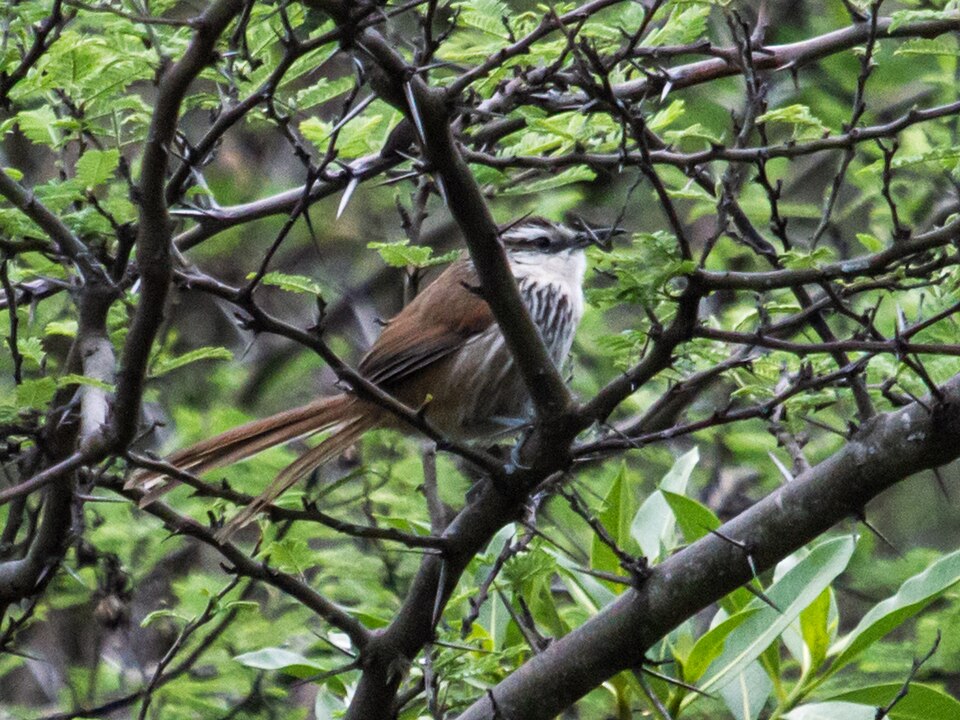 Great Spinetail
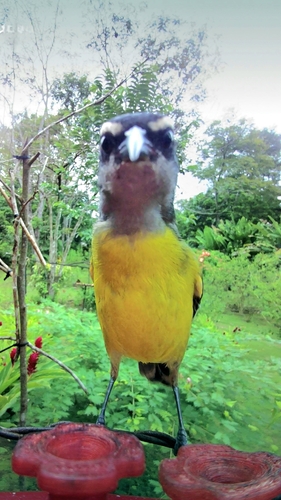 Bananaquit
In short
The most reliable field mark to separate Great Spinetail from Bananaquit is overall structure and bill shape: Great Spinetail is a large, long-tailed furnariid with a straight, sturdy bill, while Bananaquit is much smaller, with a slender, strongly curved bill adapted for nectar feeding. In plumage, Great Spinetail shows a broad white supercilium and heavily streaked white underparts, while Bananaquit has a prominent white eyebrow but a yellow belly and rump. Juvenile Bananaquits are duller but still show yellow tones, whereas juvenile Great Spinetails have less underpart streaking but never show yellow. Habitat is also a strong clue: Great Spinetail is restricted to arid montane scrub in northern Peru, while Bananaquit is widespread in lowland and foothill gardens and open habitats throughout the Neotropics.
Identification tips
- Bill shape: Great Spinetail has a straight, sturdy bill; Bananaquit's bill is slender and strongly curved. This is visible even at a distance and is diagnostic in all ages.
- Size and structure: Great Spinetail is much larger and longer-tailed, with a bulkier body and a graduated tail. Bananaquit is small, compact, and short-tailed.
- Supercilium/eyebrow: Both have a prominent white eyebrow, but Great Spinetail's is broader and contrasts with dusky lores and ear coverts; Bananaquit's is narrower but still striking.
- Underparts color: Great Spinetail has white underparts with brown-gray streaks (less streaked in juveniles), never yellow. Bananaquit always shows yellow on the belly and rump, even in dull juveniles.
- Upperparts color: Great Spinetail is brown to grayish brown above; Bananaquit is dark grey to black above, with a black crown and sides of the head.
- Tail: Great Spinetail's tail is long, graduated, and dusky brown; Bananaquit's tail is short and dark, matching the upperparts.
- Juvenile differences: Juvenile Great Spinetail is paler below with less streaking, but never shows yellow or blackish tones. Juvenile Bananaquit is duller than adult but still has yellowish underparts and a partially yellow eyebrow and throat.
- Mandible color (juveniles): Juvenile Great Spinetail has a paler, pinker mandible; Bananaquit juveniles may show a pink gape, especially in Caribbean subspecies.
- Feeding behavior: Bananaquit is often seen feeding at flowers or sugar feeders, perching to sip nectar; Great Spinetail gleans insects from foliage and branches, rarely seen at flowers.
- Habitat: Great Spinetail is restricted to arid montane scrub in northern Peru; Bananaquit is common in gardens, parks, and open habitats throughout the Neotropics, rarely above 2,000 m.
- Voice: If heard, Great Spinetail's rapid, chattering song is distinctive and unlike Bananaquit's typical calls (not described here).
- Sexes: Both species are sexually monomorphic; plumage differences are not sex-based.
- Flight style: Not described in detail, but Great Spinetail is likely heavier and less agile in flight compared to the quick, darting movements of Bananaquit.
- Context: If the bird is tame and feeding around humans or at sugar feeders, Bananaquit is far more likely; Great Spinetail is shy and restricted to wild scrub.
- Range: Outside the upper Marañón valley of northern Peru, Great Spinetail does not occur; Bananaquit is widespread except Cuba and dense Amazonian forest.
Size
Great Spinetail is substantially larger, at 17–19 cm in length and about 24 g in mass [wikidata], with a noticeably long, graduated tail. Bananaquit is much smaller, ranging from 10–13 cm in length and 5.5–19 g in mass (most typically at the lower end) [wikipedia]. In the field, Great Spinetail will appear bulkier and longer-tailed, while Bananaquit is a small, active bird with a compact, rounded appearance.
Plumage
Juvenile and adult Great Spinetails both have a wide white supercilium, dusky lores and ear coverts, a dull brown crown with faint buffy streaks, and a back that is lighter brown. Their underparts are white with brown-gray streaks (less streaked in juveniles), and their tail is long, graduated, and dusky brown. Bananaquit, in all plumages, shows a prominent white eyestripe, but differs in having dark grey to black upperparts, black crown and sides of the head, and a yellow chest, belly, and rump. Juvenile Bananaquits are duller, with partially yellow eyebrows and throat, but still show yellow tones absent in Great Spinetail. The Bananaquit's bill is slender and strongly decurved, while Great Spinetail's is straight and robust. No age-specific upperwing pattern is described for either species, but the overall coloration and presence/absence of yellow are key.
Behaviour
Great Spinetail forages mainly in dense arid montane scrub, usually singly, in pairs, or small family groups, gleaning arthropods from foliage and branches up to 2 m above ground. It is more secretive and less likely to be seen in open areas. Bananaquit is highly active, often seen flitting about in gardens, parks, and open habitats, feeding on nectar, fruit, and small insects. It frequently visits flowers and feeders and can become very tame around humans. Bananaquit must perch to feed (cannot hover like a hummingbird), and is often seen moving quickly between flowers and shrubs.
Habitat
Great Spinetail is strictly limited to arid montane scrub in the upper Marañón valley of northern Peru, at elevations of 2,000–2,800 m, sometimes up to 3,000 m [wikipedia]. It is associated with dense scrub, cactus, and scattered trees like Acacia, Bombax, and Alnus. Bananaquit, by contrast, is widespread throughout the Neotropics, absent only from Cuba and some dense forests or deserts, and is common in gardens, parks, and open to semi-open habitats at lower elevations (rarely above 2,000 m). If you see the bird in a lush garden or lowland park, it is almost certainly a Bananaquit; if in arid montane scrub in northern Peru, Great Spinetail is possible.
Voice
Great Spinetail's song is a loud, rapid, spluttering chatter of 'thk' notes that rise and fall, often sung in duet, with calls like a metallic 'TCHEE-TCHEE' or a longer 'tu-ter-CHEE-CHEE-CHEE' [wikipedia]. Bananaquit's vocalizations are not described in these notes, so voice is less reliable for separation unless you are familiar with Great Spinetail's distinctive chatter.