

Great Shearwater vs Sooty Shearwater
Ardenna gravis versus Ardenna grisea
Play a quiz with Great Shearwater and Sooty Shearwater
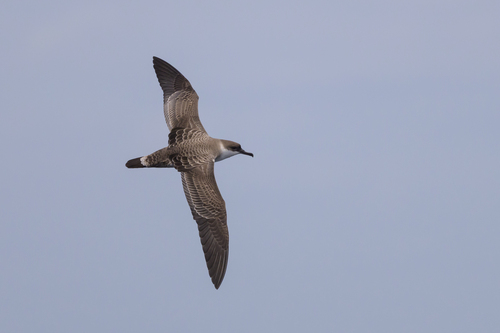 Great Shearwater
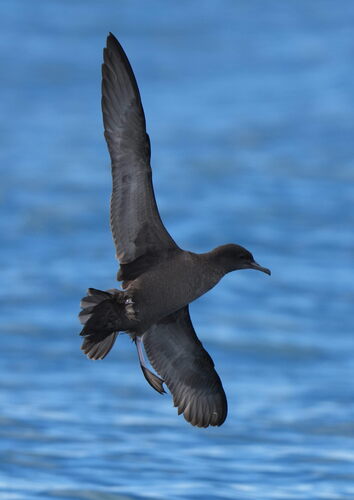 Sooty Shearwater
In short
The most reliable way to separate Great Shearwater from Sooty Shearwater is by overall plumage: Great Shearwater shows a striking contrast between its dark upperparts and white underparts, with a distinctive brown belly patch, dark cap, and a white 'horseshoe' at the base of the tail. In contrast, Sooty Shearwater is nearly uniform dark chocolate-brown all over, with only a silvery strip along the center of the underwing in good light. Both species have similar size and flight style, but the Great Shearwater’s bold patterning stands out even at a distance, while Sooty Shearwater can appear all-dark in poor light. Immature and adult plumages are similar in both species, so these marks work year-round. Be cautious in poor visibility, as Sooty Shearwater can look almost black and Great Shearwater’s belly patch may be hard to see.
Identification tips
- Underpart color: Great Shearwater has white underparts with a brown belly patch; Sooty Shearwater is uniformly dark below. This is the most reliable field mark for all ages and seasons.
- Tail base pattern: Look for the white 'horseshoe' at the base of the tail on Great Shearwater, especially in flight. Sooty Shearwater lacks this feature and is dark to the tail tip.
- Cap and face: Great Shearwater shows a black cap contrasting with a paler face and white throat; Sooty Shearwater's head is the same dark brown as the rest of the body, with no contrast.
- Underwing pattern: Sooty Shearwater shows a silvery panel along the center of the underwing in good light; Great Shearwater's underwing is mostly white with dark edges and lacks a silvery panel.
- Upperparts: Great Shearwater has dark gray-brown upperparts with a paler rump and white tail base; Sooty Shearwater is uniformly dark brown above.
- Bill color: Both have dark bills, not a separator.
- Flight style: Both species glide on stiff wings close to the water, with similar flight jizz; not a reliable separator.
- Size: Great Shearwater is slightly larger, but this is subtle and not reliable unless birds are side by side.
- Group behavior: Both can form large, noisy flocks, especially around fishing vessels; not a separator.
- Lighting pitfalls: In poor light, Sooty Shearwater can look all-black and Great Shearwater’s belly patch may be hard to see. Always look for the white underparts and tail horseshoe on Great Shearwater.
- Geographic context: Both species overlap widely in the North Atlantic; do not rely on range for separation in migration seasons.
- Age/season: No significant age-related differences in field marks; the above contrasts work for adults and immatures.
- Perched views: Rare at sea, but Great Shearwater’s white underparts and belly patch may be more obvious when sitting on the water.
- Voice: Not a practical separator at sea; both are mostly silent away from breeding grounds.
- Common pitfalls: The most frequent error is mistaking a Sooty Shearwater for a Great Shearwater in poor light, or missing the belly patch and tail horseshoe on a distant Great Shearwater. Always check for contrasting white underparts and tail pattern.
Size
Both species are large shearwaters, but Great Shearwater is slightly larger overall. Great Shearwater measures 43–51 cm in length with a wingspan of 105–122 cm, while Sooty Shearwater is 40–51 cm long with a wingspan of 94–110 cm. In the field, this size difference is subtle and rarely diagnostic unless birds are side by side. Both have long, slender wings typical of shearwaters, and their proportions are very similar.
Plumage
Plumage is the most reliable separator. Great Shearwater (all ages) shows dark gray-brown upperparts, a black cap, and sharply white underparts interrupted by a brown belly patch and dark smudges on the sides of the breast. The white 'horseshoe' at the base of the tail is a key mark, especially in flight. The bill is black. Sooty Shearwater (all ages) is overall dark chocolate-brown, appearing nearly black in poor light, with no white underparts, belly patch, or tail horseshoe. The only paler feature is a silvery panel along the center of the underwing, best seen in good light. Both species lack strong age-related variation in these marks, so these contrasts are reliable year-round. No distinctive juvenile or immature upperwing patterns are noted for either species.
Behaviour
Both species have the classic 'shearing' flight: stiff, straight wings with few wingbeats, gliding close to the water and banking from side to side. Great Shearwater is described as having a particularly stiff, direct flight, reminiscent of a large Manx Shearwater. Sooty Shearwater is also powerful and direct, sometimes likened to a small albatross. Both can gather in large, noisy flocks at sea, especially around fishing boats. Behavior is not a strong separator between these two.
Habitat
Both species are pelagic and occur in similar open-ocean habitats, often seen from ships or headlands during migration. Great Shearwater breeds on South Atlantic islands and migrates north along the Atlantic, while Sooty Shearwater breeds in the South Pacific and South Atlantic, migrating north up both the Pacific and Atlantic Oceans. In the North Atlantic, both can be seen together, especially off the coasts of Europe and North America. Habitat and context are not reliable for separation.
Voice
At sea, both species are generally silent, though Great Shearwater may give a piercing 'eeyah' cry when resting in groups, and Sooty Shearwater may call when competing for food. On breeding grounds, Sooty Shearwater is more vocal at night, but these calls are rarely heard at sea. Vocalizations are not a practical field mark for separation.