

Motmot

Great Shearwater vs Manx Shearwater

Ardenna gravis versus Puffinus puffinus

Play a quiz with Great Shearwater and Manx Shearwater
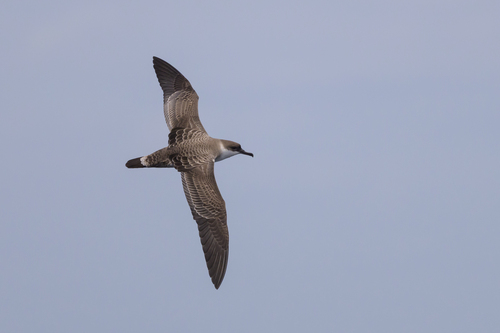
Great Shearwater (Ardenna gravis) Great Shearwater
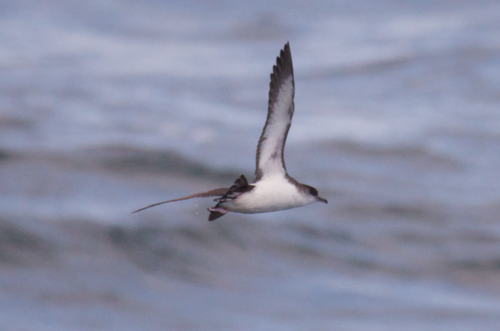
Manx Shearwater (Puffinus puffinus) Manx Shearwater

Media

Loading…

In short

The most reliable field mark between Great Shearwater and Manx Shearwater is the Great Shearwater’s distinctive brown belly patch and dark shoulder markings, which are absent in Manx. Great Shearwater is also much larger and bulkier, with a black cap and a contrasting white 'horseshoe' at the base of the tail, while Manx is slimmer and lacks these features. Both species share a similar black-and-white shearwater pattern and stiff, low gliding flight, but Great Shearwater appears more powerful and heavyset. Size, structure, and the presence or absence of the belly patch are the fastest ways to separate them at sea, especially in mixed flocks.

Identification tips

  1. Belly Patch: Great Shearwater always shows a brownish belly patch and dark shoulder smudges on otherwise white underparts; Manx Shearwater is clean white below with no patch. This is the fastest visual check in all ages and seasons.
  2. Head Pattern: Great Shearwater has a black cap contrasting with a white throat and face; Manx has a more evenly dark upper head, but lacks the sharp cap effect.
  3. Tail Markings: Look for the white 'horseshoe' at the base of the tail in Great Shearwater, visible from behind or below; Manx lacks this feature and has a plain white undertail.
  4. Size and Bulk: Great Shearwater is much larger and bulkier, with a longer wingspan and heavier build; Manx looks slim and delicate by comparison. Use size when birds are together or near other seabirds for scale.
  5. Flight Style: Both shear, but Great Shearwater’s flight is more powerful and direct, with less fluttering; Manx is more buoyant and agile, often described as a 'flying cross' due to its wing posture.
  6. Upperwing Pattern: Both are dark above, but Great Shearwater’s upperparts are darker and more uniform, while Manx may show a slightly paler panel on the upperwing in good light (not always reliable).
  7. Bill Color: Great Shearwater has a black bill; Manx’s bill is also dark, so this is not a strong separator.
  8. Shoulder Markings: Only Great Shearwater has dark shoulder marks visible on the white underwing and body; Manx is clean and unmarked here.
  9. Context and Range: In the North Atlantic in spring/summer, Manx is more likely close to breeding colonies; Great Shearwater is more common offshore and in late summer/autumn off Europe and North America.
  10. Association with Boats: Great Shearwater is more likely to follow fishing boats and squabble over discards; Manx is less gregarious in these situations.
  11. Flock Size: Both can form large flocks, but Great Shearwater is often seen in very large, dense groups offshore, sometimes mixed with other large shearwaters.
  12. Perched Views: Rare at sea, but if seen on water, Great Shearwater appears larger, with a heavier head and bill, and the belly patch may be visible; Manx sits lower and looks more compact.
  13. Voice: If heard, Great Shearwater’s 'eeyah' is distinctive, but both are usually silent at sea.
  14. Juvenile/Immature Marks: No specific juvenile or immature upperwing patterns are described for either species in these notes; focus on belly patch and overall size for all ages.
  15. Pitfalls: In poor light or at distance, Manx can look larger and darker, but will never show the belly patch or tail horseshoe. Beware of Cory’s or Sooty Shearwater confusion in mixed flocks, but those are even larger or all-dark.

Size

Great Shearwater is substantially larger: 43–51 cm long with a 105–122 cm wingspan, compared to Manx Shearwater’s 30–38 cm length and 76–89 cm wingspan [wikipedia]. Manx weighs around 521 g [wikidata], while Great Shearwater is heavier (exact mass not given, but visually and by length/wingspan, it is much bulkier). In the field, Great Shearwater stands out as a big, heavy-bodied shearwater, while Manx looks noticeably smaller, slimmer, and more delicate.

Plumage

Age-specific upperwing or flight marks are not detailed for either species in these notes, so focus is on overall plumage. Great Shearwater adults (and immatures, as no age difference is noted) show dark upperparts with a clear brown belly patch, dark shoulder markings, a black cap, and a white 'horseshoe' at the tail base. Manx Shearwater is cleanly black above and white below, with no belly patch, shoulder smudge, or tail horseshoe. Both have white underparts, but only Great Shearwater has the brownish smudge on the belly and the dark cap. In flight, Manx appears as a neat black-and-white 'flying cross' with sharp contrast, while Great Shearwater looks messier below due to the belly patch and darker head.

Behaviour

Both species exhibit classic 'shearing' flight, gliding low over the water with stiff, straight wings and minimal flapping. Great Shearwater’s flight is described as more powerful and direct, befitting its larger size, and it often appears heavier in the air. Manx Shearwater is more buoyant and agile, with a slightly more fluttery flight. Both may be seen in large feeding flocks, but Great Shearwater is more likely to follow fishing boats and engage in noisy squabbles over food.

Habitat

Both are pelagic and seen far offshore, but their breeding ranges do not overlap: Great Shearwater breeds on remote South Atlantic islands, while Manx Shearwater breeds in the North Atlantic (UK, Ireland, Iceland, etc.). At sea, both can occur off the North Atlantic coasts, especially during migration, so overlap is possible in late spring through autumn. Great Shearwater is more likely in the southern Atlantic and off southwestern Europe in late summer, while Manx is more coastal and northern in breeding season.

Voice

Great Shearwater gives a piercing 'eeyah' cry, mostly when resting in groups on the water. Manx Shearwater’s voice is not described in these notes, but both are generally silent at sea and vocalize mainly at colonies at night. Voice is rarely useful for field separation at sea.

Submit a better description

Use the same sections as the comparison. Your text is published immediately.

The most reliable field mark between Great Shearwater and Manx Shearwater is the Great Shearwater’s distinctive brown belly patch and dark shoulder markings, which are absent in Manx. Great Shearwater is also much larger and bulkier, with a black cap and a contrasting white 'horseshoe' at the base of the tail, while Manx is slimmer and lacks these features. Both species share a similar black-and-white shearwater pattern and stiff, low gliding flight, but Great Shearwater appears more powerful and heavyset. Size, structure, and the presence or absence of the belly patch are the fastest ways to separate them at sea, especially in mixed flocks.

  1. Belly Patch: Great Shearwater always shows a brownish belly patch and dark shoulder smudges on otherwise white underparts; Manx Shearwater is clean white below with no patch. This is the fastest visual check in all ages and seasons.
  2. Head Pattern: Great Shearwater has a black cap contrasting with a white throat and face; Manx has a more evenly dark upper head, but lacks the sharp cap effect.
  3. Tail Markings: Look for the white 'horseshoe' at the base of the tail in Great Shearwater, visible from behind or below; Manx lacks this feature and has a plain white undertail.
  4. Size and Bulk: Great Shearwater is much larger and bulkier, with a longer wingspan and heavier build; Manx looks slim and delicate by comparison. Use size when birds are together or near other seabirds for scale.
  5. Flight Style: Both shear, but Great Shearwater’s flight is more powerful and direct, with less fluttering; Manx is more buoyant and agile, often described as a 'flying cross' due to its wing posture.
  6. Upperwing Pattern: Both are dark above, but Great Shearwater’s upperparts are darker and more uniform, while Manx may show a slightly paler panel on the upperwing in good light (not always reliable).
  7. Bill Color: Great Shearwater has a black bill; Manx’s bill is also dark, so this is not a strong separator.
  8. Shoulder Markings: Only Great Shearwater has dark shoulder marks visible on the white underwing and body; Manx is clean and unmarked here.
  9. Context and Range: In the North Atlantic in spring/summer, Manx is more likely close to breeding colonies; Great Shearwater is more common offshore and in late summer/autumn off Europe and North America.
  10. Association with Boats: Great Shearwater is more likely to follow fishing boats and squabble over discards; Manx is less gregarious in these situations.
  11. Flock Size: Both can form large flocks, but Great Shearwater is often seen in very large, dense groups offshore, sometimes mixed with other large shearwaters.
  12. Perched Views: Rare at sea, but if seen on water, Great Shearwater appears larger, with a heavier head and bill, and the belly patch may be visible; Manx sits lower and looks more compact.
  13. Voice: If heard, Great Shearwater’s 'eeyah' is distinctive, but both are usually silent at sea.
  14. Juvenile/Immature Marks: No specific juvenile or immature upperwing patterns are described for either species in these notes; focus on belly patch and overall size for all ages.
  15. Pitfalls: In poor light or at distance, Manx can look larger and darker, but will never show the belly patch or tail horseshoe. Beware of Cory’s or Sooty Shearwater confusion in mixed flocks, but those are even larger or all-dark.

Great Shearwater is substantially larger: 43–51 cm long with a 105–122 cm wingspan, compared to Manx Shearwater’s 30–38 cm length and 76–89 cm wingspan [wikipedia]. Manx weighs around 521 g [wikidata], while Great Shearwater is heavier (exact mass not given, but visually and by length/wingspan, it is much bulkier). In the field, Great Shearwater stands out as a big, heavy-bodied shearwater, while Manx looks noticeably smaller, slimmer, and more delicate.

Age-specific upperwing or flight marks are not detailed for either species in these notes, so focus is on overall plumage. Great Shearwater adults (and immatures, as no age difference is noted) show dark upperparts with a clear brown belly patch, dark shoulder markings, a black cap, and a white 'horseshoe' at the tail base. Manx Shearwater is cleanly black above and white below, with no belly patch, shoulder smudge, or tail horseshoe. Both have white underparts, but only Great Shearwater has the brownish smudge on the belly and the dark cap. In flight, Manx appears as a neat black-and-white 'flying cross' with sharp contrast, while Great Shearwater looks messier below due to the belly patch and darker head.

Both species exhibit classic 'shearing' flight, gliding low over the water with stiff, straight wings and minimal flapping. Great Shearwater’s flight is described as more powerful and direct, befitting its larger size, and it often appears heavier in the air. Manx Shearwater is more buoyant and agile, with a slightly more fluttery flight. Both may be seen in large feeding flocks, but Great Shearwater is more likely to follow fishing boats and engage in noisy squabbles over food.

Both are pelagic and seen far offshore, but their breeding ranges do not overlap: Great Shearwater breeds on remote South Atlantic islands, while Manx Shearwater breeds in the North Atlantic (UK, Ireland, Iceland, etc.). At sea, both can occur off the North Atlantic coasts, especially during migration, so overlap is possible in late spring through autumn. Great Shearwater is more likely in the southern Atlantic and off southwestern Europe in late summer, while Manx is more coastal and northern in breeding season.

Great Shearwater gives a piercing 'eeyah' cry, mostly when resting in groups on the water. Manx Shearwater’s voice is not described in these notes, but both are generally silent at sea and vocalize mainly at colonies at night. Voice is rarely useful for field separation at sea.

Discard your changes?

You have unsaved edits. If you leave now, those changes will be lost.

Great Shearwater · Manx Shearwater · My Tricky Birds