

Motmot

Great Kiskadee vs Rusty-margined Flycatcher

Pitangus sulphuratus versus Myiozetetes cayanensis

Play a quiz with Great Kiskadee and Rusty-margined Flycatcher
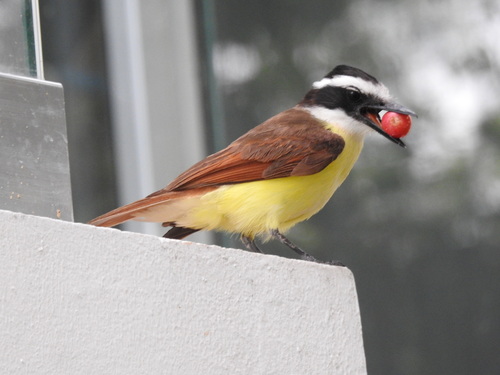
Great Kiskadee (Pitangus sulphuratus) Great Kiskadee
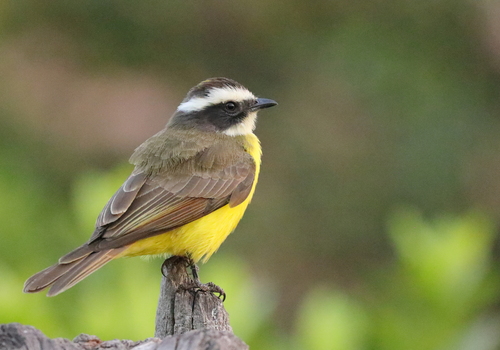
Rusty-margined Flycatcher (Myiozetetes cayanensis) Rusty-margined Flycatcher

Media

Loading…

In short

The most reliable way to separate Great Kiskadee from Rusty-margined Flycatcher is by size and structure: Great Kiskadee is much larger and bulkier, with a thicker, more robust bill and a more strikingly rufous-edged wing and tail. Both species have a blackish head with a white supercilium and a hidden yellow crown stripe, but the Kiskadee’s head pattern is bolder and its rufous wing and tail edges are broader and brighter. Juvenile Rusty-margined Flycatchers show more extensive rusty-cinnamon on the wings and tail, but never match the Kiskadee’s size or bill shape. In perched or flight views, focus first on size, bill, and the amount and brightness of rufous on the wings and tail.

Identification tips

  1. Size is the first check: Great Kiskadee is much larger and bulkier than Rusty-margined Flycatcher. If the bird looks jay-sized or noticeably bigger than a kingbird, it is almost certainly a Kiskadee (all ages).
  2. Bill structure: Kiskadee has a short, thick, heavy black bill, almost shrike-like. Rusty-margined’s bill is smaller, more proportional to head size, and never as robust (all ages).
  3. Head pattern: Both have a blackish crown with a white supercilium and a hidden yellow crown stripe, but Kiskadee’s is bolder, with a broader white line and more contrast between black and white. Rusty-margined’s supercilium is thinner but extends further behind the eye (all ages).
  4. Rufous in wings and tail: Kiskadee adults have strong, broad rufous fringes on wings and tail, visible both perched and in flight. Rusty-margined shows only thin, dull rusty or cinnamon edges, mainly on outer secondaries and primaries, never as bright or extensive (all ages, but especially adults).
  5. Juvenile Rusty-margined: Juveniles have more rusty-cinnamon on wings and tail than adults, but still not as broad or bright as Kiskadee. They lack any yellow on the crown (juveniles only).
  6. Upperparts color: Kiskadee’s upperparts are plain brown; Rusty-margined is brown to olive-brown, sometimes with a slightly plainer look (all ages).
  7. Tail color: Kiskadee’s tail is brown with strong rufous fringes; Rusty-margined’s is dusky brownish with light olive edges, lacking obvious rufous (all ages).
  8. Underparts: Both species have bright yellow bellies and white throats, so this is not a useful field mark.
  9. Perched jizz: Kiskadee sits upright, often high and conspicuous, with a bulky, big-headed look. Rusty-margined is slimmer and less imposing, sometimes in pairs or small groups (all ages).
  10. Flight jizz: In flight, Kiskadee appears heavy and broad-winged, with obvious rufous in wings and tail. Rusty-margined is more agile, with less obvious rufous and a slimmer profile (all ages).
  11. Vocalizations: If you hear a loud, ringing "BEE-tee-WEE" or similar, it is Kiskadee. Rusty-margined’s calls are less distinctive and not as loud (all ages).
  12. Habitat: Both can occur in similar habitats, but Kiskadee is more likely in urban areas and at feeders. Rusty-margined is more typical of forest edge and semi-open woodland (all ages).
  13. Feeding behavior: Kiskadee is bold, often sallying from high perches and taking a wide variety of prey, including small vertebrates. Rusty-margined is less aggressive and more insectivorous (all ages).
  14. Direct comparison: If both species are present, the size and bill differences are immediately obvious. In single-bird situations, focus on rufous in the wings/tail and bill thickness.
  15. Pitfalls: Beware of juvenile Rusty-margined, which can look more rufous than adults, but never matches Kiskadee’s size or bill. If the bird is small and slim, it is not a Kiskadee.

Size

Great Kiskadee is one of the largest tyrant flycatchers, at 25–28 cm in length and about 74 g in mass [wikipedia][wikidata]. Rusty-margined Flycatcher is much smaller, at 16.5–18 cm and 22–29.5 g. In the field, this size difference is obvious: Kiskadee looks stocky and almost jay-sized, while Rusty-margined is closer to a bulky kingbird. The Kiskadee’s bill is notably thick and short, almost shrike-like, while Rusty-margined has a smaller, stubby bill. Even without a direct comparison, the overall bulk and head size of Kiskadee stand out.

Plumage

Juvenile Rusty-margined Flycatchers have more extensive rusty-cinnamon edging on the wings and tail than adults, but never as broad or bright as the adult Great Kiskadee’s strong rufous fringes. Kiskadee adults show a bold black crown with a wide white supercilium and a hidden yellow crown stripe; the upperparts are brown, with wings and tail showing strong rufous edges. Rusty-margined adults have a dark sooty brown to blackish crown (with a concealed yellow or orange patch), a white supercilium that extends well past the eye, and plain brown to olive-brown upperparts. Their wings have thin rusty or cinnamon-rufous edges (especially on outer secondaries and primaries), but these are always narrower and duller than Kiskadee’s. The tail of Rusty-margined is dusky brownish with light olive edges, lacking the Kiskadee’s broad rufous. Both species have bright yellow underparts and a white throat, but the Kiskadee’s head pattern is bolder and more contrasting.

Behaviour

Great Kiskadee is conspicuous, noisy, and often perches high in the open, sallying out for insects or even small vertebrates, and is frequently seen around human habitation. It is bold and will visit feeders. Rusty-margined Flycatcher is less conspicuous and more likely to be seen in pairs or small groups, often in edge or semi-open habitats. Both species may perch openly, but Kiskadee’s behavior is flashier and more aggressive, while Rusty-margined is more retiring.

Habitat

Both species occur in open woodland and edge habitats, often near water and around human habitation. Great Kiskadee is especially common in urban and suburban areas, and is one of the most conspicuous birds in Latin American cities. Rusty-margined Flycatcher shares much of the same range but is generally less abundant in heavily urbanized areas and more typical of forest edge, secondary growth, and open woodland. Habitat overlap is extensive, so context alone is not diagnostic.

Voice

Great Kiskadee has a loud, exuberant, and distinctive call often rendered as "BEE-tee-WEE" or similar, which is onomatopoeic and gives the bird its name in several languages. Rusty-margined Flycatcher’s vocalizations are less well described in these notes, but are not as loud or distinctive as the Kiskadee’s. In noisy urban environments, the Kiskadee’s call is often the most obvious clue.

Submit a better description

Use the same sections as the comparison. Your text is published immediately.

The most reliable way to separate Great Kiskadee from Rusty-margined Flycatcher is by size and structure: Great Kiskadee is much larger and bulkier, with a thicker, more robust bill and a more strikingly rufous-edged wing and tail. Both species have a blackish head with a white supercilium and a hidden yellow crown stripe, but the Kiskadee’s head pattern is bolder and its rufous wing and tail edges are broader and brighter. Juvenile Rusty-margined Flycatchers show more extensive rusty-cinnamon on the wings and tail, but never match the Kiskadee’s size or bill shape. In perched or flight views, focus first on size, bill, and the amount and brightness of rufous on the wings and tail.

  1. Size is the first check: Great Kiskadee is much larger and bulkier than Rusty-margined Flycatcher. If the bird looks jay-sized or noticeably bigger than a kingbird, it is almost certainly a Kiskadee (all ages).
  2. Bill structure: Kiskadee has a short, thick, heavy black bill, almost shrike-like. Rusty-margined’s bill is smaller, more proportional to head size, and never as robust (all ages).
  3. Head pattern: Both have a blackish crown with a white supercilium and a hidden yellow crown stripe, but Kiskadee’s is bolder, with a broader white line and more contrast between black and white. Rusty-margined’s supercilium is thinner but extends further behind the eye (all ages).
  4. Rufous in wings and tail: Kiskadee adults have strong, broad rufous fringes on wings and tail, visible both perched and in flight. Rusty-margined shows only thin, dull rusty or cinnamon edges, mainly on outer secondaries and primaries, never as bright or extensive (all ages, but especially adults).
  5. Juvenile Rusty-margined: Juveniles have more rusty-cinnamon on wings and tail than adults, but still not as broad or bright as Kiskadee. They lack any yellow on the crown (juveniles only).
  6. Upperparts color: Kiskadee’s upperparts are plain brown; Rusty-margined is brown to olive-brown, sometimes with a slightly plainer look (all ages).
  7. Tail color: Kiskadee’s tail is brown with strong rufous fringes; Rusty-margined’s is dusky brownish with light olive edges, lacking obvious rufous (all ages).
  8. Underparts: Both species have bright yellow bellies and white throats, so this is not a useful field mark.
  9. Perched jizz: Kiskadee sits upright, often high and conspicuous, with a bulky, big-headed look. Rusty-margined is slimmer and less imposing, sometimes in pairs or small groups (all ages).
  10. Flight jizz: In flight, Kiskadee appears heavy and broad-winged, with obvious rufous in wings and tail. Rusty-margined is more agile, with less obvious rufous and a slimmer profile (all ages).
  11. Vocalizations: If you hear a loud, ringing "BEE-tee-WEE" or similar, it is Kiskadee. Rusty-margined’s calls are less distinctive and not as loud (all ages).
  12. Habitat: Both can occur in similar habitats, but Kiskadee is more likely in urban areas and at feeders. Rusty-margined is more typical of forest edge and semi-open woodland (all ages).
  13. Feeding behavior: Kiskadee is bold, often sallying from high perches and taking a wide variety of prey, including small vertebrates. Rusty-margined is less aggressive and more insectivorous (all ages).
  14. Direct comparison: If both species are present, the size and bill differences are immediately obvious. In single-bird situations, focus on rufous in the wings/tail and bill thickness.
  15. Pitfalls: Beware of juvenile Rusty-margined, which can look more rufous than adults, but never matches Kiskadee’s size or bill. If the bird is small and slim, it is not a Kiskadee.

Great Kiskadee is one of the largest tyrant flycatchers, at 25–28 cm in length and about 74 g in mass [wikipedia][wikidata]. Rusty-margined Flycatcher is much smaller, at 16.5–18 cm and 22–29.5 g. In the field, this size difference is obvious: Kiskadee looks stocky and almost jay-sized, while Rusty-margined is closer to a bulky kingbird. The Kiskadee’s bill is notably thick and short, almost shrike-like, while Rusty-margined has a smaller, stubby bill. Even without a direct comparison, the overall bulk and head size of Kiskadee stand out.

Juvenile Rusty-margined Flycatchers have more extensive rusty-cinnamon edging on the wings and tail than adults, but never as broad or bright as the adult Great Kiskadee’s strong rufous fringes. Kiskadee adults show a bold black crown with a wide white supercilium and a hidden yellow crown stripe; the upperparts are brown, with wings and tail showing strong rufous edges. Rusty-margined adults have a dark sooty brown to blackish crown (with a concealed yellow or orange patch), a white supercilium that extends well past the eye, and plain brown to olive-brown upperparts. Their wings have thin rusty or cinnamon-rufous edges (especially on outer secondaries and primaries), but these are always narrower and duller than Kiskadee’s. The tail of Rusty-margined is dusky brownish with light olive edges, lacking the Kiskadee’s broad rufous. Both species have bright yellow underparts and a white throat, but the Kiskadee’s head pattern is bolder and more contrasting.

Great Kiskadee is conspicuous, noisy, and often perches high in the open, sallying out for insects or even small vertebrates, and is frequently seen around human habitation. It is bold and will visit feeders. Rusty-margined Flycatcher is less conspicuous and more likely to be seen in pairs or small groups, often in edge or semi-open habitats. Both species may perch openly, but Kiskadee’s behavior is flashier and more aggressive, while Rusty-margined is more retiring.

Both species occur in open woodland and edge habitats, often near water and around human habitation. Great Kiskadee is especially common in urban and suburban areas, and is one of the most conspicuous birds in Latin American cities. Rusty-margined Flycatcher shares much of the same range but is generally less abundant in heavily urbanized areas and more typical of forest edge, secondary growth, and open woodland. Habitat overlap is extensive, so context alone is not diagnostic.

Great Kiskadee has a loud, exuberant, and distinctive call often rendered as "BEE-tee-WEE" or similar, which is onomatopoeic and gives the bird its name in several languages. Rusty-margined Flycatcher’s vocalizations are less well described in these notes, but are not as loud or distinctive as the Kiskadee’s. In noisy urban environments, the Kiskadee’s call is often the most obvious clue.

Discard your changes?

You have unsaved edits. If you leave now, those changes will be lost.

Great Kiskadee · Rusty-margined Flycatcher · My Tricky Birds