

Great Crested Tern vs Polynesian Storm-Petrel
Thalasseus bergii versus Nesofregetta fuliginosa
Play a quiz with Great Crested Tern and Polynesian Storm-Petrel
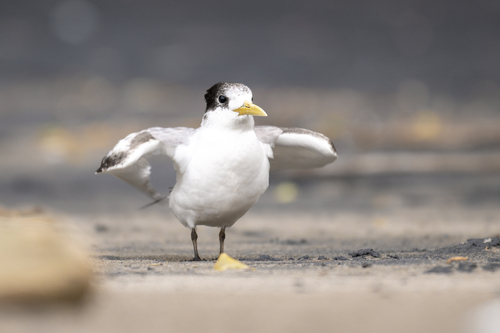 Great Crested Tern
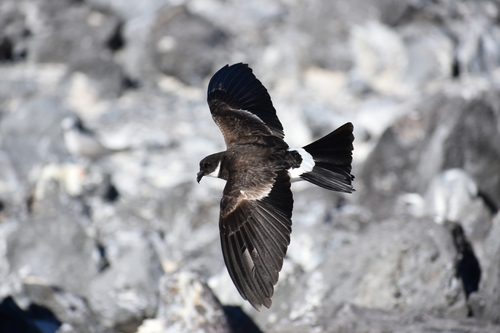 Polynesian Storm-Petrel
In short
The most reliable field mark to separate Great Crested Tern from Polynesian Storm-Petrel is overall structure and flight style: Great Crested Tern is a large, heavy-billed tern with long, pointed wings and a strong, direct flight, while Polynesian Storm-Petrel is much smaller, with broad, rounded wings, a short black bill, and a distinctive zig-zag, fluttery flight. Juvenile Great Crested Terns show a variegated upperwing with dark bars, unlike any storm-petrel. In all plumages, the tern’s greenish-yellow bill and shaggy black crest are unique, while the storm-petrel’s black bill, black feet, and polymorphic underparts (often with white belly) are distinctive. These species differ so strongly in size, structure, and flight that confusion is rare except in poor conditions or with distant, fast-moving birds.
Identification tips
- Size and shape: Great Crested Tern is much larger and longer-winged than Polynesian Storm-Petrel; compare proportions if seen together or with other seabirds.
- Bill color and shape: Tern has a long, straight, greenish-yellow bill; storm-petrel has a short, stubby, black bill. Bill color is visible at moderate range in good light.
- Wing shape in flight: Tern’s wings are long and pointed, giving a sharp, angular look; storm-petrel’s wings are broad and rounded, with a more paddle-like appearance.
- Flight style: Tern flies with strong, direct wingbeats and glides; storm-petrel has a fluttery, zig-zagging flight, often low over the water.
- Tail shape: Both have forked tails, but the tern’s is longer and more deeply forked; storm-petrel’s is shorter and less pronounced.
- Juvenile/immature upperwing: Juvenile Great Crested Terns show a variegated upperwing with dark bars and a dark bar on the inner primaries; storm-petrel never shows this pattern at any age.
- Crest and head pattern: Adult tern has a shaggy black crest and white forehead (breeding), or white crown with peppered black (nonbreeding); storm-petrel lacks any crest and has a plain or dark-capped head.
- Leg color: Tern has black legs, but these are usually hidden in flight; storm-petrel’s black legs and feet may be visible when pattering on the water.
- Underparts: Tern is white below; storm-petrel is variable, but white is usually limited to the belly and throat, not the entire underparts.
- Plumage polymorphism: Only storm-petrel is polymorphic, with some birds almost entirely dark and others with extensive white; tern is consistent in pattern except for age and wear.
- Vocalizations: Any loud, harsh, or crow-like calls indicate tern; storm-petrel is nearly always silent at sea.
- Habitat context: Tern is common along coasts and islands, often in flocks; storm-petrel is strictly pelagic except at remote breeding islands.
- Association with other birds: Tern often associates with other terns and gulls; storm-petrel is usually solitary or in small groups, rarely with terns.
- Perched posture: Tern stands upright with long wings and tail extending well past the body; storm-petrel sits more horizontally and appears compact.
- Pitfalls: Distant, fast-flying terns may appear smaller, and storm-petrels with extensive white can superficially resemble small terns, but structure, bill, and flight style are always reliable if seen well.
Size
Great Crested Tern is a much larger bird: adults are 46–49 cm long with a wingspan of 125–130 cm and weigh 325–397 g [wikipedia]. Polynesian Storm-Petrel is less than a quarter the mass, at 56–86 g and about 26 cm (10.2 in) in length [wikipedia]. In the field, the tern appears long and lanky, with a big head and bill, while the storm-petrel is compact and slight, with a proportionally large head for its body but a much smaller overall presence.
Plumage
Juvenile Great Crested Terns have a strongly variegated upperwing with dark bars and a dark bar on the inner flight feathers, a pattern not seen in Polynesian Storm-Petrel of any age. Adult Great Crested Terns in breeding plumage have a white forehead, glossy black shaggy crest, and battleship-grey upperparts, while in nonbreeding plumage the crown becomes white with a peppered black crest and mask. Their bill is always greenish-yellow, never black. Polynesian Storm-Petrel is highly variable (polymorphic): some birds have mostly dark plumage, others have extensive white on the belly and throat, but all have a black bill and black feet. Their wings are broad and rounded, and their tail is forked but not as long or deeply forked as the tern's. No storm-petrel shows the tern’s combination of white forehead, shaggy crest, and yellow bill. The storm-petrel’s underparts can be white or dark, but the white is usually confined to the belly and throat, not the entire underparts as in the tern.
Behaviour
Great Crested Tern flies with strong, direct wingbeats and often glides or hovers before diving for fish. It is highly vocal and usually seen in flocks, especially at breeding colonies or roosts. Polynesian Storm-Petrel has a fluttery, zig-zag flight low over the water, often pattering or dipping to pick food from the surface. It is solitary or in small groups, rarely associating with terns. When perched, the tern stands upright with long wings and tail extending well past the body, while the storm-petrel sits more horizontally and appears much smaller and rounder.
Habitat
Great Crested Tern is found along coastlines and islands in tropical and subtropical regions, often seen over open water, beaches, and sandbars, especially near breeding colonies. Polynesian Storm-Petrel is strictly pelagic outside the breeding season, coming to land only to nest in burrows or rock crevices on remote islands. It is rarely seen close to shore except near breeding sites. If observed from land, the tern is much more likely unless you are on a remote island or at sea.
Voice
Great Crested Tern is highly vocal, especially at colonies, giving loud, raucous crow-like calls (kerrak), a korrkorrkorr at the nest, and a hard wep wep in flight. Polynesian Storm-Petrel is generally silent at sea and rarely heard except at breeding sites, where it may give soft calls. Any loud, harsh calling suggests tern, not storm-petrel.
Great Crested Tern · Polynesian Storm-Petrel · My Tricky Birds