

Glossy Ibis vs Tricoloured Munia
Plegadis falcinellus versus Lonchura malacca
Play a quiz with Glossy Ibis and Tricoloured Munia
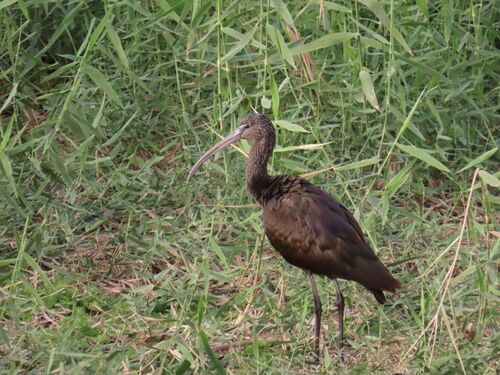 Glossy Ibis
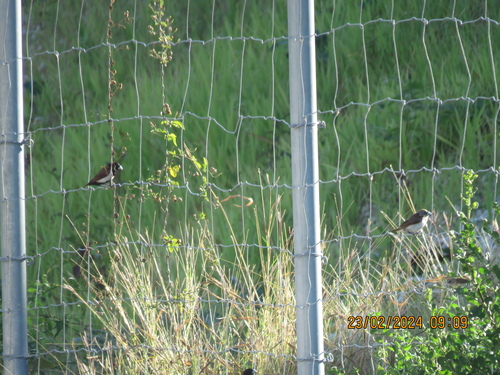 Tricoloured Munia
In short
Glossy Ibis and Tricoloured Munia are extremely unlikely to be confused in the field due to their vast difference in size, structure, and habitat. The most reliable separation is size: Glossy Ibis is a large, long-legged wader, while Tricoloured Munia is a tiny, seed-eating finch. In flight or perched, Glossy Ibis shows a long, downcurved bill and iridescent wings, while Tricoloured Munia is compact with a thick, conical bill and bold, blocky plumage pattern. Juveniles of both species are duller, but even then, the ibis’s proportions and flight style are unmistakable. If you’re seeing a bird in a wetland with a sickle-shaped bill, it’s Glossy Ibis; a small bird in grassland or rice fields with a black head and white belly is Tricoloured Munia.
Identification tips
- Size is the fastest check: Glossy Ibis is huge compared to Tricoloured Munia; if you can see both in the same binocular field, the difference is overwhelming. Use this even at a distance.
- Bill shape: Glossy Ibis has a long, slender, strongly downcurved bill (like a sickle), visible even in silhouette. Tricoloured Munia has a short, thick, conical finch bill, pale bluish in adults, never downcurved.
- Leg length and posture: Glossy Ibis has long, stilt-like legs and stands tall, wader-style, often in water. Munia has short legs and perches low in grass or on stalks.
- Flight style: Ibises fly with neck and legs fully outstretched, often in lines or V formations. Munias fly with rapid, bounding wingbeats, often in tight, twisting flocks, never in V formation.
- Adult plumage: Breeding Glossy Ibis is reddish-brown with metallic green/bronze/purple wings and a subtle white facial band. Munia is sharply patterned: black head/breast, white belly/flanks, chestnut back/rump. No overlap.
- Juvenile confusion: Juvenile Glossy Ibis is dull brown with fine white streaks on the head/neck and a long, curved bill. Juvenile Munia is plain warm brown above, buff below, with a short, thick bill and no streaking or iridescence.
- Iridescence: Only Glossy Ibis shows metallic iridescence on the wings (especially adults). Munia is entirely matte.
- Facial markings: Glossy Ibis has a narrow white facial band (breeding) or blue-grey facial skin (non-breeding), but never a solid black head like adult munia. Munia’s black head is sharply demarcated from the white belly.
- Habitat context: If the bird is wading in open water or probing mud, it’s Glossy Ibis. If it’s feeding on grass seeds or perched in a rice field, it’s Munia.
- Group size and composition: Large, loose flocks or mixed-species wader groups suggest Glossy Ibis. Tight, chattering flocks in grassland or crops are typical of Munia.
- Tail and wing shape: Glossy Ibis has a long, rounded tail and broad wings; Munia has a short tail and compact wings.
- Leg color: Ibis legs are red-brown; Munia legs are grey or horn-grey.
- Bill color: Ibis bill is brownish; Munia bill is pale bluish-grey in adults.
- Perched silhouette: Ibis is upright and lanky, even when perched. Munia is compact and round-bodied.
- Vocalization is not a useful separator in this pair, as the notes do not provide diagnostic calls for either species.
Size
The size difference is dramatic and diagnostic. Glossy Ibis averages 633 g and is about 48–66 cm long, with a wingspan of 80–105 cm. Tricoloured Munia is tiny by comparison, at just 12.6 g and about 11.5 cm long, with a wingspan of 5.5–5.7 cm. Even at a distance, the ibis is a large, heron-like bird, while the munia is sparrow-sized or smaller. There is no overlap in size or silhouette.
Plumage
- Juvenile/immature birds: Juvenile Glossy Ibis is dull brown overall with fine white streaking on the head and neck, lacking the strong iridescence of adults. Juvenile Tricoloured Munia is warm brown above and buff below, lacking the adult’s black head and white belly, and never shows any iridescence or streaking. Juvenile munias are much plainer and smaller, with no white facial streaks or iridescent sheen.
- Adults: Adult Glossy Ibis in breeding plumage has a reddish-brown body with strongly iridescent (green, bronze, or purple) wings and a narrow white facial band. Non-breeding adults are duller but retain the long, curved bill and dark, glossy wings. Tricoloured Munia adults have a sharply contrasting plumage: black head, throat, and breast; white belly and flanks; chestnut back and rump; and a thick, pale bluish bill. The wing feathers are dark brown, and underwing coverts are white to cream. There is no iridescence in munia plumage.
Behaviour
Glossy Ibis is a wader, often seen walking and probing in shallow wetlands, marshes, or flooded fields, usually in small to large flocks. It flies with neck and legs outstretched, often in graceful lines or V formations. Tricoloured Munia is a seed-eating finch, typically seen in tight, active flocks feeding on grass seeds or perched on reeds and rice stalks. Its flight is short, bouncy, and direct, with rapid wingbeats and no extended gliding. The two species’ behaviors and flocking styles are entirely different.
Habitat
Glossy Ibis is found in freshwater or brackish wetlands, marshes, floodplains, and sometimes irrigated farmland, but always prefers areas with standing water and tall emergent vegetation. It may roost in trees near wetlands. Tricoloured Munia inhabits grasslands, reedbeds, rice paddies, and agricultural fields, especially where there is tall grass or crops, but does not wade or forage in open water. Munias are rarely, if ever, seen in the deep wetland environments preferred by ibises.