

Glossy Ibis vs Black-headed Ibis
Plegadis falcinellus versus Threskiornis melanocephalus
Play a quiz with Glossy Ibis and Black-headed Ibis
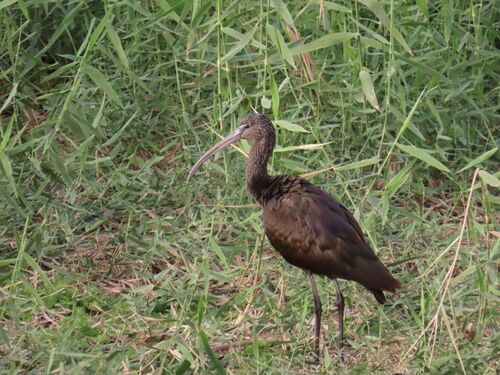 Glossy Ibis
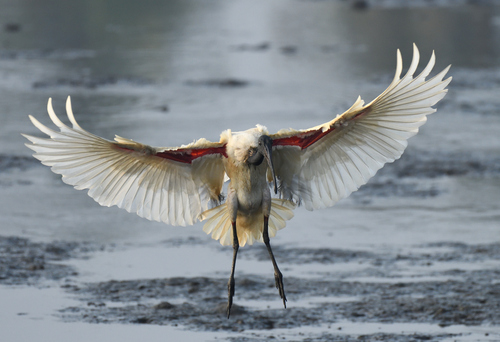 Black-headed Ibis
In short
The most reliable field mark to separate Glossy Ibis from Black-headed Ibis is overall plumage color: Glossy Ibis is dark and iridescent (reddish-brown with green or purple gloss), while Black-headed Ibis is mostly white with a starkly black bare head and neck. Juvenile Black-headed Ibis show some greyish and brown-grey feathering, but never approach the all-dark look of Glossy Ibis. Bill color and shape also help: Glossy Ibis has a brown, slender, sickle-shaped bill, while Black-headed Ibis has a heavier, black, down-curved bill. In flight or at rest, these differences are clear even at a distance. Both species may be found in similar wetland habitats, but their appearance is strikingly different once seen well.
Identification tips
- Overall plumage color: Glossy Ibis is dark reddish-brown to blackish with metallic green or purple gloss; Black-headed Ibis is white-bodied with a bare black head and neck. This is the most immediate and reliable distinction for all ages and seasons.
- Bill color and shape: Glossy Ibis has a slender, brown, sickle-shaped bill; Black-headed Ibis has a heavier, black, down-curved bill. Bill color is especially helpful at a distance or in poor light.
- Head and neck: Glossy Ibis has a feathered head and neck, dark brown with fine white streaks in juveniles and non-breeders; Black-headed Ibis has a conspicuous bare black head and neck in adults, and greyish feathering in juveniles, but never fully feathered like Glossy.
- Flight appearance: In flight, Glossy Ibis is uniformly dark above and below, with no pale areas; Black-headed Ibis shows white wings and body with a black head and neck, creating a strong contrast.
- Breeding plumage details: Breeding Glossy Ibis shows a subtle narrow white facial border; Black-headed Ibis may show black ornamental tail feathers, red bare patches under the wing, and sometimes blueish or reddish tinges on the head, but these are minor compared to the overall color difference.
- Juvenile confusion: Juvenile Black-headed Ibis has greyish and brown-grey speckling, but still appears much paler than any Glossy Ibis. Juvenile Glossy Ibis is dark brown with fine white streaking on the neck, never approaching the white-bodied look of Black-headed Ibis.
- Leg color: Glossy Ibis has red-brown legs; Black-headed Ibis has black legs. This can help when birds are standing or wading.
- Size and structure: Black-headed Ibis is larger and bulkier, with a longer neck and heavier bill. Glossy Ibis is slimmer and more graceful, especially in flight.
- Habitat overlap: Both species use wetlands, but Black-headed Ibis is more likely in urban, agricultural, or even polluted sites. Glossy Ibis prefers more natural, vegetated wetlands, but this is not diagnostic.
- Group behavior: Glossy Ibis often forms tight flocks and flies in V formation; Black-headed Ibis is more often seen singly or in loose groups.
- Roosting: Both may roost in trees, sometimes in mixed-species flocks, so roosting context does not separate them.
- Voice: Both are generally silent, so do not rely on calls for identification.
- Seasonal changes: Breeding season brings subtle changes (facial border in Glossy, ornamental feathers and bare skin color in Black-headed), but overall color pattern remains the key mark.
- Sex differences: Both species are sexually monomorphic; do not use sex as a field mark.
- Pitfalls: Poor light or distance can make Black-headed Ibis look darker, but the white body usually remains obvious. Mud-stained Black-headed Ibis may appear dingy, but never as dark or glossy as Glossy Ibis.
Size
Glossy Ibis is slightly smaller, with an average body mass of 633 g and a length of 48–66 cm, while Black-headed Ibis is larger, measuring 65–76 cm in length (no mass given, but visually bulkier). In the field, Black-headed Ibis appears heavier and longer-necked, with a stouter bill and longer legs. When seen together, the size difference is noticeable, but not as dramatic as the color contrast.
Plumage
Juvenile and non-breeding Glossy Ibis are dark brown overall, with the head and neck finely streaked with white, and lack any white or pale areas on the body or wings. Adults become more richly reddish-brown with strong metallic green, bronze, or purple gloss on the wings, and a subtle white facial border in breeding season. By contrast, Black-headed Ibis of all ages have a predominantly white body. Adults have a bare black head and neck, and black bill and legs; in breeding season, they may show black ornamental tail feathers, red bare patches under the wing, and sometimes blueish or reddish tinges on the head. Juveniles show greyish feathering on the neck and brown-grey speckling on the wings and back, but still appear much paler than any Glossy Ibis. In flight, Black-headed Ibis shows white wings and body with black head and neck, while Glossy Ibis is uniformly dark.
Behaviour
Both species forage in shallow wetlands, often in groups, and may roost communally in trees. Glossy Ibis tends to form tighter flocks and often flies in V formations with neck outstretched. Black-headed Ibis is more often seen singly or in loose groups, and may be more tolerant of urban and disturbed areas. Both build platform nests in colonies, sometimes with other waterbirds.
Habitat
Glossy Ibis prefers freshwater or brackish wetlands with dense emergent vegetation, such as reeds and papyrus, but can also be found in wet meadows, floodplains, and even irrigated farmland. It is less common in coastal or saline habitats. Black-headed Ibis is highly versatile, using a wide range of wetlands, including freshwater and saltwater marshes, lakes, rice fields, sewage ponds, and even garbage dumps and urban lakes. In India, Black-headed Ibis is the only native ibis with a white body and black head/neck, making habitat less useful for separation.
Voice
Neither species is notably vocal. Black-headed Ibis is generally silent, lacking a true voice-producing mechanism, but may utter ventriloquistic grunts at the nest. Glossy Ibis is also quiet, with no distinctive calls noted in the sources. Voice is not a reliable field mark for separating these two.