

Fork-tailed Woodnymph vs Swallow-tailed Hummingbird
Thalurania furcata versus Eupetomena macroura
Play a quiz with Fork-tailed Woodnymph and Swallow-tailed Hummingbird
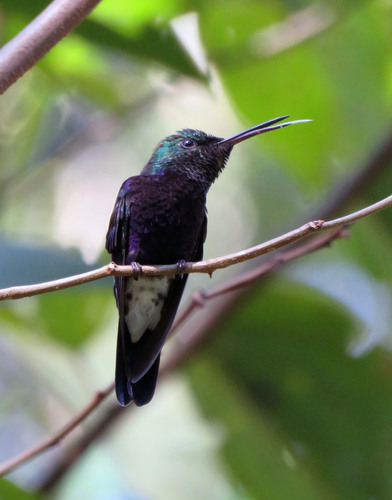 Fork-tailed Woodnymph
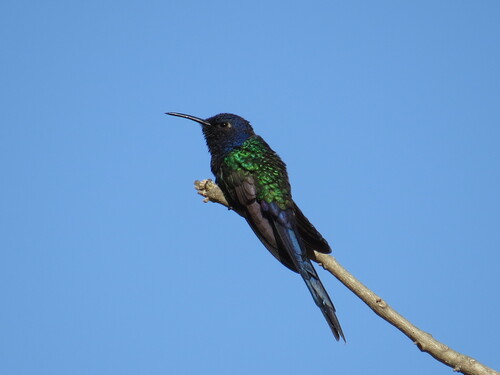 Swallow-tailed Hummingbird
In short
The most reliable field mark to separate Fork-tailed Woodnymph from Swallow-tailed Hummingbird is size and tail structure: Swallow-tailed is much larger and has a dramatically longer, deeply forked tail, nearly half its total length, while Fork-tailed Woodnymph is smaller with a shorter, less exaggerated forked tail. In flight or perched, Swallow-tailed shows a blue head and chest with a mostly blue tail, whereas Fork-tailed Woodnymph males have a green crown and throat with a violet belly and blue-black tail. Females and immatures of both can be confusing, but Swallow-tailed is always bulkier and longer-tailed. If you see a hummingbird with a huge, swallow-like tail and blue head, it's Swallow-tailed; a smaller, greenish bird with a modest fork is Fork-tailed Woodnymph.
Identification tips
- Size and bulk: Swallow-tailed Hummingbird is much larger and heavier than Fork-tailed Woodnymph. If the bird appears large for a hummingbird and dwarfs nearby species, suspect Swallow-tailed.
- Tail length and shape: Swallow-tailed's tail is extremely long (nearly half its body length) and deeply forked, giving a swallow-like silhouette in flight or when perched. Fork-tailed Woodnymph's tail is forked but much shorter and less dramatic.
- Head and chest color (adult males): Swallow-tailed shows a blue head and upper chest, contrasting with the green body. Fork-tailed Woodnymph males have a green crown and throat, with a violet belly and a violet band on the upper back.
- Tail color (adults): Swallow-tailed's tail is blue and prominent, while Fork-tailed Woodnymph's is blue-black (males) or green at the base with white tips on outer feathers (females).
- Underparts (females): Fork-tailed Woodnymph females have pale gray underparts, while Swallow-tailed females are greenish with blue tail and head, though slightly duller than males.
- Bill shape: Both species have medium-length, black bills, but Swallow-tailed's is slightly decurved; Fork-tailed Woodnymph's is straight. This is subtle and best used as a supporting mark.
- Juvenile/immature plumage: Immature Swallow-taileds are like dull females with especially brownish heads; Fork-tailed Woodnymph juveniles are bronzy green above, with males dull below and females showing buffy fringes. In the field, these differences are subtle and may not be diagnostic at a distance.
- White tail tips (females): Fork-tailed Woodnymph females have white tips on the outer three pairs of tail feathers; Swallow-tailed females do not.
- Behavior: Swallow-tailed is highly aggressive and territorial, often chasing other birds, while Fork-tailed Woodnymph is less dominant, especially females.
- Habitat context: In open, urban, or savanna-like habitats, Swallow-tailed is more likely; in forested or dense edge habitats, Fork-tailed Woodnymph is more typical.
- Flight style: Swallow-tailed often appears lanky and long-tailed in flight, with the tail trailing and opening/closing; Fork-tailed Woodnymph is more compact, with a shorter forked tail.
- Voice: Loud, sharp 'psek' or 'tik' calls suggest Swallow-tailed. Fork-tailed Woodnymph's calls are less distinctive in the field.
- Subspecific variation: Both species show some variation in the hue of blue and green, but tail length and head color remain reliable.
- Perched posture: Swallow-tailed often perches with tail spread or drooping, emphasizing its length; Fork-tailed Woodnymph perches more compactly.
- Confusion risk: In poor light or at a distance, females and immatures can be confused, but size, tail length, and head color are the best separators.
Size
Swallow-tailed Hummingbird is distinctly larger and heavier (body mass ~9 g) than Fork-tailed Woodnymph (males 3.6–6 g, females 3–5 g) [wikidata, wikipedia]. Swallow-tailed measures 15–17 cm in length, with the tail making up nearly half of this, while Fork-tailed Woodnymph is much shorter (males 9.5–12.9 cm, females 8–10.7 cm) and more compact overall. In the field, Swallow-tailed appears lanky and long-tailed, often dwarfing other hummingbirds, whereas Fork-tailed Woodnymph is noticeably smaller and less elongated.
Plumage
Juvenile and immature plumages are not highly distinctive for either species, but some contrasts exist. Immature Swallow-tailed Hummingbirds resemble duller females, with particularly brownish, dull heads. Fork-tailed Woodnymph juveniles are dull bronze-green above and dusky bronze-green below (males), or more bronzy green above with buffy feather fringes (females). In adults, male Fork-tailed Woodnymphs have a dark bronzy green upperparts, violet band on the upper back, glittering green throat, violet belly, and blue-black forked tail. Adult Swallow-tailed Hummingbirds of both sexes are brilliant iridescent green with a blue head, upper chest, tail, and vent, and a very long, deeply forked blue tail. Females of both species are duller, but Swallow-tailed females still show the blue tail and head, while Fork-tailed Woodnymph females have green upperparts, pale gray underparts, and a shorter, green-based tail with white tips on the outer feathers. Subspecific variation in both species affects the hue and extent of blue and green, but the overall pattern and tail structure remain reliable.
Behaviour
Swallow-tailed Hummingbird is notably aggressive and dominant, often defending food sources from other hummingbirds and even much larger birds. It is bold, frequently dive-bombing intruders and showing little fear, especially when nesting. Fork-tailed Woodnymph males also defend flower patches, but are less dominant overall; females usually forage by trap-lining. In mixed-species encounters, Swallow-tailed is likely to be the aggressor and more conspicuous due to its size and behavior.
Habitat
Fork-tailed Woodnymph is widespread in mainland South America (except Chile and Uruguay), occurring in a variety of forested and edge habitats. Swallow-tailed Hummingbird is more localized to east-central South America, especially Brazil, and is often found in open woodlands, savannas, gardens, and urban parks. While both can occur in human-modified landscapes, Swallow-tailed is more likely in open or semi-open areas, whereas Fork-tailed Woodnymph is more typical of forested environments.
Voice
Swallow-tailed Hummingbird has relatively loud 'psek' notes and weaker twitters, with a sharp 'tik' call when excited or alarmed. Fork-tailed Woodnymph's vocalizations are not described in detail in the sources, so voice is not a reliable separator unless Swallow-tailed's loud, sharp calls are heard.
Fork-tailed Woodnymph · Swallow-tailed Hummingbird · My Tricky Birds