

Fork-tailed Palm Swift vs Silver-beaked Tanager
Tachornis squamata versus Ramphocelus carbo
Play a quiz with Fork-tailed Palm Swift and Silver-beaked Tanager
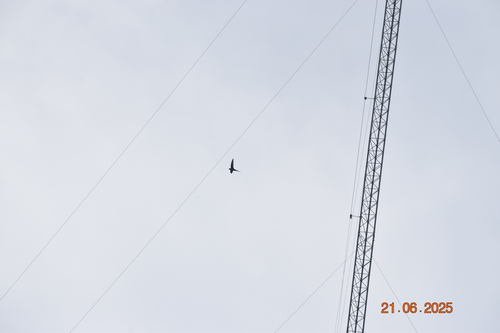 Fork-tailed Palm Swift
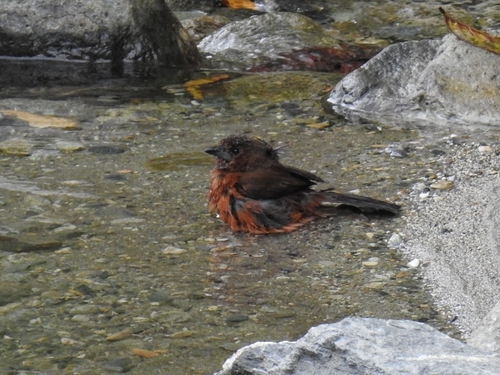 Silver-beaked Tanager
In short
The most reliable field mark is the deeply forked tail and long, slender wings of the Fork-tailed Palm Swift, which are never matched by the Silver-beaked Tanager. In flight, the swift's streamlined shape and aerial agility are unmistakable, while the tanager is a bulkier, perching songbird with a heavy bill and no fork in the tail. Plumage is also diagnostic: the swift is mostly dark brownish above with pale mottled underparts, while the tanager (especially the male) is a plush, deep crimson with blackish wings and tail. Juvenile swifts may show buffy feather edges, but never the rich reds or heavy bill of the tanager. If you see a bird perched on a palm frond, check tail shape and bill size first.
Identification tips
- Tail shape is the fastest check: Fork-tailed Palm Swift always shows a long, deeply forked tail, visible both in flight and when perched. Silver-beaked Tanager has a short, squared or slightly rounded tail, never forked.
- Bill structure is diagnostic: The swift has a tiny, needle-like bill suited for catching insects in flight. The tanager's bill is heavy, thick, and broad at the base, adapted for fruit and seeds. This is obvious even at a distance.
- Flight style: Swifts are almost always seen in rapid, acrobatic flight, rarely perching for long. Tanagers perch frequently and move with short, direct flights between shrubs or trees.
- Plumage color (adult males): Male Silver-beaked Tanagers are deep crimson to carmine with a plush, velvety look, and blackish wings and tail. Fork-tailed Palm Swifts are dark brownish above with a greenish gloss and pale, mottled underparts—never red or plush.
- Plumage color (females/immatures): Female and immature tanagers are reddish-brown to warm brown with dusky wings and tail, lacking the swift's pale mottled underparts and forked tail. Juvenile swifts may show buffy feather edges but never the tanager's warm brown or reddish tones.
- Underparts: Swifts have pale underparts with light brown mottling, especially on the throat and belly. Tanagers are richly colored below (crimson in males, reddish-brown in females/immatures) and never show the swift's pale, mottled look.
- Perched posture: Swifts perch almost exclusively on palm fronds, often hanging or clinging, and look slim and elongated. Tanagers perch upright on branches or wires, appearing stocky.
- Wing shape: Swifts have long, narrow, pointed wings extending well past the tail when folded. Tanagers have shorter, more rounded wings that do not extend beyond the tail.
- Facial pattern: Swifts have a pale brownish-white throat with dusky mottling and grayish-brown cheeks; tanagers have a uniform head color (deep red in males, reddish-brown in females) without contrasting throat or cheek.
- Mandible color (males): Male tanagers have a silvery white lower mandible with a black tip; females have a brownish dusky bill. Swifts have a uniformly dark, tiny bill.
- Size and bulk: Swifts are much smaller and lighter (13 cm, 9–13.6 g) than tanagers (16–17 cm, 21–37.5 g). If the bird looks chunky or heavy, it's a tanager.
- Habitat context: A bird seen high in the air above palms, especially in a flock, is almost certainly a swift. A bird foraging in shrubs, trees, or perched in the open is more likely a tanager.
- Sexual dimorphism: Swifts show no sexual dimorphism; both sexes look alike. Tanagers are strongly dimorphic, with males much brighter than females.
- Juvenile confusion: Juvenile swifts have buffy feather edges and a buff tinge to the head, but never the tanager's rich brown or red tones. Immature tanagers look like females and never show a forked tail or swift-like flight.
- Subspecies variation: While tanager subspecies vary in shade and bill size, none ever approach the swift's structure or flight style. Swifts may be slightly darker or glossier depending on subspecies, but always retain the forked tail and slender build.
Size
Fork-tailed Palm Swift is much smaller and lighter: about 13 cm long and 9–13.6 g in weight [wikipedia]. Silver-beaked Tanager is larger and heavier: 16–17 cm long and 21–37.5 g [wikipedia]. The tanager is noticeably bulkier, with a thickset body and a heavy, wide-based bill, while the swift is slender and almost swallow-like in build. Size alone is a strong clue, especially if both species are seen in the same area.
Plumage
Juvenile and adult Fork-tailed Palm Swifts are dark above with a slight greenish gloss and pale gray feather edges; juveniles show buffy edges and a buff tinge to the head. Underparts are pale with light brown mottling, never red or plush. The tail is always deeply forked and dark. Silver-beaked Tanager males are deep carmine to crimson with plush, velvety plumage and blackish wings and tail; females and immatures are rich reddish brown to warm brown, with dusky wings and tail, and lack the forked tail. No age or sex of tanager shows the swift's pale mottled underparts or forked tail. The tanager's bill is always heavy and pale on the lower mandible in males, while the swift's bill is tiny and black.
Behaviour
Fork-tailed Palm Swifts are almost always seen in fast, agile flight, often high above palms, rarely perching except briefly and usually on palm fronds. Their flight is rapid, erratic, and reminiscent of swallows or other swifts. Silver-beaked Tanagers are typical perching songbirds, often seen hopping or sitting in the open, foraging in shrubs or trees, and rarely in sustained flight. They do not show the swift's aerial agility or flocking behavior in the open sky.
Habitat
Both species can occur in similar lowland habitats with palms, especially in Trinidad and northern South America. However, Fork-tailed Palm Swifts are strongly tied to open areas with palms (especially Mauritia flexuosa), palm swamps, and urban areas with planted palms, and are almost always seen in the air or near palm crowns. Silver-beaked Tanagers are more generalist, found in a wide variety of wooded and shrubby habitats, forest edges, gardens, and do not require palms. Seeing a bird high above palms in open sky strongly favors swift.
Fork-tailed Palm Swift · Silver-beaked Tanager · My Tricky Birds