

Fire-tailed Sunbird vs Green-tailed Sunbird
Aethopyga ignicauda versus Aethopyga nipalensis
Play a quiz with Fire-tailed Sunbird and Green-tailed Sunbird
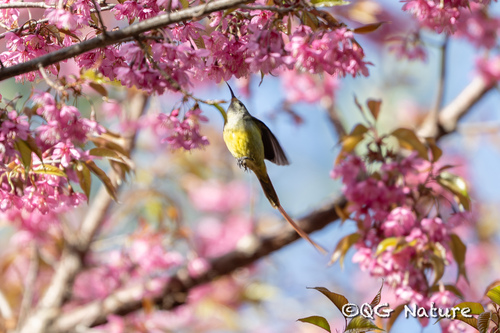 Fire-tailed Sunbird
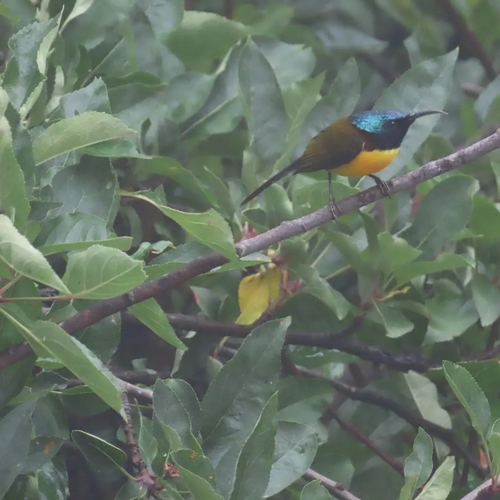 Green-tailed Sunbird
In short
The most reliable field mark between Fire-tailed Sunbird and Green-tailed Sunbird is the tail: adult male Fire-tailed Sunbird in breeding plumage shows a long, bright scarlet tail, while Green-tailed Sunbird males have a shorter, greenish tail. Females are trickier, but Fire-tailed Sunbird females have a squarer tail lacking white tips and show a straighter bill and more olive-yellow on the rump. Both species overlap in Himalayan and Southeast Asian montane forests, so careful attention to tail shape, bill, and subtle plumage is essential, especially outside the breeding season or with females and immatures. Structural and tail differences are the safest clues when birds are not in full adult male plumage.
Identification tips
- Tail length and color (adult males): Fire-tailed Sunbird males in breeding plumage have a long, bright scarlet tail, which is the most obvious field mark. Green-tailed Sunbird males have a shorter, greenish tail.
- Tail shape and markings (females): Female Fire-tailed Sunbird has a squarer tail lacking white tips, with a trace of brownish orange on the sides. Green-tailed Sunbird females often show a more rounded tail with white tips.
- Bill shape: Fire-tailed Sunbird females have a noticeably straighter bill compared to the slightly more decurved bill of Green-tailed Sunbird females. This is subtle but can help with close views.
- Rump color (females): Fire-tailed Sunbird females show more olive-yellow on the rump, which is less marked in Green-tailed Sunbird females.
- Scarlet uppertail coverts (eclipse/immature males): Fire-tailed Sunbird eclipse males (non-breeding) show scarlet uppertail coverts and scarlet sides to the tail, even when not in full breeding plumage. Green-tailed Sunbird immatures lack these features.
- Nape and mantle color (adult males): Fire-tailed Sunbird males have a scarlet nape and mantle, while Green-tailed Sunbird males do not.
- Breast and belly color: Fire-tailed Sunbird males have a yellow-orange breast and olive-green belly; Green-tailed Sunbird males have a yellow back and lack the orange tones.
- Overall size: Fire-tailed Sunbird males appear longer due to the tail, but this is less reliable for females and immatures.
- Habitat context: If seen in high-elevation conifer forest during breeding season, Fire-tailed Sunbird is more likely, but both species overlap widely in habitat.
- Flight jizz: Fire-tailed Sunbird males in flight show a long, streaming tail; Green-tailed Sunbird appears more compact.
- Perched posture: The long tail of Fire-tailed Sunbird males often droops or streams well past the wingtips when perched, unlike Green-tailed Sunbird.
- Seasonal movement: Both species descend to lower elevations in winter, so elevation is not a reliable separator outside the breeding season.
- No distinctive upperwing pattern: Neither species shows a unique juvenile or immature upperwing pattern in the sources, so focus on tail and rump.
- Voice: Not described in the sources, so do not rely on vocalizations for separation.
- When in doubt: If the bird lacks a long scarlet tail and is not an obvious adult male, look for tail shape, bill straightness, and rump color in females and immatures. Use a combination of these subtle marks for best results.
Size
Adult male Fire-tailed Sunbird is noticeably longer than Green-tailed Sunbird due to its elongated tail, reaching about 15 cm including the tail, while females are about two-thirds that length. Green-tailed Sunbird is generally smaller overall, with a proportionally shorter tail in both sexes. In the field, the Fire-tailed's long, streaming tail on males is obvious, but size difference is less reliable for females or immatures unless seen side-by-side.
Plumage
- Adult males in breeding plumage: Fire-tailed Sunbird males have a scarlet nape and mantle, yellow-orange breast, olive-green belly, and a long, bright scarlet tail. Green-tailed Sunbird males lack the scarlet tail, instead showing a greenish tail and a yellow back, with no scarlet on the nape or mantle.
- Females: Fire-tailed Sunbird females have a grey-olive head and throat, yellow belly, and a squarer tail with no white tips and a trace of brownish orange on the sides, plus a straighter bill and more olive-yellow on the rump. Green-tailed Sunbird females have a more rounded tail, often with white tips, and less olive-yellow on the rump.
- Eclipse/immature males: Fire-tailed Sunbird eclipse males resemble females but show brighter yellow bellies, scarlet uppertail coverts, and scarlet tail sides. Green-tailed Sunbird immatures do not show these scarlet tones.
- Juvenile/first-winter/immature upperwing: No distinctive upperwing pattern is described for either species in the sources, so tail and rump color remain the best clues for non-adult males.
Behaviour
Both species are active, nectar- and insect-feeding sunbirds, often seen moving quickly among flowers and foliage. Fire-tailed Sunbird may appear more striking in flight due to the long, streaming scarlet tail of adult males. Both descend to lower elevations in winter, but behavior is otherwise similar and not a strong separator.
Habitat
Both species occupy temperate and subtropical or tropical moist montane forests in the Himalayas and adjacent Southeast Asia. Fire-tailed Sunbird is more closely associated with conifer forests at higher elevations (up to 4,000 meters), especially during breeding, and winters in broadleaved forests. Green-tailed Sunbird is also found in open mountain woods with mossy trees, especially in southeast Szechwan and Yunnan, from 1,825 to 3,350 meters. Habitat overlap is extensive, so context alone is rarely diagnostic.
Fire-tailed Sunbird · Green-tailed Sunbird · My Tricky Birds