

Fan-tailed Widowbird vs Grosbeak Weaver
Euplectes axillaris versus Amblyospiza albifrons
Play a quiz with Fan-tailed Widowbird and Grosbeak Weaver
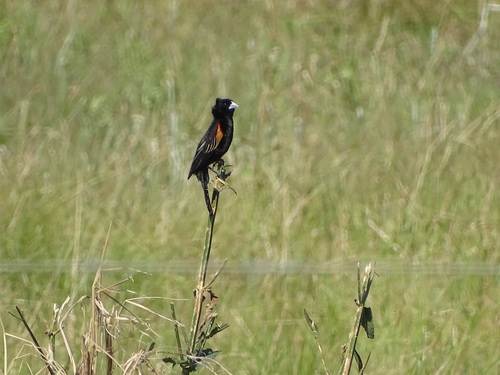 Fan-tailed Widowbird
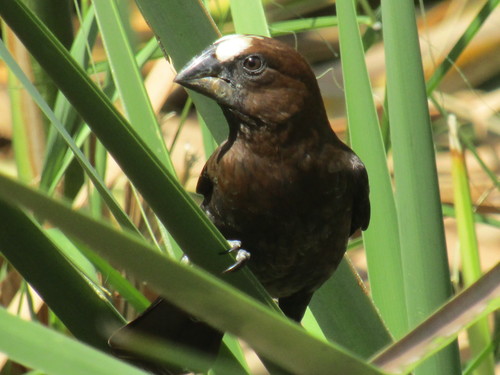 Grosbeak Weaver
In short
The most reliable field mark between Fan-tailed Widowbird and Grosbeak Weaver is the bill: the Grosbeak Weaver has a very thick, heavy, conical bill, while the Fan-tailed Widowbird’s bill is more slender and typical of widowbirds. In addition, the Grosbeak Weaver habitually fans and flicks its tail, and is often seen in or near reedbeds, whereas the Fan-tailed Widowbird is more at home in open grassy or swampy areas. Both species can be found in wetlands, but their structure, behavior, and especially bill shape are the quickest ways to separate them in the field. Plumage differences are less pronounced outside of breeding males, so structure and behavior are key for immature or non-breeding birds.
Identification tips
- Bill shape is the fastest field mark: Grosbeak Weaver has a massive, thick, conical bill (like a grosbeak), while Fan-tailed Widowbird has a slimmer, more pointed bill typical of widowbirds. This is reliable at all ages and sexes.
- Tail behavior: Grosbeak Weaver frequently fans and flicks its tail, a unique behavioral trait. Fan-tailed Widowbird does not show this behavior.
- Body structure: Grosbeak Weaver is stockier and heavier-headed, while Fan-tailed Widowbird is more slender and elongated. This difference is visible both perched and in flight.
- Plumage (adult males): Fan-tailed Widowbird may show a subtle red patch on the shoulder (wing coverts) in breeding plumage, but this is not always obvious. Grosbeak Weaver males have a white forehead but otherwise lack bright patches.
- Plumage (females and immatures): Both species are duller and more uniform; rely on bill shape and structure, as plumage is not diagnostic.
- Wing pattern: Neither species shows strong age-specific upperwing contrasts or panels in flight, so do not rely on wing pattern for separation.
- Habitat: Fan-tailed Widowbird is most often in open grassy or swampy areas, while Grosbeak Weaver is strongly tied to reedbeds and marshes, especially for nesting.
- Nest type (if observed): Grosbeak Weaver builds a globe-shaped nest suspended between reeds, with the entrance near the top and to the side. Fan-tailed Widowbird does not build this type of nest.
- Song: If heard, Grosbeak Weaver’s song is harsh and unmusical. Fan-tailed Widowbird’s vocalizations are less distinctive in the notes.
- Feeding behavior: Grosbeak Weaver uses its strong bill to crack seeds and drupes, often seen manipulating food with its bill. Fan-tailed Widowbird feeds more like a typical weaver, gleaning seeds from grasses.
- Social structure: Both can be colonial, but Grosbeak Weaver colonies are often in dense reedbeds, sometimes with over 100 nests. Fan-tailed Widowbird is social but more dispersed in open habitats.
- Jizz in flight: Fan-tailed Widowbird may appear more elongated and graceful in flight, while Grosbeak Weaver looks bulkier and less streamlined.
- Seasonal context: During the breeding season, Fan-tailed Widowbird males may be more obvious in display flights over grassland, while Grosbeak Weaver activity is concentrated around reedbeds.
- Pitfalls: Non-breeding males, females, and immatures of both species can be confusingly plain; always check bill size and shape first.
- Local abundance: Both species can be locally common in the right habitat, but Fan-tailed Widowbird is more likely in open grassland, while Grosbeak Weaver is more restricted to reedbeds and marshes.
Size
Fan-tailed Widowbird averages about 25.75g in body mass [wikidata], which is within the range of small to medium weavers. No direct mass is given for Grosbeak Weaver, but its robust build and especially its massive bill give it a bulkier impression than the more slender Fan-tailed Widowbird. In the field, Grosbeak Weaver appears stockier and heavier-headed, while Fan-tailed Widowbird looks slimmer and more elongated.
Plumage
No detailed age-specific wing or flight pattern marks are described for either species in the available notes. Adult male Fan-tailed Widowbirds in breeding plumage may show some red on the shoulder (hence the alternate name 'red-shouldered widowbird'), but this is not always visible and is less pronounced than in some other widowbirds. Grosbeak Weavers do not have any red or bright plumage patches; their coloration is more uniform, and their most striking feature is the white forehead in males. Both species lack strong wing panels or contrasting upperwing patterns in juveniles or immatures according to the sources. Thus, for all ages and sexes, plumage is less diagnostic than structure and behavior, though adult male Fan-tailed Widowbirds may show subtle red on the wing.
Behaviour
Grosbeak Weavers are notable for their habit of fanning and flicking their tails, which is a distinctive behavioral cue. They are also often seen manipulating seeds with their powerful bills. Fan-tailed Widowbirds do not display this tail-fanning behavior and are more likely to be seen foraging in grasses or displaying in flight. Grosbeak Weavers often nest in colonies in reedbeds, with their unique globe-shaped nests suspended between reeds. Fan-tailed Widowbirds are also social but are more associated with open grassy or swampy habitats and do not build the same type of nest.
Habitat
Both species are associated with wetlands, but with different preferences. Fan-tailed Widowbird is most often found in grassy and swampy areas, preferring open spaces with tall grass or sedges. Grosbeak Weaver favors reedy wetlands and marshes, especially where there are dense stands of reeds for nesting. Outside the breeding season, Grosbeak Weaver may also be found at forest edges and even in suburban wetlands, while Fan-tailed Widowbird remains more tied to open grassland and marsh.
Voice
Grosbeak Weaver’s song is described as unmusical and harsh, which may help distinguish it from the more typical weaver or widowbird calls, though no specific description is given for Fan-tailed Widowbird’s voice in the notes. In practice, vocalizations may be of limited use unless the harsh, unmusical quality of the Grosbeak Weaver’s song is noted.