

European Honey-buzzard vs Hen Harrier
Pernis apivorus versus Circus cyaneus
Play a quiz with European Honey-buzzard and Hen Harrier
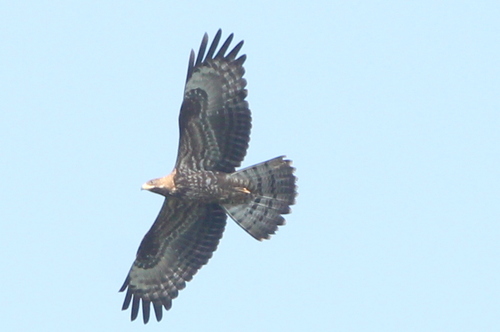 European Honey-buzzard
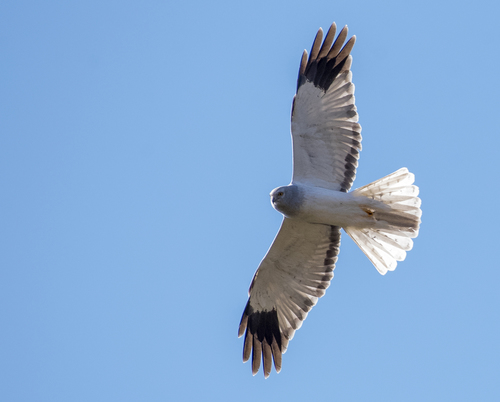 Hen Harrier
In short
The most reliable field mark to separate European Honey-buzzard from Hen Harrier, especially in flight, is the combination of structure and wing posture: Honey-buzzard shows a long neck and small head projecting forward, flat wings, and a long, barred tail, while Hen Harrier appears slimmer, with a more pronounced white rump, and holds its wings in a shallow V. Juvenile Honey-buzzards can mimic Common Buzzard but not Hen Harrier, so age-specific confusion is less likely here. Adult male Honey-buzzard has a blue-grey head, while male Hen Harrier is pale grey above with black wingtips; females of both are brown, but Honey-buzzard is bulkier with fewer tail bars and a less obvious white rump. Habitat and flight style also help: Honey-buzzard is a woodland specialist and soars high, while Hen Harrier quarters low over open ground.
Identification tips
- Wing posture in flight: Honey-buzzard soars on flat, straight wings with tips sometimes slightly downturned; Hen Harrier holds wings in a shallow V, especially when hunting low.
- Head and neck projection: Honey-buzzard shows a long neck and small head that projects forward, giving a distinctive profile; Hen Harrier's head is less protruding and more proportionate.
- Tail pattern: Honey-buzzard has a long tail with two narrow dark bars and a broad subterminal bar; Hen Harrier's tail is shorter, more rounded, and often shows a prominent white rump, especially in females and juveniles.
- White rump: Hen Harrier (especially females and juveniles) shows a bright white rump patch, visible from above and below; Honey-buzzard lacks this feature.
- Adult male plumage: Male Honey-buzzard has a blue-grey head and brownish body; male Hen Harrier is pale grey above, white below, with black wingtips and a white rump.
- Female/juvenile confusion: Female and juvenile Honey-buzzards are brown but lack the Hen Harrier's white rump and have a longer, less barred tail; female/juvenile Hen Harriers ('ringtails') are brown above, buff below, with a white rump and brown barring.
- Size and shape: Honey-buzzard is larger, longer-winged, and lankier; Hen Harrier is more slender and agile, with a shorter tail and smaller overall size.
- Flight style: Honey-buzzard soars high, often over woodland, and may show wing-clapping in display; Hen Harrier quarters low over open ground, gliding and flapping with buoyant, owl-like flight.
- Habitat context: Honey-buzzard is almost always associated with woodland or forest edge; Hen Harrier is found over open country, moorland, and marsh.
- Vocalization: Hen Harrier is more vocal, especially during breeding season; Honey-buzzard is usually silent except for a clear 'peee-lu' in display.
- Bill and feet: Not usually visible in the field, but Honey-buzzard has longer toes and claws adapted for digging; Hen Harrier's feet are typical for a harrier.
- Seasonal presence: In Britain, Honey-buzzard is scarce and mainly a summer migrant; Hen Harrier can be resident or winter visitor, especially in open habitats.
- Perched birds: Honey-buzzard perches in trees and may appear long-necked and upright; Hen Harrier is rarely seen perched except on the ground or low posts in open country.
- Mimicry pitfalls: Juvenile Honey-buzzard can mimic Common Buzzard but not Hen Harrier; confusion is more likely with female/juvenile Hen Harrier due to brown plumage, but structural and tail differences remain reliable.
- Display behavior: Honey-buzzard males may wing-clap in spring; Hen Harrier males perform sky-dancing and food passes, often with vocalizations.
Size
European Honey-buzzard is significantly larger and longer-winged than Hen Harrier. Honey-buzzard measures 52–60 cm in length with a 130–150 cm wingspan, while Hen Harrier is 41–52 cm long with a 97–122 cm wingspan. In terms of mass, Hen Harrier averages about 436.5 g (with males lighter and females heavier), while Honey-buzzard is heavier overall (440–1050 g), though not as heavy-bodied as a Common Buzzard. In the field, Honey-buzzard looks lankier and longer-necked, while Hen Harrier is more slender and agile.
Plumage
-
Juveniles and females: Juvenile and female Hen Harriers ('ringtails') are brown above with a distinctive white rump and buff underparts with brown barring. Their wings show dark brown secondaries and less distinct barring on the belly. Juvenile Honey-buzzards can be brownish and may superficially resemble buzzards, but they lack the prominent white rump and instead show a longer tail with two narrow dark bars and a broad subterminal bar. The Honey-buzzard's tail pattern is a key difference: fewer, broader bars compared to the more finely barred Hen Harrier tail.
-
Adult males: Male Honey-buzzard has a blue-grey head (unique among large raptors in Europe) and is otherwise brownish above, while male Hen Harrier is pale grey above and white below, with black wingtips and a striking white rump. The Honey-buzzard's head is small and projects forward, while the Hen Harrier's head is proportionate and less protruding.
-
In flight: Honey-buzzard soars on flat wings with a slight downward kink at the wrist, while Hen Harrier holds its wings in a shallow V, especially when hunting low over fields. The Honey-buzzard's tail is longer and less rounded, with fewer bars, while the Hen Harrier's tail is shorter and often shows a more obvious white rump patch, especially in females and juveniles.
Behaviour
European Honey-buzzard is typically inconspicuous except during spring display, when it soars high over woodland and may wing-clap. It spends much time on the forest floor digging for wasp nests. In contrast, Hen Harrier is often seen hunting low over open ground, flying with wings held in a shallow V and gliding close to the contours of the land. Hen Harrier is much more vocal in flight and is often seen quartering fields and moors, rarely soaring high like a Honey-buzzard.
Habitat
European Honey-buzzard breeds in woodland and forested areas, often being secretive and hard to detect except during migration or display. Hen Harrier is a specialist of open habitats: moorland, marshes, grasslands, and farmland. If you see a raptor soaring over dense forest, Honey-buzzard is more likely; if it's flying low over open country, especially with a white rump, Hen Harrier is the better candidate.
Voice
Honey-buzzard gives a clear 'peee-lu' call, but is generally quiet and inconspicuous. Hen Harrier is much more vocal, especially the female, who gives a whistled 'piih-eh' when receiving food and a rapid 'chit-it-it-it-it-et-it' as an alarm. The male's call is a 'chek-chek-chek' or a bouncing 'chuk-uk-uk-uk' during display. In the field, Hen Harrier is more likely to be heard.