

European Honey-buzzard vs Eurasian Goshawk
Pernis apivorus versus Astur gentilis
Play a quiz with European Honey-buzzard and Eurasian Goshawk
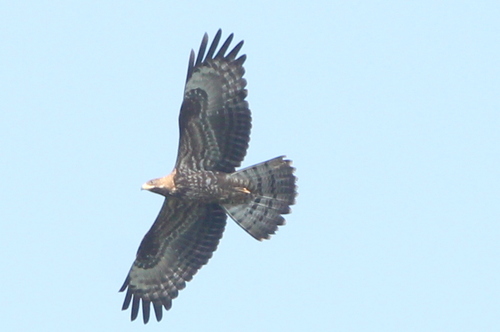 European Honey-buzzard
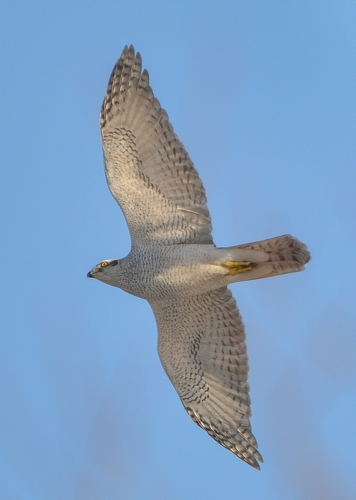 Eurasian Goshawk
In short
The most reliable field mark between European Honey-buzzard and Eurasian Goshawk is overall structure and flight jizz: Honey-buzzard appears long-necked and small-headed with long, flat wings and a long tail, while Goshawk is bulkier, with shorter, broader wings and a more robust body. Juvenile plumage can be confusing, as young Honey-buzzards mimic Common Buzzards, but Goshawk juveniles are more heavily streaked below and have a different tail pattern. In flight, Honey-buzzard soars on flat wings with a protruding head and sometimes an angular chest, while Goshawk shows deeper, more deliberate wingbeats and a classic 'flap-flap-glide' style. Sex differences are visible in Honey-buzzard (male blue-grey head, female brown), but not in Goshawk. Use structure and flight style first, then plumage details, especially for immatures.
Identification tips
- Structure in Flight: Honey-buzzard is long-necked, small-headed, with long, flat wings and a long tail; Goshawk is bulkier, with shorter, broader wings and a more robust body. This is the most reliable field mark for all ages.
- Tail Pattern: Honey-buzzard shows two narrow dark tail bars plus a broad subterminal bar (all ages), while Goshawk has 3–5 dark tail bars (both juvenile and adult). Count bars if possible.
- Head Shape: Honey-buzzard's head is small and pigeon-like, often protruding forward; Goshawk's head is larger, with a pronounced supercilium in adults.
- Flight Jizz: Honey-buzzard soars on flat wings, often with horizontal or slightly drooped primaries, and may show an angular chest in direct flight; Goshawk uses deeper, slower wingbeats and a 'flap-flap-glide' pattern, rarely soaring for long except on migration.
- Juvenile Underparts: Juvenile Honey-buzzards are pale below with limited streaking and mimic Common Buzzard; Goshawk juveniles are heavily streaked or barred below, often with a cinnamon-brown tone.
- Adult Head Color: Male Honey-buzzard has a blue-grey head, female brown; Goshawk adults are blue- or brownish-grey above, both sexes with a white supercilium.
- Supercilium: Adult Goshawk always shows a strong white supercilium; Honey-buzzard lacks this feature at all ages.
- Tail Length: Honey-buzzard's tail is proportionally longer and narrower; Goshawk's is shorter and broader.
- Bill and Feet: Goshawk has a more robust bill and thicker toes; Honey-buzzard's bill and toes are adapted for digging and raking, but this is subtle at a distance.
- Behavior on Ground: Honey-buzzard may be seen on the forest floor excavating wasp nests; Goshawk is rarely seen on the ground except at kills.
- Sexual Dimorphism: Only Honey-buzzard shows clear male/female plumage differences (head color); Goshawk sexes are similar in plumage but differ in size (not easily judged in the field).
- Habitat Context: In Britain, Honey-buzzard is scarce and secretive, mostly in southeast England; Goshawk is more widespread in suitable woodland.
- Voice: Honey-buzzard's 'peee-lu' call may be heard in spring; Goshawk's call is not described here.
- Mimicry Pitfall: Juvenile Honey-buzzard can mimic Common Buzzard, but not Goshawk; Goshawk juveniles are more heavily streaked and never mimic Honey-buzzard.
- Wing Shape: Honey-buzzard's wings are longer and narrower; Goshawk's are shorter and broader, aiding maneuverability in dense woodland.
Size
Eurasian Goshawk is heavier-bodied (average adult mass ~926g [wikidata]), with a robust build, thick toes, and a sizeable bill. European Honey-buzzard is longer and longer-winged (52–60 cm length, 130–150 cm wingspan [wikipedia]), but not as heavy as Goshawk, and appears slender and less muscular. In the field, Honey-buzzard looks lankier and more graceful, while Goshawk is compact and powerful.
Plumage
- Juvenile/Immature: Juvenile Honey-buzzards can closely mimic Common Buzzards, with pale underparts and fewer tail bars (usually two narrow dark bars plus a broad subterminal bar). Juvenile Goshawks are brown above with variable, often heavy, cinnamon-brown streaking below and a tail with 3–5 dark bars. Goshawk juveniles lack the honey-buzzard's pale, long-necked look and have a more solid, streaky appearance.
- Adult: Adult Honey-buzzard males have a blue-grey head, females brown; both have a long tail with fewer, broader bars. Adult Goshawks are blue- or brownish-grey above, with a white supercilium (eyebrow), and fine dark barring or streaking below. Goshawk adults always show a white supercilium and barred tail (3–5 bars).
- Tail: Honey-buzzard's tail is longer, with fewer, broader bars; Goshawk's is shorter, with more bars.
- Head: Honey-buzzard has a small, pigeon-like head; Goshawk's is larger, with a pronounced supercilium in adults.
Behaviour
European Honey-buzzard soars on flat wings, often holding them straight with horizontal or slightly downward-tipped primaries, and the head projects forward with a slight downward kink. The flight is buoyant and graceful, sometimes showing an angular chest. Goshawk flight is more powerful and direct, with deeper, slower wingbeats and a 'flap-flap-glide' pattern. Goshawks are more likely to be seen flying low and fast through woodland, while Honey-buzzards are often seen soaring high, especially during migration or display. Honey-buzzards spend time on the ground excavating wasp nests, which is not a Goshawk behavior.
Habitat
Both species breed in woodland, but Honey-buzzard is more often associated with mature, mixed or coniferous forests and is inconspicuous except during spring display. Goshawk is a widespread forest raptor, found in a variety of temperate woodlands, and is generally more common and less secretive than Honey-buzzard in much of its range. In Britain, Honey-buzzard is scarce and localized, while Goshawk is more widespread.
Voice
Honey-buzzard has a clear 'peee-lu' call, especially during display. Goshawk's vocalizations are not described in the provided notes, so are not diagnostic here.