

European Honey-buzzard vs Black Vulture
Pernis apivorus versus Aegypius monachus
Play a quiz with European Honey-buzzard and Black Vulture
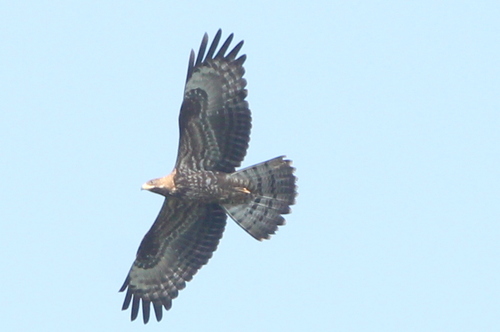 European Honey-buzzard
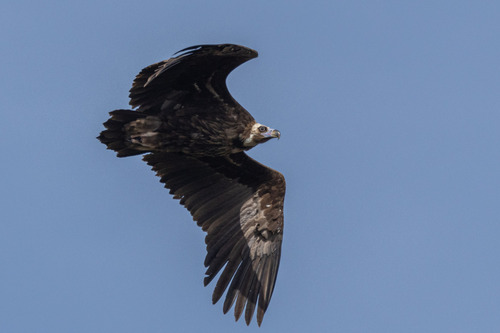 Black Vulture
In short
The most reliable field mark is size and structure: Black Vulture is a massive, heavy-bodied bird with extremely broad, 'barn door' wings and a huge bill, while European Honey-buzzard is much smaller, long-necked, with a small head and long tail. In flight, Honey-buzzard shows flat, straight wings and a protruding head, sometimes with an angular chest, while Black Vulture soars with slightly arched, very broad wings and a slow, heavy flight style. Juvenile Honey-buzzards can mimic the plumage of Common Buzzard, but never approach the bulk or proportions of a vulture. If you see a bird that appears all-black and is truly gigantic, it is Black Vulture; a slimmer, long-tailed bird with a small head and subtle barring on the tail is Honey-buzzard.
Identification tips
- Size is the most immediate clue: Black Vulture is truly gigantic, with a wingspan up to 3.1 m; Honey-buzzard is only slightly larger than a Common Buzzard and never approaches vulture size.
- Wing shape: Black Vulture has extremely broad, rectangular ('barn door') wings, held slightly arched; Honey-buzzard's wings are long, narrow, and held flat or with tips slightly downturned.
- Tail length and shape: Honey-buzzard has a long, narrow tail with two or three dark bars; Black Vulture's tail is relatively short and broad.
- Head and neck: Black Vulture has a massive, pale, downy head and a huge, powerful bill; Honey-buzzard has a small, pigeon-like head that projects forward, with a long neck.
- Plumage color: Black Vulture is dark blackish-brown all over, appearing almost black at a distance; Honey-buzzard is paler, with variable brown, grey, or rufous tones and never truly black.
- Flight style: Black Vulture soars with slow, heavy wingbeats and buoyant, ponderous movement; Honey-buzzard is more agile, with flat wings and a distinctive, slightly 'kinked' head-forward posture.
- Upperwing pattern (all ages): Neither species shows the classic 'black carpal patch' or trailing edge of Buteo buzzards, but Honey-buzzard may show subtle barring and a paler base to primaries; Black Vulture is uniformly dark above and below.
- Juvenile confusion: Juvenile Honey-buzzards can mimic Common Buzzard but never look as dark or as massive as a vulture; juvenile Black Vultures are still huge and dark, with a paler underside but not buzzard-like.
- Bill size: Black Vulture's bill is enormous, thick, and hooked; Honey-buzzard's bill is slim and delicate for a raptor.
- Habitat context: Black Vulture is rarely found in dense woodland; Honey-buzzard is rarely seen far from forests, except on migration.
- Perched posture: Black Vulture perches upright, often hunched, with a huge head and bill; Honey-buzzard is slimmer, more hawk-like, with a small head.
- Voice: Only Honey-buzzard is likely to call, with a clear 'peee-lu'; Black Vulture is silent.
- Sex differences: Male Honey-buzzard has a blue-grey head, female brown; Black Vulture shows no obvious sex differences in the field.
- Seasonal context: In Europe, Honey-buzzard is a summer migrant; Black Vulture is resident or dispersive but not a regular migrant in most of its range.
- Pitfalls: Do not confuse a very dark Common Buzzard or juvenile Honey-buzzard for a vulture—size and structure will always separate them, even at a distance.
Size
Black Vulture is one of the largest flying birds in the world, measuring 98–120 cm in length with a 2.5–3.1 m wingspan and weighing 6.3–12.5 kg [wikipedia]. It dwarfs the European Honey-buzzard, which is 52–60 cm long, with a 130–150 cm wingspan and a mass of 440–1050 g [wikipedia]. Even at a distance, the vulture's immense size, bulk, and broad wings are unmistakable compared to the much lighter, more agile Honey-buzzard.
Plumage
Age-specific upperwing patterns are not diagnostic between these two species, as neither shows striking juvenile wing panels or trailing edge contrasts. Instead, focus on overall coloration and head/neck pattern. Adult Black Vulture is dark blackish-brown all over with a pale, downy head and massive bill; in flight, the wings appear uniformly dark, sometimes with slightly paler coverts, and the bird can look all-black at a distance. Immature Black Vultures are sepia-brown above, with paler underparts and grey down on the head, but still appear large and dark. European Honey-buzzard, by contrast, is much paler and more variable: adults have a brown or blue-grey head (female brown, male blue-grey), paler underparts with variable barring, and a long tail with two or three dark bars (not the many bars of Buteo buzzards). Juveniles can mimic Common Buzzard but still show a longer tail with fewer bars and a smaller head. In all ages, Honey-buzzard never looks truly black or as massive as the vulture.
Behaviour
Black Vulture soars with slow, deep, heavy wingbeats and often holds its huge wings slightly arched; its flight is ponderous and buoyant. It spends much time circling high over open country, searching for carrion. European Honey-buzzard soars on flat, straight wings with wing tips horizontal or slightly drooped, and the head projects forward with a slight kink; its flight is more agile and less labored. Honey-buzzards are secretive, often seen only during migration or display, and spend much time foraging on the ground in woodland.
Habitat
Black Vulture is a bird of open country, mountains, and steppe, often seen soaring over wide, treeless landscapes or near carcasses. European Honey-buzzard breeds in woodland and is much more secretive, usually seen in or near forests, especially during migration. The vulture's preference for open, arid, or semi-open habitats contrasts with the honey-buzzard's association with wooded areas.
Voice
European Honey-buzzard gives a clear 'peee-lu' call, especially in display. Black Vulture is generally silent and does not have a distinctive call that is likely to be heard in the field.