

European Golden Plover vs American Golden Plover
Pluvialis apricaria versus Pluvialis dominica
Play a quiz with European Golden Plover and American Golden Plover
 European Golden Plover
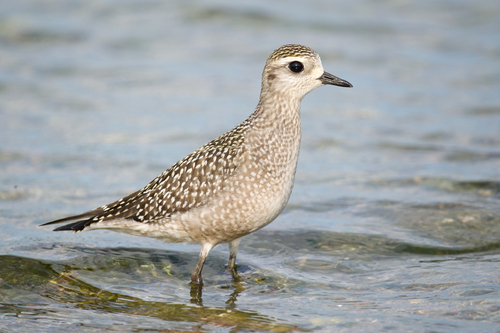 American Golden Plover
In short
The most reliable field mark to separate European Golden Plover from American Golden Plover is the color of the axillary (armpit) feathers visible in flight: European has white, American has grey. Structurally, European is bulkier and shorter-legged, while American is slimmer and longer-legged. In breeding plumage, European shows a distinctive white S-shaped band from forehead to flanks, whereas American has a solid black belly and undertail with a white crown and nape. Non-breeding and immature birds are trickier, but the axillary color and overall shape remain key. Both species are superficially similar, so careful attention to these details is essential, especially with birds in flight or at a distance.
Identification tips
- Axillary (armpit) feather color in flight: European Golden Plover shows white axillaries; American Golden Plover shows grey. This is the single most reliable mark for all ages and seasons, especially on flying or stretching birds.
- Overall structure: European is bulkier, with a thickset body and relatively short legs; American is slimmer, more elongated, and longer-legged. This is subtle but useful when birds are side by side or with experience.
- Breeding plumage: underparts: European has a white S-shaped band from forehead to flanks and often some white on the flanks and undertail; American has a solid black face, neck, breast, and belly, with a white crown and nape extending to the sides of the breast, and a solid black undertail.
- Breeding plumage: back and upperparts: Both species have gold-spotted backs, but American tends to have a more mottled black-and-white appearance with paler gold spots, while European is more uniform.
- Non-breeding/immature plumage: Both species become grey-brown above and pale below, but axillary color and structure still separate them. First-summer American may show patchy or incomplete black on the underparts, increasing confusion.
- Wing and tail proportions: European's wings are only slightly longer than its tail, giving a compact look. American's wings are proportionally longer, contributing to a sleeker profile.
- Leg length: American Golden Plover has noticeably longer legs, which can be seen when the bird is standing or running.
- Bill size and shape: American has a smaller head and bill compared to the more robust European, though this is a minor point.
- Flight action: Both are powerful and rapid in flight, but European may appear more compact and less elongated than American.
- Habitat and context: In Europe, a golden plover outside of migration is almost always European. American is a rare vagrant, mainly in fall.
- Voice: European gives a distinctive 'tuu' call; American's call is not described here, so do not rely on voice for separation.
- Pitfalls with immatures: First-summer and juvenile American Golden Plovers can show incomplete black underparts, making them resemble European, but axillary color and structure remain reliable.
- Seasonal timing: American Golden Plover molts later in the year (September–October) than Pacific Golden Plover, but this is not helpful for separating from European.
- Sex differences: Both species show similar patterns between sexes, with females being duller in breeding plumage, but this does not aid in separation.
- Direct comparison: If you see both species together, use axillary color, structure, and leg length as your primary field marks.
Size
European Golden Plover is noticeably heavier (about 175g vs 145g for American) and appears more thickset and robust in the field. Its wings are only slightly longer than its tail, contributing to a compact look. American Golden Plover is slimmer, with relatively longer legs and a slightly longer wingspan for its body size. These differences are subtle but can be appreciated with direct comparison or experience.
Plumage
For all ages, the color of the axillary feathers (seen in flight or when stretching) is diagnostic: European Golden Plover has white axillaries, while American Golden Plover has grey. In breeding plumage, European shows a striking white S-shaped band from the forehead down the sides, with black underparts that often have some white on the flanks and undertail. American in breeding plumage has a solid black face, neck, breast, and belly, with a white crown and nape extending to the sides of the breast, and lacks the S-shaped band. Non-breeding and immature birds of both species are more subdued, with grey-brown upperparts and pale underparts, but the axillary color and overall structure remain reliable. First-summer American Golden Plovers may show incomplete black on the underparts, making them more confusing, but the axillary color and slimmer build still help. Juvenile-specific upperwing patterns are not described in the sources, so focus on axillary color and structure for immatures.
Behaviour
Both species are active and alert, but European Golden Plover tends to look more robust and less upright than the slimmer, longer-legged American. In flight, European appears more compact, while American shows a sleeker, more elongated profile. Both species have rapid, powerful wingbeats, but these differences are subtle and best used in combination with plumage and structure.
Habitat
Both species use open habitats, but European Golden Plover is the common breeder in European tundra and moorland, while American Golden Plover breeds in Arctic tundra of North America and is only a rare migrant in Europe. If you are in Europe outside of migration periods, a golden plover is almost certainly European. American Golden Plover is a rare vagrant in Europe, most often seen in fall.
Voice
European Golden Plover gives a monosyllabic, slightly descending, melancholic 'tuu' call. No distinctive vocal field marks are provided for American Golden Plover in the sources, so voice is not a reliable separator here.
European Golden Plover · American Golden Plover · My Tricky Birds