

Eurasian Wren vs Mistle Thrush
Troglodytes troglodytes versus Turdus viscivorus
Play a quiz with Eurasian Wren and Mistle Thrush
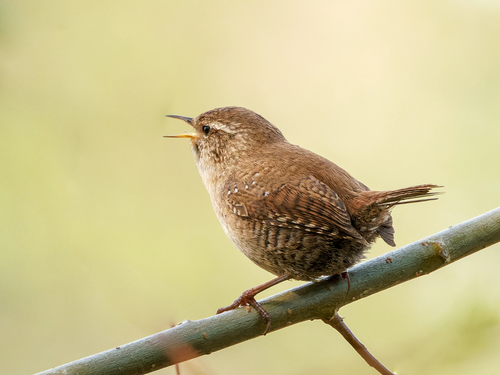 Eurasian Wren
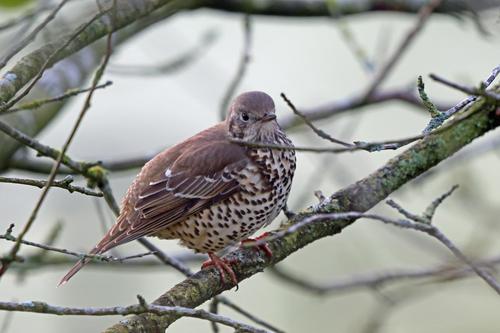 Mistle Thrush
In short
The most reliable field mark is size and structure: Mistle Thrush is dramatically larger and longer-tailed than Eurasian Wren, with a pale, boldly spotted breast versus the wren’s compact, rufous-brown, finely barred look. Juvenile wrens lack strong barring below, but even then, their tiny, round body, short cocked tail, and mouse-like movement contrast sharply with the upright, robust Mistle Thrush. In flight, Mistle Thrush shows long, rounded wings and a white-tipped tail, while the wren’s wings are short and rounded, with rapid, whirring beats. Voice and habitat can help, but structure and size are unmistakable in direct comparison.
Identification tips
- Size is the most decisive clue: Mistle Thrush is nearly three times the length and many times the mass of Eurasian Wren. If the bird appears sparrow-sized or larger, it cannot be a wren.
- Tail length and carriage: Eurasian Wren has a very short tail, usually cocked upright; Mistle Thrush has a long, straight tail, often flicked but never cocked.
- Body shape and posture: Wren is compact, round, and low to the ground; Mistle Thrush is upright, long-bodied, and stands tall when foraging.
- Plumage below: Wren is finely barred and plain below (juveniles more mottled), never with bold spots. Mistle Thrush always shows round, black spots on a pale background, densest on the lower chest.
- Upperparts: Wren is rufous-brown and uniform above; Mistle Thrush is pale grey-brown with a paler face and throat.
- Juvenile confusion: Young wrens lack strong barring but are still plain and never spotted; juvenile thrushes have smaller, but still obvious, spots and creamy feather centers above.
- Wing and flight pattern: Wren’s wings are short, rounded, and whir rapidly in short, direct flights. Mistle Thrush has long, rounded wings and flies with undulating bounds and glides.
- Tail pattern in flight: Mistle Thrush shows white tips to the outer tail feathers; wren’s tail is plain and very short.
- Bill shape: Wren has a thin, relatively long bill for its size; Mistle Thrush has a stouter, blackish bill with a yellowish base to the lower mandible.
- Leg color: Wren’s legs are pale brown; Mistle Thrush’s are yellowish-brown.
- Habitat context: Wrens are almost always in dense cover or low to the ground; Mistle Thrushes are often in open areas or perched high.
- Behavior: Wren moves with quick, jerky hops and probes into crevices; Mistle Thrush hops with head up, flicks tail and wings, and may be seen in small flocks.
- Vocalization: Wren’s song is a loud, complex, trilling burst; its call is a rapid 'tic-tic-tic.' Mistle Thrush’s song is not trilling and is less likely to be confused.
- Season and sex: No significant seasonal or sex-based plumage differences in either species; all ages of Mistle Thrush are much larger and spottier than any wren.
- Common pitfalls: In poor light or at a distance, a wren may look like a small, plain bird, but the extreme size difference and tail posture are always reliable if seen well.
Size
Eurasian Wren is one of the smallest European birds, measuring only 9–10 cm in length, with a wingspan of 13–17 cm and weighing about 10 g [wikipedia][avonet]. In stark contrast, Mistle Thrush is the largest native European thrush, at 27–28 cm long, a 45 cm wingspan, and 93–167 g in mass [wikipedia][avonet]. The thrush appears bulky, with a long tail and upright stance, while the wren is tiny, plump, and short-tailed. Even at a distance or in poor light, the size gap is so extreme that confusion is only likely in silhouette or with very poor views.
Plumage
Juvenile and adult Eurasian Wrens are rufous-brown above, greyer below, and finely barred with darker brown and grey across the wings, tail, and flanks. Juveniles are less distinctly barred and more mottled underneath, but never show bold spots. The tail is always short and often cocked. Mistle Thrush of all ages is pale grey-brown above, with a yellowish-buff to off-white belly and breast marked by round, irregular black spots. Juveniles have paler upperparts with creamy 'teardrop' feather centers and smaller spots below, but still show the characteristic thrush spotting. The tail is long with white tips on the outer feathers, and the underwing coverts are white. No age of wren ever shows the bold, round spotting or pale underparts of Mistle Thrush, and no age of thrush is as uniformly brown or as finely barred as a wren.
Behaviour
Eurasian Wren is extremely active, moving with quick jerks, probing crevices, and often staying low to the ground or under cover. It hops and flits with short, direct, whirring flights, rarely perching in the open except when singing. Mistle Thrush is more terrestrial, often upright and alert while hopping on open ground, and when excited, flicks its wings and tail. Its flight is undulating with glides, and it is comfortable foraging in open fields or lawns, sometimes in flocks. The wren’s mouse-like, furtive behavior is very different from the bold, upright, and sometimes gregarious Mistle Thrush.
Habitat
Eurasian Wren is found in a wide range of habitats but prefers dense vegetation, undergrowth, and forest edges, often near the ground or in tangles. Mistle Thrush is common in open woodlands, parks, and even open fields, often seen foraging in the open or perched high in trees. While both can occur in similar regions, the wren is almost always in cover, and the thrush is more likely to be seen in the open or high perches.
Voice
Eurasian Wren has a remarkably loud, complex song for its size: a series of clear, shrill trills and tinkling notes, often with repeated trills and a sharp 'tic-tic-tic' call. Its song is longer and more exuberant than a dunnock’s, with trills absent in the latter. Mistle Thrush’s song is not described in detail here, but it is not similar to the wren’s explosive, high-pitched trills. Calls and songs are unlikely to be confused if heard well, with the wren’s voice being much higher-pitched and more rapid.