

Eurasian Woodcock vs Great Snipe
Scolopax rusticola versus Gallinago media
Play a quiz with Eurasian Woodcock and Great Snipe
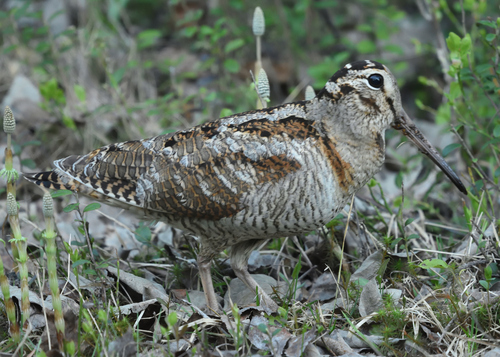 Eurasian Woodcock
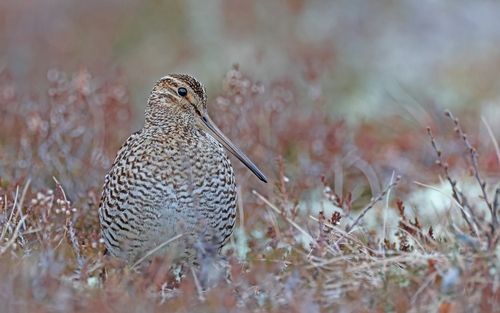 Great Snipe
In short
The most reliable field mark is the head pattern: Eurasian Woodcock shows bold black bars across the crown, while Great Snipe has a dark stripe running through the eye and a more striped head. In flight, Great Snipe displays a conspicuous pale wingbar and white outer tail feathers, both lacking in Woodcock. Structurally, Woodcock is larger, with a longer, straight bill and rounded wings, while Great Snipe is stocky but shorter-billed. Habitat is also a strong clue: Woodcock prefers dense woodland, Great Snipe open marshes and wet meadows. If you see a cryptically patterned wader in woodland with a barred crown, it's almost certainly a Woodcock; in open marsh, look for the wingbar and striped face of Great Snipe.
Identification tips
- Head pattern is key: Woodcock shows bold black bars across the crown (side-to-side); Great Snipe has a dark stripe through the eye and a more striped (longitudinal) head. This works in all ages and seasons.
- Wingbar in flight: Great Snipe of all ages shows a pale wingbar across the upperwing, especially obvious in flight. Woodcock never shows a wingbar; its upperwing is uniformly patterned.
- White outer tail: Great Snipe fans its tail to show white outer feathers, especially during display or when flushed; Woodcock's tail is uniformly patterned with no white.
- Bill length and shape: Woodcock has a long, straight bill (6–8 cm), flesh-coloured at the base with a dark tip. Great Snipe's bill is shorter (6–7 cm), and less striking in the field.
- Size and bulk: Woodcock is larger and bulkier (33–38 cm, 55–65 cm wingspan) than Great Snipe (26–30 cm, 43–50 cm wingspan). In flight, Woodcock appears heavier and more rounded.
- Wing shape: Woodcock has rounded wings; Great Snipe's wings are broad but less rounded, and the wingbar adds to the impression of width.
- Flight style: Woodcock flushes with a zigzag, dropping quickly back into cover; Great Snipe flies straight and fast for a long distance before dropping.
- Habitat: Woodcock in dense woodland or tall heather; Great Snipe in open marshes and wet meadows. Habitat alone can often separate them.
- Underpart pattern: Woodcock is buff below; Great Snipe is barred below. This is subtle and not always visible.
- Eye placement: Woodcock's eyes are set high and far back, giving a distinctive 'wide-eyed' look; Great Snipe's eyes are more typical for a snipe.
- Leg colour: Woodcock's legs are grey to pinkish; Great Snipe's leg colour is not distinctive in the field.
- Vocalizations: Woodcock's roding call ('orr, orr, orr, pist') at dusk is unique; Great Snipe's display sounds are varied but rarely heard except at leks.
- Sex/age: Woodcock sexes cannot be separated in the field; Great Snipe also lacks obvious sex differences in plumage. Juvenile/immature marks are not distinctive beyond the wingbar in Great Snipe.
- Context: If you see a cryptic wader in woodland, it's almost always Woodcock; in open marsh, check for the wingbar and striped face of Great Snipe.
- Common pitfalls: Do not rely on size alone unless you have direct comparison. The wingbar and head pattern are the most reliable field marks at all ages.
Size
Eurasian Woodcock is significantly larger: 33–38 cm in length with a 55–65 cm wingspan, compared to Great Snipe's 26–30 cm length and 43–50 cm wingspan [wikipedia]. Woodcock also appears bulkier and heavier-bodied, especially at rest. The bill of Woodcock is longer (6–8 cm) and straight, while Great Snipe's is shorter (6–7 cm) and slightly less prominent. In the hand or at close range, Woodcock is the heavier, more robust bird, but in the field, size can be hard to judge unless both species are seen together.
Plumage
- Juvenile/immature/flight views:
- Great Snipe in flight shows a distinct pale wingbar across the upperwing, visible in all ages and especially obvious in good light. The white outer tail feathers are also conspicuous when the tail is fanned, especially during display. Eurasian Woodcock lacks both the wingbar and the white outer tail, showing instead a uniform, intricately patterned upperwing and tail with no strong contrast.
- Head pattern:
- Woodcock has bold black bars across the crown (from side to side), never a stripe through the eye. Great Snipe has a dark stripe through the eye and a more longitudinally striped head, lacking the Woodcock's transverse bars.
- Body and underparts:
- Woodcock: Reddish-brown, intricately patterned upperparts, buff underparts. Great Snipe: Mottled brown above, barred below.
- Bill and legs:
- Woodcock: Long, straight, flesh-coloured at base with dark tip; legs grey to pinkish. Great Snipe: Shorter bill, not as striking; leg colour not diagnostic.
- Sex/age variation:
- Woodcock is sexually dimorphic in size but not in plumage; sexes cannot be separated in the field. No age-specific plumage marks noted for either species beyond the wingbar and tail pattern in Great Snipe.
Behaviour
Eurasian Woodcock is typically solitary, secretive, and flushes only at close range, flying off in a zigzag with rounded wings and dropping quickly back into cover. Its flight is strong but not especially fast. Great Snipe, though also well-camouflaged and difficult to see, is noted for its fast, straight, and sustained flight when flushed, often flying a considerable distance before dropping. During the breeding season, Great Snipe males display at leks, fanning their tails and jumping, while Woodcock males perform 'roding' display flights at dusk, flying circuits over woodland and calling. Feeding behavior also differs: Woodcock probes in soft woodland soil, while Great Snipe prefers open, wetter ground and may pick food by sight as well as probe.
Habitat
Habitat is a strong separator. Eurasian Woodcock is a bird of dense woodland or tall heather, rarely venturing into open ground except at night. If you flush a cryptic wader from deep cover in a forest, it's almost certainly a Woodcock. Great Snipe breeds and feeds in open marshes and wet meadows with short vegetation, never in dense woodland. In migration, Great Snipe may be found in similar open, damp habitats but avoids true forest. If the setting is open and marshy, favor Great Snipe; if wooded, favor Woodcock.
Voice
Eurasian Woodcock males perform a distinctive 'roding' flight at dusk, giving repeated calls described as 'orr, orr, orr, pist.' These calls are low, gruff, and mechanical, and are a key indicator of presence in spring. Great Snipe's voice is much less likely to be heard except at leks, where males produce a faint 'yeah' and a variety of rattles, clicks, buzzes, and whistles, sometimes audible at great distance. In most field situations, Woodcock's roding call is much more likely to be heard than any Great Snipe vocalization.