

Eurasian Skylark vs Fieldfare
Alauda arvensis versus Turdus pilaris
Play a quiz with Eurasian Skylark and Fieldfare
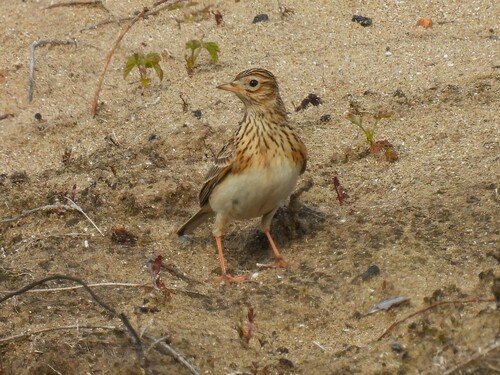 Eurasian Skylark
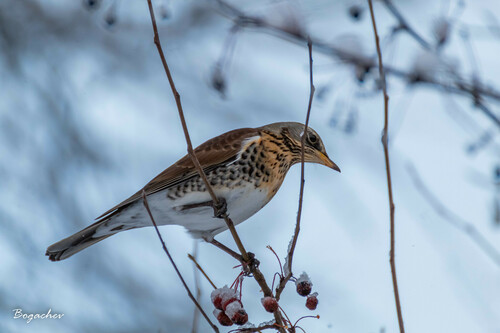 Fieldfare
In short
The most reliable field mark between Eurasian Skylark and Fieldfare is the Fieldfare's bold, slate-grey head and rump, and its striking white underwing coverts visible in flight, compared to the Skylark's overall brown, streaky appearance and white trailing edges on the wings and tail. Juvenile Fieldfares are duller but still show a thrush-like pattern, while Skylarks of all ages remain brown and inconspicuous except for their short crest and white rear wing/tail edges. In flight, Fieldfares appear larger and more robust with a distinct thrush jizz, while Skylarks are smaller, with short tails and broad wings, often seen hovering. Vocalizations are also distinct: Skylark males deliver long, bubbling songs in hovering flight, while Fieldfares give harsh 'tsak tsak' calls, especially in flight.
Identification tips
- In flight, look for white underwing coverts and axillaries: Only Fieldfare shows these bold white patches under the wing, visible from below and at a distance. Skylark never shows this feature.
- Slate-grey head and rump: Fieldfare adults have a distinctive grey head and rump, contrasting with a chestnut back and blackish tail. Skylark is brown and streaky all over, with no grey or chestnut.
- Breast pattern: Fieldfare has a boldly speckled, creamy-buff breast and throat, with clear dark spots. Skylark is paler below with fine streaking, never with bold thrush-like spots.
- Tail shape and pattern: Fieldfare's tail is rounded with 14 feathers and some white on the inner edge of the outer feathers. Skylark's tail is short, with white edges only visible from behind in flight.
- Crest: Skylark has a short, blunt crest that can be raised and lowered, sometimes visible when perched or alert. Fieldfare lacks any crest.
- Size and structure: Fieldfare is much larger, bulkier, and thrush-shaped, with a strong, slightly curved bill. Skylark is smaller, more delicate, with a fine bill and compact body.
- Flight style: Skylark often hovers and sings high above open fields, appearing as a small dot. Fieldfare flies directly, often in flocks, and rarely hovers.
- Perching behavior: Fieldfares perch in trees or on exposed branches, especially in groups. Skylarks almost always stay on the ground or low in vegetation.
- Juvenile confusion: Juvenile Fieldfares are duller but still show a thrush-like pattern and pale streaks, quickly moulting into adult plumage. Skylark juveniles look like adults—brown and streaky, with no bold pattern.
- Vocalizations: Skylark's song is a long, musical warble delivered in flight. Fieldfare's call is a harsh 'tsak tsak', especially in flight or alarm; its song is weak and rarely heard.
- Habitat context: If the bird is in open farmland or grassland, especially singing in the air, Skylark is likely. If in a tree, hedgerow, or in a flock in winter, especially with harsh calls, Fieldfare is likely.
- Bill color: Fieldfare's bill is orange-yellow in winter, yellow in summer, with a dark tip; Skylark's bill is plain and fine.
- Sex differences: Fieldfare females are browner and less boldly marked than males, but still show the same overall pattern. Skylark males have broader wings for hovering but are otherwise similar to females.
- Song display: Only Skylark performs long, sustained song-flights. Fieldfare does not display this way.
- White on wings and tail: Skylark shows white only on the trailing edge of the wing and tail, visible from behind; Fieldfare's white is on the underwing and inner tail edges, visible from below.
Size
Fieldfare is significantly larger and heavier than Eurasian Skylark. Fieldfare averages 25 cm in length with a wingspan of 39–42 cm and a body mass around 105 g [wikidata], while Eurasian Skylark is smaller at 18–19 cm in length and a noticeably lighter build (no mass given, but much less than Fieldfare). Fieldfares look robust and thrush-like, whereas Skylarks are compact and delicate.
Plumage
Juvenile Fieldfares are duller than adults but still show pale streaks and a thrush-like pattern, quickly moulting into the adult's distinctive plumage by autumn. Adults of both sexes have a slate-grey head, nape, and rump, a dark brown back, blackish tail, and a boldly speckled breast. In flight, Fieldfares show white underwing coverts and axillaries, and a rounded tail with some white on the inner edges of the outer feathers. Eurasian Skylarks of all ages are brown above and paler below, with fine streaking and a short, blunt crest. In flight, Skylarks show a short tail and broad wings, with white edges on the tail and rear wing—these are only visible when the bird is flying away. Skylarks lack any bold grey, chestnut, or blackish patterning, and never show the Fieldfare's white underwing flash. Sex differences are subtle in both species, but Fieldfare females are a bit browner and less boldly marked than males, while Skylark males have broader wings for hovering.
Behaviour
Eurasian Skylarks are famous for their display flights: males hover high in the air, singing continuously for minutes, often appearing as a dot in the sky. On the ground, they are inconspicuous, moving through grass and rarely perching high. Fieldfares are much more likely to perch in trees or on exposed branches, often in flocks, and fly with a strong, direct flight typical of thrushes. Fieldfares rarely hover and do not display in the air like Skylarks. In winter, Fieldfares are often seen in large, noisy groups, especially in open countryside or feeding on berries.
Habitat
Eurasian Skylarks are birds of open farmland, grassland, and heath, rarely venturing into woodland or dense scrub. Fieldfares breed in woodland and scrub but are often seen in open fields, especially in winter, sometimes overlapping with Skylark habitat. However, Fieldfares are more likely to be found in trees or hedgerows, especially outside the breeding season, while Skylarks avoid trees and stick to open ground.
Voice
Skylark males deliver a long, bubbling, warbling song, usually given in sustained hovering flight high above open ground. The song can last several minutes and is continuous, clear, and musical. Fieldfares do not sing in flight in the same way; their main vocalization is a harsh, repeated 'tsak tsak' call, especially in flight or when alarmed. Their song is weak and rarely heard, a mix of blackbird-like phrases and squeaks, usually given from a perch. The difference in flight calls is especially useful: Skylark is musical and continuous, Fieldfare is harsh and chattering.