

Eurasian Scops Owl vs Maghreb Owl
Otus scops versus Strix mauritanica
Play a quiz with Eurasian Scops Owl and Maghreb Owl
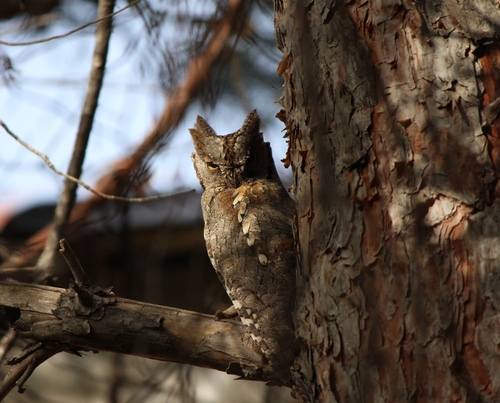 Eurasian Scops Owl
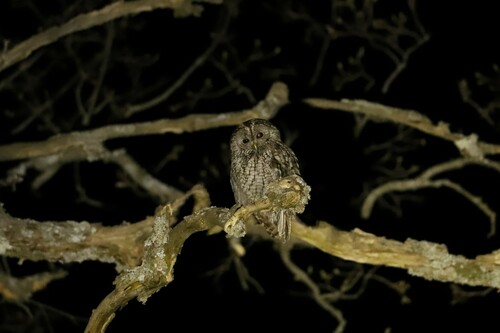 Maghreb Owl
In short
The most reliable field mark to separate Eurasian Scops Owl from Maghreb Owl (here, represented by the Tawny Owl group) is size and structure: Eurasian Scops Owl is much smaller, with a slim, upright posture and prominent ear-tufts, while Maghreb Owl is much larger, stockier, and lacks ear-tufts. In flight, Scops Owl shows long, narrow wings and a strong, direct flight, contrasting with the broad, rounded wings and heavy, slow flight of Maghreb Owl. Plumage differences are also key: Scops Owl is grey-brown overall with a pale face and shoulder line, while Maghreb Owl is more robustly streaked below and can be rufous or greyish above, with a plain, rounded facial disc. If you see a small, upright owl with ear-tufts and a pale shoulder line, it is Scops; a large, rounded, earless owl with streaked underparts is Maghreb/Tawny.
Identification tips
- Size is the most immediate clue: Eurasian Scops Owl is tiny (barely 20 cm), while Maghreb Owl is twice as long and much bulkier. If the owl looks large and chunky, rule out Scops.
- Ear-tufts: Scops Owl has small, pointed ear-tufts that are often visible when perched or alert. Maghreb Owl lacks ear-tufts entirely; its head is smoothly rounded.
- Posture and jizz: Scops Owl perches upright and appears slim, almost elongated. Maghreb Owl is squat, with a large, rounded head and a more horizontal posture.
- Facial disc: Scops Owl has a pale face with a noticeable pale shoulder line; Maghreb Owl's facial disc is plain, rounded, and lacks any pale shoulder line.
- Underparts: Scops Owl is pale below but generally unmarked or subtly streaked. Maghreb Owl always shows strong brown streaks on whitish underparts, regardless of upperpart color.
- Upperparts: Scops Owl is grey-brown, with little contrast; Maghreb Owl can be rufous or greyish brown above, but this is variable and not always reliable.
- Wings in flight: Scops Owl has long, narrow wings and a direct, purposeful flight. Maghreb Owl has broad, rounded wings and flies heavily, often with long glides and slow wingbeats.
- Head size and shape: Scops Owl's head is small and angular due to ear-tufts; Maghreb Owl's head is large, rounded, and smooth.
- Eye color: Both have dark eyes, but Maghreb Owl's are particularly large and striking in its facial disc.
- Voice: Scops Owl's call is a deep, repetitive whistle, like a toad; Maghreb Owl's call is a classic owl hoot (not detailed here, but well-known in the group). If you hear a toad-like whistle, it's Scops.
- Habitat: In dense, mature woodland, expect Maghreb Owl; in open woodland or Mediterranean scrub, Scops is more likely.
- Shoulder line: The pale shoulder line is a subtle but useful mark for Scops Owl when perched.
- Flight style: If you see an owl flying quickly and directly with long, narrow wings, it's Scops; heavy, slow, gliding flight with broad wings is Maghreb.
- Perched silhouette: Scops Owl looks slim and upright; Maghreb Owl is round and squat.
- Pitfalls: Young Maghreb Owls may appear paler, but will still lack ear-tufts and show streaked underparts. Scops Owl is never as large or as heavily streaked as Maghreb.
Size
Eurasian Scops Owl is much smaller, at 19–21 cm length and 47–54 cm wingspan [wikipedia], compared to Maghreb Owl (Tawny Owl group) at 37–46 cm length and 81–105 cm wingspan [wikipedia]. Maghreb Owl is more than twice as heavy (385–800 g vs. Scops Owl's much lighter build). In the field, this is a dramatic difference: Scops Owl appears petite, even compared to a Little Owl, while Maghreb Owl is a large, chunky bird with a big, rounded head.
Plumage
There are no distinctive juvenile or immature upperwing patterns described for either species in the sources. For all ages, Scops Owl is grey-brown with a paler face, underparts, and a noticeable pale shoulder line. It has small, pointed ear-tufts that are often visible. Maghreb Owl (Tawny Owl group) is much more variable above (rufous or greyish brown), but always has pale, heavily streaked underparts and a plain, rounded facial disc with no ear-tufts. The upperparts may be brown or grey, but the underparts are always whitish with brown streaks. In flight, Scops Owl's long, narrow wings contrast with the broad, rounded wings of Maghreb Owl. The pale shoulder line of Scops is often visible when perched. Maghreb Owl's facial disc is plain and rounded, and the eyes are dark brown, set in a large, rounded head.
Behaviour
Scops Owl perches upright and is often seen on exposed branches, appearing slim and alert. Its flight is strong and direct, with long, narrow wings suited to migration. Maghreb Owl is stockier, perches more horizontally, and flies with heavy, slow wingbeats on broad, rounded wings, often gliding for long stretches. The difference in flight style is notable: Scops Owl is quick and direct, Maghreb Owl is heavy and gliding.
Habitat
Scops Owl breeds from southern Europe to southern Siberia and winters in sub-Saharan Africa, but can be resident in Mediterranean woodlands. Maghreb Owl (Tawny Owl group) is a woodland specialist, found in forests and mature woodlands across Europe and western Siberia. If you are in dense, mature woodland, Maghreb Owl is more likely; Scops Owl favors more open woodland, Mediterranean scrub, and edge habitats.
Voice
Scops Owl gives a deep, repetitive whistle, reminiscent of midwife toads (Alytes), and both sexes call. Maghreb Owl's (Tawny Owl group) call is not described in the provided notes, but is typically a classic, far-carrying hoot or 'twit-twoo' in the group. The Scops Owl's call is more toad-like and less owl-typical, which can be a useful clue if heard.