

Motmot

Eurasian Pygmy-Owl vs Tengmalm's Owl

Glaucidium passerinum versus Aegolius funereus

Play a quiz with Eurasian Pygmy-Owl and Tengmalm's Owl
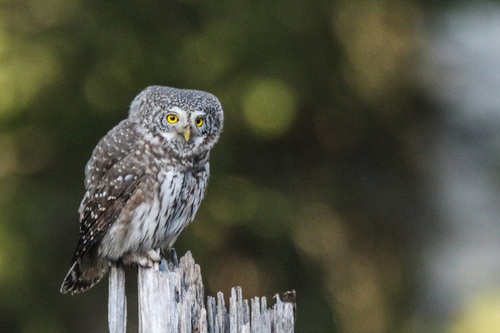
Eurasian Pygmy-Owl (Glaucidium passerinum) Eurasian Pygmy-Owl
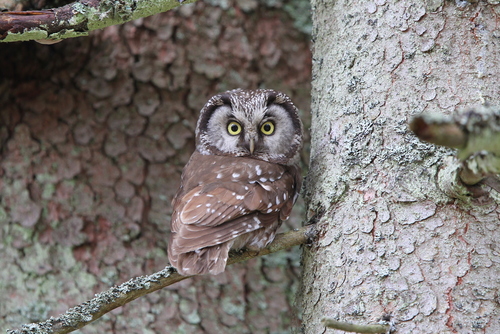
Tengmalm's Owl (Aegolius funereus) Tengmalm's Owl

Media

Loading…

In short

The most reliable field mark between Eurasian Pygmy-Owl and Tengmalm's Owl is their overall structure and facial pattern: Pygmy-Owl is notably smaller, with a short tail and a plain, rounded head lacking ear tufts, while Tengmalm's Owl is larger, with a broad, rounded head and a striking pale facial disc bordered by dark, giving a 'surprised' look. Juvenile Tengmalm's Owls are chocolate-brown with a broad white 'X' between the eyes, unlike any Pygmy-Owl plumage. In adults, Pygmy-Owls show a reddish to grey-brown back with white spots and a half-collar, whereas Tengmalm's has a brown back with prominent white 'pearl' spots and a streaked underpart. Both have yellow eyes, but their face and body proportions are distinct. Calls are very different: Pygmy-Owl gives high, fluted, monotonous notes, while Tengmalm's Owl produces trills and a variety of softer and harsher calls.

Identification tips

  1. Juvenile plumage: Juvenile Tengmalm's Owl is chocolate-brown overall with a broad white 'X' between the eyes and white markings on neck and scapulars—no Pygmy-Owl ever shows this pattern. If you see a dark brown, almost uniform young owl with a pale facial marking, it's Tengmalm's.
  2. Facial disc: Adult Tengmalm's Owl has a large, pale facial disc with a dark border and white 'eyebrows,' giving a 'surprised' look. Pygmy-Owl has a plain, rounded head with only faint white to grey eyebrows and no facial disc.
  3. Size and jizz: Pygmy-Owl is much smaller and more compact, with a short tail and small, rounded head. Tengmalm's Owl is larger, bulkier, with a broad head and longer tail and wings. If you see both together, the difference is obvious, but even singly, Pygmy-Owl often looks 'miniature.'
  4. Back and wing spotting: Tengmalm's Owl has prominent pearly-white spots on the back and wings, and the tail shows three rows of white spots that remain distinct even when folded. Pygmy-Owl has white spots on the back but less extensive and not as 'pearl-like'; tail has five narrow whitish bars, not rows of spots.
  5. Underparts: Pygmy-Owl has a mostly white belly with brown speckles, while Tengmalm's Owl has cream-white underparts with russet-brown streaks—look for streaks vs. speckles.
  6. Nape marking: Pygmy-Owl shows a half white collar on the back of the neck; Tengmalm's Owl lacks this but may have white markings on the neck in juveniles.
  7. Tail pattern: Pygmy-Owl's tail is darker than the body with five narrow whitish bars; Tengmalm's Owl's tail is olive-brown with three rows of white spots.
  8. Bill color: Tengmalm's Owl has a light yellow bill; Pygmy-Owl's bill is greyish-yellow, but this is subtle and rarely diagnostic in the field.
  9. Eye color: Both have yellow eyes, so this is not a separator.
  10. Ear tufts: Neither species has ear tufts, so don't use this mark.
  11. Vocalization: If calling, Pygmy-Owl gives high, fluted, monotonous notes, while Tengmalm's Owl produces trills and a variety of softer and harsher calls—listen for the difference, especially at night.
  12. Behavior: Pygmy-Owl may be seen perched openly at dawn or dusk; Tengmalm's Owl is strictly nocturnal and rarely seen except at the nest or if flushed from a roost.
  13. Habitat: Both in boreal/taiga forests, but Pygmy-Owl may occur more at forest edges or in mixed woods; Tengmalm's Owl prefers deep, mature taiga.
  14. Flight: In flight, Pygmy-Owl appears compact and short-tailed; Tengmalm's Owl is bulkier, with broader wings and a more buoyant, straight flight.
  15. Pitfalls: Beware of confusing juvenile Tengmalm's with other brown owls, but the white 'X' and facial disc are unique. Pygmy-Owl's small size and plain face are key—if the bird looks 'cute' and tiny, it's likely Pygmy-Owl.

Size

Eurasian Pygmy-Owl is the smallest European owl, with an average mass around 65.5g and a length of 15–19 cm, appearing compact and short-tailed. Tengmalm's Owl is noticeably larger and bulkier, with a broader head and longer wings and tail, though still small compared to most owls. In the field, Pygmy-Owl looks almost 'toy-like' next to the more robust Tengmalm's Owl.

Plumage

Juvenile Tengmalm's Owls (about 3 weeks to fledging) are uniform chocolate-brown above and below, with a dark brown facial disc, white markings on the neck, scapulars, and tail, and a broad white 'X' between the eyes—this is unique and not matched by any Pygmy-Owl plumage. Adult Tengmalm's Owls have a brown back with striking pearly-white spots, a pale facial disc with a dark border, and cream underparts with russet streaks. Their flight feathers and tail show rows of white spots, which remain distinct even when the tail is closed. In contrast, Eurasian Pygmy-Owl adults are reddish to greyish-brown above with white spots, a half white collar on the nape, and a mostly white belly with brown speckles. Their tail is darker with five narrow whitish bars. Pygmy-Owls lack the bold facial disc and 'surprised' expression of Tengmalm's. Both species have yellow eyes, but Pygmy-Owl's face is plainer and more compact.

Behaviour

Both species are forest owls, but Tengmalm's Owl is strictly nocturnal and often confiding if found during the day, sometimes allowing close approach before flying. Pygmy-Owl is more likely to be active at dawn and dusk and may be seen perched openly, especially in the breeding season. Pygmy-Owls are known for storing prey in autumn, while Tengmalm's Owl's behavior is less likely to be observed due to its secretive, nocturnal habits.

Habitat

Both species inhabit boreal and taiga forests, but Pygmy-Owl is more often found in mixed or coniferous woodlands of northern and central Europe and Siberia, sometimes at forest edges. Tengmalm's Owl prefers deep, mature taiga and is less likely to be seen in more open or edge habitats. Both are rarely seen, but Pygmy-Owl may be more easily detected by call or diurnal activity.

Voice

Eurasian Pygmy-Owl gives a high-pitched, monotonous series of clear, fluted notes, quite unlike the classic owl 'hoot.' Tengmalm's Owl has a much more varied repertoire: the main song is a loud trill, with additional softer courtship melodies, delivery calls, screeches, peeping, and defensive hissing. The calls are generally lower-pitched and more complex than Pygmy-Owl's simple, repetitive song.

Submit a better description

Use the same sections as the comparison. Your text is published immediately.

The most reliable field mark between Eurasian Pygmy-Owl and Tengmalm's Owl is their overall structure and facial pattern: Pygmy-Owl is notably smaller, with a short tail and a plain, rounded head lacking ear tufts, while Tengmalm's Owl is larger, with a broad, rounded head and a striking pale facial disc bordered by dark, giving a 'surprised' look. Juvenile Tengmalm's Owls are chocolate-brown with a broad white 'X' between the eyes, unlike any Pygmy-Owl plumage. In adults, Pygmy-Owls show a reddish to grey-brown back with white spots and a half-collar, whereas Tengmalm's has a brown back with prominent white 'pearl' spots and a streaked underpart. Both have yellow eyes, but their face and body proportions are distinct. Calls are very different: Pygmy-Owl gives high, fluted, monotonous notes, while Tengmalm's Owl produces trills and a variety of softer and harsher calls.

  1. Juvenile plumage: Juvenile Tengmalm's Owl is chocolate-brown overall with a broad white 'X' between the eyes and white markings on neck and scapulars—no Pygmy-Owl ever shows this pattern. If you see a dark brown, almost uniform young owl with a pale facial marking, it's Tengmalm's.
  2. Facial disc: Adult Tengmalm's Owl has a large, pale facial disc with a dark border and white 'eyebrows,' giving a 'surprised' look. Pygmy-Owl has a plain, rounded head with only faint white to grey eyebrows and no facial disc.
  3. Size and jizz: Pygmy-Owl is much smaller and more compact, with a short tail and small, rounded head. Tengmalm's Owl is larger, bulkier, with a broad head and longer tail and wings. If you see both together, the difference is obvious, but even singly, Pygmy-Owl often looks 'miniature.'
  4. Back and wing spotting: Tengmalm's Owl has prominent pearly-white spots on the back and wings, and the tail shows three rows of white spots that remain distinct even when folded. Pygmy-Owl has white spots on the back but less extensive and not as 'pearl-like'; tail has five narrow whitish bars, not rows of spots.
  5. Underparts: Pygmy-Owl has a mostly white belly with brown speckles, while Tengmalm's Owl has cream-white underparts with russet-brown streaks—look for streaks vs. speckles.
  6. Nape marking: Pygmy-Owl shows a half white collar on the back of the neck; Tengmalm's Owl lacks this but may have white markings on the neck in juveniles.
  7. Tail pattern: Pygmy-Owl's tail is darker than the body with five narrow whitish bars; Tengmalm's Owl's tail is olive-brown with three rows of white spots.
  8. Bill color: Tengmalm's Owl has a light yellow bill; Pygmy-Owl's bill is greyish-yellow, but this is subtle and rarely diagnostic in the field.
  9. Eye color: Both have yellow eyes, so this is not a separator.
  10. Ear tufts: Neither species has ear tufts, so don't use this mark.
  11. Vocalization: If calling, Pygmy-Owl gives high, fluted, monotonous notes, while Tengmalm's Owl produces trills and a variety of softer and harsher calls—listen for the difference, especially at night.
  12. Behavior: Pygmy-Owl may be seen perched openly at dawn or dusk; Tengmalm's Owl is strictly nocturnal and rarely seen except at the nest or if flushed from a roost.
  13. Habitat: Both in boreal/taiga forests, but Pygmy-Owl may occur more at forest edges or in mixed woods; Tengmalm's Owl prefers deep, mature taiga.
  14. Flight: In flight, Pygmy-Owl appears compact and short-tailed; Tengmalm's Owl is bulkier, with broader wings and a more buoyant, straight flight.
  15. Pitfalls: Beware of confusing juvenile Tengmalm's with other brown owls, but the white 'X' and facial disc are unique. Pygmy-Owl's small size and plain face are key—if the bird looks 'cute' and tiny, it's likely Pygmy-Owl.

Eurasian Pygmy-Owl is the smallest European owl, with an average mass around 65.5g and a length of 15–19 cm, appearing compact and short-tailed. Tengmalm's Owl is noticeably larger and bulkier, with a broader head and longer wings and tail, though still small compared to most owls. In the field, Pygmy-Owl looks almost 'toy-like' next to the more robust Tengmalm's Owl.

Juvenile Tengmalm's Owls (about 3 weeks to fledging) are uniform chocolate-brown above and below, with a dark brown facial disc, white markings on the neck, scapulars, and tail, and a broad white 'X' between the eyes—this is unique and not matched by any Pygmy-Owl plumage. Adult Tengmalm's Owls have a brown back with striking pearly-white spots, a pale facial disc with a dark border, and cream underparts with russet streaks. Their flight feathers and tail show rows of white spots, which remain distinct even when the tail is closed. In contrast, Eurasian Pygmy-Owl adults are reddish to greyish-brown above with white spots, a half white collar on the nape, and a mostly white belly with brown speckles. Their tail is darker with five narrow whitish bars. Pygmy-Owls lack the bold facial disc and 'surprised' expression of Tengmalm's. Both species have yellow eyes, but Pygmy-Owl's face is plainer and more compact.

Both species are forest owls, but Tengmalm's Owl is strictly nocturnal and often confiding if found during the day, sometimes allowing close approach before flying. Pygmy-Owl is more likely to be active at dawn and dusk and may be seen perched openly, especially in the breeding season. Pygmy-Owls are known for storing prey in autumn, while Tengmalm's Owl's behavior is less likely to be observed due to its secretive, nocturnal habits.

Both species inhabit boreal and taiga forests, but Pygmy-Owl is more often found in mixed or coniferous woodlands of northern and central Europe and Siberia, sometimes at forest edges. Tengmalm's Owl prefers deep, mature taiga and is less likely to be seen in more open or edge habitats. Both are rarely seen, but Pygmy-Owl may be more easily detected by call or diurnal activity.

Eurasian Pygmy-Owl gives a high-pitched, monotonous series of clear, fluted notes, quite unlike the classic owl 'hoot.' Tengmalm's Owl has a much more varied repertoire: the main song is a loud trill, with additional softer courtship melodies, delivery calls, screeches, peeping, and defensive hissing. The calls are generally lower-pitched and more complex than Pygmy-Owl's simple, repetitive song.

Discard your changes?

You have unsaved edits. If you leave now, those changes will be lost.

Eurasian Pygmy-Owl · Tengmalm's Owl · My Tricky Birds