

Motmot

スズメフクロウ 対 キンメフクロウ

Glaucidium passerinum 対 Aegolius funereus

スズメフクロウとキンメフクロウのクイズ
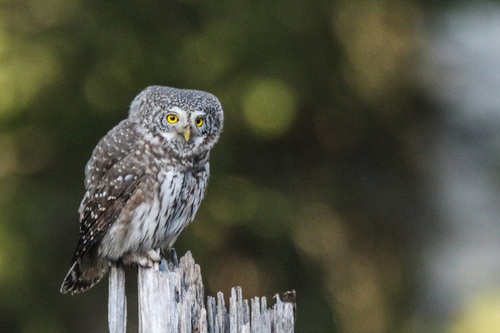
スズメフクロウ (Glaucidium passerinum) スズメフクロウ
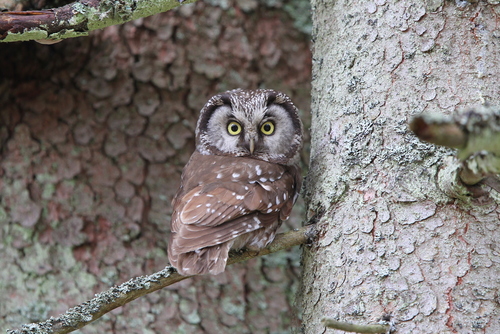
キンメフクロウ (Aegolius funereus) キンメフクロウ

メディア

読み込み中…

要点

ユーラシアコキンメフクロウとキンメフクロウの最も信頼できるフィールドマークは、全体的な構造と顔のパターンです:コキンメフクロウは特に小さく、短い尾と耳の房がない平らで丸い頭を持っていますが、キンメフクロウは大きく、広い丸い頭と暗い縁取りのある目を引く淡い顔の円盤を持ち、「驚いた」ように見えます。幼鳥のキンメフクロウはチョコレートブラウンで、目の間に広い白い「X」があり、コキンメフクロウの羽毛とは異なります。成鳥では、コキンメフクロウは白い斑点のある赤褐色から灰褐色の背中と半分の襟を示しますが、キンメフクロウは目立つ白い「真珠」斑点のある茶色の背中と縞模様の腹部を持っています。両者とも黄色い目を持っていますが、顔と体の比率は異なります。鳴き声は非常に異なります:コキンメフクロウは高く、フルートのような単調な音を出しますが、キンメフクロウはトリルやさまざまな柔らかい音と厳しい音を出します。

識別のコツ

  1. Juvenile plumage: 幼鳥のキンメフクロウは全体がチョコレートブラウンで、目の間に広い白い「X」があり、首と肩羽に白い模様があります—コキンメフクロウはこのパターンを示すことはありません。もし暗い茶色でほぼ均一な若いフクロウを見たら、淡い顔の模様があれば、それはキンメフクロウです。
  2. Facial disc: 成鳥のキンメフクロウは大きく淡い顔の円盤を持ち、暗い縁と白い「眉毛」があり、「驚いた」ように見えます。コキンメフクロウは平らで丸い頭を持ち、わずかに白から灰色の眉毛しかなく、顔の円盤はありません。
  3. Size and jizz: コキンメフクロウは非常に小さく、よりコンパクトで、短い尾と小さく丸い頭を持っています。キンメフクロウは大きく、ずっしりとしており、広い頭と長い尾と翼を持っています。両者を一緒に見ると、違いは明らかですが、単独でもコキンメフクロウはしばしば「ミニチュア」に見えます。
  4. Back and wing spotting: キンメフクロウは背中と翼に目立つ真珠のような白い斑点を持ち、尾には折りたたんでもはっきりとした三列の白い斑点があります。コキンメフクロウは背中に白い斑点がありますが、広がりが少なく「真珠のよう」ではありません;尾には五つの狭い白っぽい帯があり、斑点の列ではありません。
  5. Underparts: コキンメフクロウは主に白い腹に茶色の斑点がありますが、キンメフクロウはクリーム色の白い腹に赤褐色の縞模様があります—縞模様と斑点を見分けてください。
  6. Nape marking: コキンメフクロウは首の後ろに半分の白い襟を示します;キンメフクロウはこれを欠いていますが、幼鳥には首に白い模様があるかもしれません。
  7. Tail pattern: コキンメフクロウの尾は体よりも暗く、五つの狭い白っぽい帯があります;キンメフクロウの尾はオリーブブラウンで、三列の白い斑点があります。
  8. Bill color: キンメフクロウは淡い黄色のくちばしを持っています;コキンメフクロウのくちばしは灰色がかった黄色ですが、これは微妙で、フィールドではめったに診断的ではありません。
  9. Eye color: 両者とも黄色い目を持っているので、これは区別にはなりません。
  10. Ear tufts: どちらの種も耳の房を持っていないので、このマークは使用しないでください。
  11. Vocalization: 鳴いている場合、コキンメフクロウは高く、フルートのような単調な音を出しますが、キンメフクロウはトリルやさまざまな柔らかい音と厳しい音を出します—特に夜間の違いを聞いてください。
  12. Behavior: コキンメフクロウは夜明けや夕暮れにオープンに止まっているのを見かけることがあります;キンメフクロウは厳密に夜行性で、巣の近くや止まり木から追い出されない限り、めったに見られません。
  13. Habitat: 両者とも北方/タイガの森林にいますが、コキンメフクロウは森林の端や混合林に出現することが多いかもしれません;キンメフクロウは深く成熟したタイガを好みます。
  14. Flight: 飛行中、コキンメフクロウはコンパクトで短い尾に見えます;キンメフクロウはずっしりとしており、広い翼とより浮遊感のあるまっすぐな飛行をします。
  15. Pitfalls: 幼鳥のキンメフクロウを他の茶色のフクロウと混同しないように注意してくださいが、白い「X」と顔の円盤はユニークです。コキンメフクロウの小さなサイズと平らな顔が重要です—もしその鳥が「かわいらしく」小さく見えたら、それはおそらくコキンメフクロウです。

大きさ

ユーラシアコキンメフクロウは最小のヨーロッパのフクロウで、平均体重は約65.5g、長さは15〜19cmで、コンパクトで短い尾に見えます。キンメフクロウは明らかに大きく、ずっしりとしており、広い頭と長い翼と尾を持っていますが、ほとんどのフクロウと比べるとまだ小さいです。フィールドでは、コキンメフクロウはより頑丈なキンメフクロウの隣でほぼ「おもちゃのよう」に見えます。

羽色

幼鳥のキンメフクロウ(約3週間から巣立ち)は、上面と下面が均一なチョコレートブラウンで、暗い茶色の顔の円盤、首、肩羽、尾に白い模様があり、目の間に広い白い「X」があります—これはユニークで、コキンメフクロウの羽毛とは一致しません。成鳥のキンメフクロウは、目立つ真珠のような白い斑点のある茶色の背中、暗い縁のある淡い顔の円盤、赤褐色の縞模様のあるクリーム色の腹を持っています。彼らの飛行羽と尾には白い斑点の列があり、尾が閉じていてもはっきりとしています。対照的に、ユーラシアコキンメフクロウの成鳥は、上面が赤褐色から灰褐色で白い斑点があり、後頭部に半分の白い襟があり、主に白い腹に茶色の斑点があります。彼らの尾は暗く、五つの狭い白っぽい帯があります。コキンメフクロウはキンメフクロウの大胆な顔の円盤と「驚いた」表情を欠いています。両種とも黄色い目を持っていますが、コキンメフクロウの顔はより平坦でコンパクトです。

行動

両者とも森林のフクロウですが、キンメフクロウは厳密に夜行性で、昼間に見つかるとしばしば人懐っこく、飛ぶ前に近づくことを許すことがあります。コキンメフクロウは夜明けや夕暮れに活動する可能性が高く、特に繁殖期にはオープンに止まっているのを見かけることがあります。コキンメフクロウは秋に獲物を貯蔵することで知られていますが、キンメフクロウの行動はその秘密主義的で夜行性の習性のために観察されることは少ないです。

生息環境

両者とも北方とタイガの森林に生息していますが、コキンメフクロウは北部および中央ヨーロッパとシベリアの混合林や針葉樹林でより頻繁に見られ、時には森林の端にいます。キンメフクロウは深く成熟したタイガを好み、より開けたまたは端の生息地では見られる可能性が低いです。両者ともめったに見られませんが、コキンメフクロウは鳴き声や日中の活動によってより簡単に検出されるかもしれません。

声

ユーラシアコキンメフクロウは高音で単調な明瞭なフルートのような音を出し、クラシックなフクロウの「フー」とは全く異なります。キンメフクロウははるかに多様なレパートリーを持っています:主な歌は大きなトリルで、追加の柔らかい求愛メロディ、配達音、悲鳴、ピーピー音、防御的なシュー音があります。鳴き声は一般的に低音で、コキンメフクロウの単純で繰り返しの歌よりも複雑です。

より良い説明を送る

比較と同じ項目を使ってください。文章はすぐに公開されます。

The most reliable field mark between Eurasian Pygmy-Owl and Tengmalm's Owl is their overall structure and facial pattern: Pygmy-Owl is notably smaller, with a short tail and a plain, rounded head lacking ear tufts, while Tengmalm's Owl is larger, with a broad, rounded head and a striking pale facial disc bordered by dark, giving a 'surprised' look. Juvenile Tengmalm's Owls are chocolate-brown with a broad white 'X' between the eyes, unlike any Pygmy-Owl plumage. In adults, Pygmy-Owls show a reddish to grey-brown back with white spots and a half-collar, whereas Tengmalm's has a brown back with prominent white 'pearl' spots and a streaked underpart. Both have yellow eyes, but their face and body proportions are distinct. Calls are very different: Pygmy-Owl gives high, fluted, monotonous notes, while Tengmalm's Owl produces trills and a variety of softer and harsher calls.

  1. Juvenile plumage: Juvenile Tengmalm's Owl is chocolate-brown overall with a broad white 'X' between the eyes and white markings on neck and scapulars—no Pygmy-Owl ever shows this pattern. If you see a dark brown, almost uniform young owl with a pale facial marking, it's Tengmalm's.
  2. Facial disc: Adult Tengmalm's Owl has a large, pale facial disc with a dark border and white 'eyebrows,' giving a 'surprised' look. Pygmy-Owl has a plain, rounded head with only faint white to grey eyebrows and no facial disc.
  3. Size and jizz: Pygmy-Owl is much smaller and more compact, with a short tail and small, rounded head. Tengmalm's Owl is larger, bulkier, with a broad head and longer tail and wings. If you see both together, the difference is obvious, but even singly, Pygmy-Owl often looks 'miniature.'
  4. Back and wing spotting: Tengmalm's Owl has prominent pearly-white spots on the back and wings, and the tail shows three rows of white spots that remain distinct even when folded. Pygmy-Owl has white spots on the back but less extensive and not as 'pearl-like'; tail has five narrow whitish bars, not rows of spots.
  5. Underparts: Pygmy-Owl has a mostly white belly with brown speckles, while Tengmalm's Owl has cream-white underparts with russet-brown streaks—look for streaks vs. speckles.
  6. Nape marking: Pygmy-Owl shows a half white collar on the back of the neck; Tengmalm's Owl lacks this but may have white markings on the neck in juveniles.
  7. Tail pattern: Pygmy-Owl's tail is darker than the body with five narrow whitish bars; Tengmalm's Owl's tail is olive-brown with three rows of white spots.
  8. Bill color: Tengmalm's Owl has a light yellow bill; Pygmy-Owl's bill is greyish-yellow, but this is subtle and rarely diagnostic in the field.
  9. Eye color: Both have yellow eyes, so this is not a separator.
  10. Ear tufts: Neither species has ear tufts, so don't use this mark.
  11. Vocalization: If calling, Pygmy-Owl gives high, fluted, monotonous notes, while Tengmalm's Owl produces trills and a variety of softer and harsher calls—listen for the difference, especially at night.
  12. Behavior: Pygmy-Owl may be seen perched openly at dawn or dusk; Tengmalm's Owl is strictly nocturnal and rarely seen except at the nest or if flushed from a roost.
  13. Habitat: Both in boreal/taiga forests, but Pygmy-Owl may occur more at forest edges or in mixed woods; Tengmalm's Owl prefers deep, mature taiga.
  14. Flight: In flight, Pygmy-Owl appears compact and short-tailed; Tengmalm's Owl is bulkier, with broader wings and a more buoyant, straight flight.
  15. Pitfalls: Beware of confusing juvenile Tengmalm's with other brown owls, but the white 'X' and facial disc are unique. Pygmy-Owl's small size and plain face are key—if the bird looks 'cute' and tiny, it's likely Pygmy-Owl.

Eurasian Pygmy-Owl is the smallest European owl, with an average mass around 65.5g and a length of 15–19 cm, appearing compact and short-tailed. Tengmalm's Owl is noticeably larger and bulkier, with a broader head and longer wings and tail, though still small compared to most owls. In the field, Pygmy-Owl looks almost 'toy-like' next to the more robust Tengmalm's Owl.

Juvenile Tengmalm's Owls (about 3 weeks to fledging) are uniform chocolate-brown above and below, with a dark brown facial disc, white markings on the neck, scapulars, and tail, and a broad white 'X' between the eyes—this is unique and not matched by any Pygmy-Owl plumage. Adult Tengmalm's Owls have a brown back with striking pearly-white spots, a pale facial disc with a dark border, and cream underparts with russet streaks. Their flight feathers and tail show rows of white spots, which remain distinct even when the tail is closed. In contrast, Eurasian Pygmy-Owl adults are reddish to greyish-brown above with white spots, a half white collar on the nape, and a mostly white belly with brown speckles. Their tail is darker with five narrow whitish bars. Pygmy-Owls lack the bold facial disc and 'surprised' expression of Tengmalm's. Both species have yellow eyes, but Pygmy-Owl's face is plainer and more compact.

Both species are forest owls, but Tengmalm's Owl is strictly nocturnal and often confiding if found during the day, sometimes allowing close approach before flying. Pygmy-Owl is more likely to be active at dawn and dusk and may be seen perched openly, especially in the breeding season. Pygmy-Owls are known for storing prey in autumn, while Tengmalm's Owl's behavior is less likely to be observed due to its secretive, nocturnal habits.

Both species inhabit boreal and taiga forests, but Pygmy-Owl is more often found in mixed or coniferous woodlands of northern and central Europe and Siberia, sometimes at forest edges. Tengmalm's Owl prefers deep, mature taiga and is less likely to be seen in more open or edge habitats. Both are rarely seen, but Pygmy-Owl may be more easily detected by call or diurnal activity.

Eurasian Pygmy-Owl gives a high-pitched, monotonous series of clear, fluted notes, quite unlike the classic owl 'hoot.' Tengmalm's Owl has a much more varied repertoire: the main song is a loud trill, with additional softer courtship melodies, delivery calls, screeches, peeping, and defensive hissing. The calls are generally lower-pitched and more complex than Pygmy-Owl's simple, repetitive song.

変更を破棄しますか?

保存していない編集があります。今離れると失われます。

スズメフクロウ · キンメフクロウ · 苦手な鳥