

Eurasian Pygmy-Owl vs Little Owl
Glaucidium passerinum versus Athene noctua
Play a quiz with Eurasian Pygmy-Owl and Little Owl
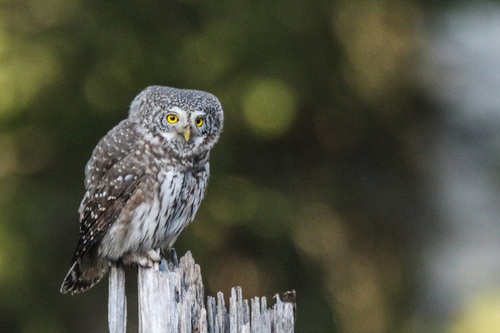 Eurasian Pygmy-Owl
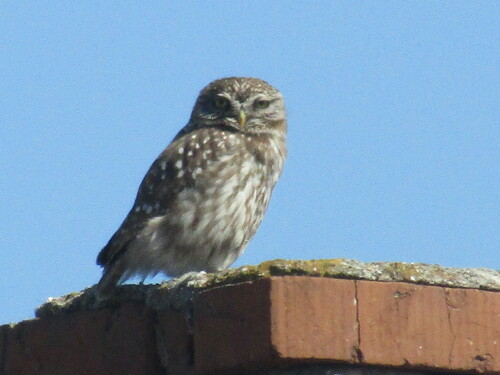 Little Owl
In short
The most reliable field mark to separate Eurasian Pygmy-Owl from Little Owl is size: the pygmy-owl is much smaller and more delicate, with a short tail and fine, spotted plumage, while the Little Owl is noticeably bulkier, with a flat-topped head and a fierce, 'frowning' expression. In flight, Little Owl shows a bounding, woodpecker-like action and a longer wingspan, while Pygmy-Owl appears more fluttery and compact. Plumage differences include the pygmy-owl's white half-collar on the nape and fine brown spotting, versus the Little Owl's bold white eyebrows and streaked underparts. Both have yellow eyes, but the Little Owl's are set in a more prominent, stern-looking face. Voice and habitat can also help, but size and structure are the quickest field clues.
Identification tips
- Size is the fastest check: Eurasian Pygmy-Owl is tiny (about 65 g, 17 cm), while Little Owl is much larger and heavier (180 g, 22 cm). If the bird looks chunky or pigeon-sized, it's not a pygmy-owl.
- Head shape and facial expression: Little Owl has a flat-topped head and bold white eyebrows, giving a fierce, frowning look. Pygmy-Owl's head is small, rounded, and lacks any 'eyebrow' effect.
- Tail and wing structure: Pygmy-Owl has a short tail with five narrow, whitish bars; Little Owl's tail is short but the wings are broad and long in proportion, giving a much larger wingspan.
- Plumage pattern: Pygmy-Owl is reddish to greyish-brown with fine white spots and a half-collar on the nape. Little Owl is greyish-brown above, boldly speckled with white, and has streaked (not spotted) underparts.
- Facial disc and eyes: Both have yellow eyes, but Little Owl's are set in a more prominent, expressive face with a flattened disc; Pygmy-Owl's face is plain and lacks any dramatic features.
- Juvenile confusion: Juvenile Little Owls lack white crown spots but still show the flat-topped head and streaked belly; juvenile Pygmy-Owls are always much smaller and have a plain, round head.
- Flight style: Little Owl flies with bounding, woodpecker-like action—bursts of wingbeats and glides. Pygmy-Owl's flight is more fluttery and direct, matching its tiny size.
- Perching behavior: Little Owl often perches in the open, on posts or buildings, and may be seen in daylight. Pygmy-Owl is more secretive, perching quietly in trees, especially conifers.
- Habitat context: Forest interior or dense woodland points to Pygmy-Owl; open farmland, orchards, or urban edges favor Little Owl.
- Vocalizations: Listen for a high, monotonous, fluted series from Pygmy-Owl versus the lower, more varied 'kiew' and trills of Little Owl.
- Bill and feet: Pygmy-Owl has a small, greyish-yellow, hooked bill and disproportionately large feet for its size. Little Owl's bill is less obviously oversized for its body.
- White nape collar: The half-collar of white on the nape is a good mark for Pygmy-Owl, not shown by Little Owl.
- Underpart markings: Pygmy-Owl's belly is mostly white with brown speckles; Little Owl's is pale with bold brown streaks.
- Sexual dimorphism: Female Pygmy-Owls are larger than males, but both sexes are still much smaller than any Little Owl.
- Seasonal context: Both species can be seen year-round, but Pygmy-Owl's food-hoarding and forest habits are most obvious in autumn and winter, while Little Owl is more active and visible in open habitats in spring and summer.
Size
Eurasian Pygmy-Owl is dramatically smaller: adult females are 17.4–19 cm long (males even smaller), with a body mass around 65.5 g. Little Owl is much larger and heavier, at about 22 cm in length and 180 g in weight. In the field, this difference is obvious—Little Owl looks chunky and robust, while Pygmy-Owl is tiny, delicate, and almost toy-like by comparison. The Little Owl's wingspan (56 cm) is also much greater than the pygmy-owl's, making flight jizz and perched bulk reliable at a glance.
Plumage
- Juvenile/immature contrast: Juvenile Little Owls are duller than adults and lack the white crown spots, but still show the characteristic flat-topped head and streaked underparts. Eurasian Pygmy-Owl juveniles resemble adults, with spotted sides and a half-collar on the nape, but are always much smaller and lack the Little Owl's bold facial pattern.
- Adults: Eurasian Pygmy-Owl is reddish to greyish-brown, with fine white spotting on the back, a white half-collar on the nape, and a mostly white belly with brown speckles. The tail is dark with five narrow, whitish bars. Little Owl is greyish-brown above, with bold white speckles, white 'eyebrows,' and a pale, streaked underside. The face of Little Owl is more expressive and 'frowning,' while Pygmy-Owl's is plain, round, and lacks ear tufts. Both have yellow eyes, but the Little Owl's are set in a more prominent, stern-looking face.
Behaviour
Little Owl often perches boldly in the open, on posts or buildings, and exhibits a bounding, woodpecker-like flight with bursts of wingbeats and glides. Eurasian Pygmy-Owl is more secretive, typically perching quietly in conifers and showing a fluttery, direct flight. Pygmy-Owl can catch birds in flight and is known for food-hoarding, especially in autumn. Little Owl is more terrestrial, often hunting insects and small mammals on the ground, and is more likely to be seen in daylight.
Habitat
Eurasian Pygmy-Owl is a bird of boreal and mixed forests in Northern and Central Europe to Siberia, favoring dense coniferous or mixed woodland. Little Owl prefers open, temperate, and warmer landscapes—farmland, orchards, parkland, and even urban edges—across Europe, North Africa, and Asia. If seen in a deep forest, Pygmy-Owl is more likely; in open country or near human habitation, Little Owl is the default.
Voice
Eurasian Pygmy-Owl gives a high-pitched, monotonous series of clear, fluted notes, spaced by about two seconds, with both sexes rising in pitch before and after the mating season. Little Owl's call is a querulous 'kiew, kiew,' sometimes whistling or trilling, and pairs may duet in the breeding season. The Little Owl's voice is lower and more varied, while Pygmy-Owl's is higher and more repetitive.