

Eurasian Nightjar vs Water Rail
Caprimulgus europaeus versus Rallus aquaticus
Play a quiz with Eurasian Nightjar and Water Rail
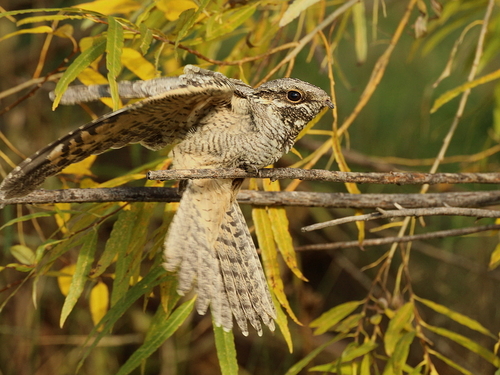 Eurasian Nightjar
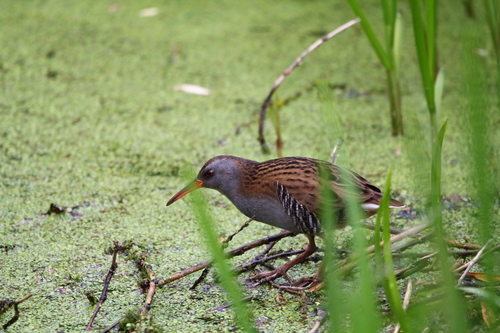 Water Rail
In short
The most reliable way to separate Eurasian Nightjar from Water Rail is by structure and behavior: nightjars are long-winged, cryptic, aerial birds with a distinctive buoyant flight and, in males, bold white wing and tail flashes; Water Rails are secretive, laterally compressed wetland birds with a long red bill, short tail, and a habit of skulking through reeds. Juvenile and adult plumages are very different: nightjars are intricately patterned in greys and browns for camouflage, while Water Rails show brown upperparts, blue-grey underparts, and bold black-and-white flank barring. In flight, the nightjar's long pointed wings and silent, moth-like movement contrast sharply with the rail's short, rounded wings and weak, fluttery flight. Habitat is also a strong clue: nightjars are found in open, dry habitats at dusk or night, while Water Rails are strictly tied to dense, wet reedbeds.
Identification tips
- Flight structure: Nightjar has long, pointed wings and a long tail; Water Rail has short, rounded wings and a short tail. This is most obvious in flight.
- Male Nightjar wing/tail flashes: In flight, male Nightjar shows bold white patches on the wings (three primaries) and white tips to the outer tail feathers. Female Nightjar and all Water Rails lack these white flashes.
- Bill shape and color: Water Rail has a long, slightly down-curved red bill, much longer than the Nightjar's short, blackish bill. This is visible even at a distance.
- Body shape: Nightjar is slender and elongated with a flat head and large eyes, adapted for aerial feeding. Water Rail is laterally compressed, with a flattened body for squeezing through reeds.
- Plumage pattern: Nightjar is intricately patterned grey-brown with dark streaks and a pale buff collar; Water Rail is brown above, blue-grey below, with bold black-and-white barred flanks and a white undertail.
- Juvenile confusion: Juvenile Water Rails have buff underparts and a buff undertail, but still show a long bill and brown upperparts. Juvenile Nightjars resemble adult females but lack white in the wings/tail and have cryptic, streaked plumage.
- Undertail color: Water Rail adults have a white undertail with some dark streaks; Nightjar's undertail is patterned and never pure white.
- Behavior: Nightjar is active at dusk and night, often seen flying or perched along a branch or on the ground; Water Rail is secretive, skulking in reeds, rarely seen in the open except when flushed.
- Habitat: Nightjar is found in open, dry habitats (heath, woodland clearings); Water Rail is strictly in dense, wet reedbeds and marshes.
- Vocalizations: Nightjar's churring trill is very different from Water Rail's pig-like squeal and grunts. If you hear a churring at dusk, think Nightjar; if you hear a squeal from reeds, think Water Rail.
- Legs and feet: Water Rail has long toes and flesh-brown legs, adapted for walking on soft mud; Nightjar's legs and feet are short and brown, rarely seen except when perched.
- Daytime visibility: Nightjar is very hard to find by day, relying on camouflage; Water Rail is also elusive, but more likely to be heard than seen.
- Sex differences: Only male Nightjar shows white in the wings and tail; Water Rail sexes are similar, with males slightly larger and stronger undertail streaks.
- Moult and flightlessness: Water Rail is flightless for about three weeks after breeding due to moult; Nightjar moults after breeding but remains flight-capable.
- Context clues: If you see a bird flying at dusk in open terrain, especially with white wing flashes, it's a Nightjar. If you glimpse a skulking bird in reeds with a long red bill, it's a Water Rail.
Size
Water Rail is slightly heavier on average (adult mass ~111.5 g) than Eurasian Nightjar (males 51–101 g, females 67–95 g), but both are similar in length (Nightjar 24.5–28 cm, Rail 23–28 cm). However, Nightjar has a much longer wingspan (52–59 cm) compared to Water Rail (38–45 cm), giving it a more elongated and aerial appearance. Water Rail is more compact and laterally flattened, adapted for squeezing through reeds, while Nightjar is built for buoyant, sustained flight.
Plumage
- Juvenile/immature birds: Nightjar fledglings are similar to adult females, with cryptic grey-brown plumage and no white in the wings or tail. Water Rail juveniles have a blackish crown, white chin and throat, buff or white underparts with brown and buff flank markings, and a buff undertail (not the adult's white). Their bill and legs are duller than adults.
- Adults: Nightjar adults are intricately patterned grey-brown above with dark streaks, a pale buff hindneck collar, and (in males) bold white patches on the wings and tail visible in flight. Females lack white in the wings/tail. Water Rail adults have olive-brown upperparts with black streaks, dark slate-blue underparts, black-and-white barred flanks, a white undertail, and a long red bill. Both sexes are similar in Water Rail, but males may have stronger black undertail streaks.
- Flight: Nightjar's long, pointed, soft wings and white wing/tail flashes (male) are unique; Water Rail has short, rounded wings and no white in the wings, with a white undertail often visible as it flicks its tail. Nightjar's plumage is cryptic for ground roosting, while Water Rail's is for reedbed concealment.
Behaviour
Eurasian Nightjar is crepuscular/nocturnal, most often seen flying at dusk or night, sometimes perching along branches or on the ground, relying on camouflage. Its flight is buoyant, silent, and moth-like, often with glides and abrupt turns. Water Rail is secretive and terrestrial, rarely seen in the open, moving through dense reeds with a laterally compressed body. It is much more likely to be heard than seen, and when flushed, flies weakly and briefly before dropping back into cover. Nightjar is rarely seen during the day except when flushed from a roost.
Habitat
Nightjar breeds and roosts in open, dry habitats—heathland, clearings, forest edges, or open woodland—often far from water. It is active at dusk and night. Water Rail is strictly a wetland species, inhabiting dense, well-vegetated reedbeds, marshes, and wet ditches. It is never found in dry, open habitats and is highly dependent on cover and water. If you see a bird in thick reeds or marsh, it is almost certainly a Water Rail, not a Nightjar.
Voice
Nightjar males produce a long, mechanical churring trill at dusk or dawn, sometimes ending with a bubbling trill and wing-clapping; both sexes give a short 'cuick' call in flight. The song is ventriloquial and can be confused with mole cricket. Water Rail gives a distinctive pig-like squeal and a variety of grunts and squeaks, very different from the nightjar's churring. Water Rail is much more likely to be heard than seen, especially during the day.