

Eurasian Nightjar vs Swamp Nightjar
Caprimulgus europaeus versus Caprimulgus natalensis
Play a quiz with Eurasian Nightjar and Swamp Nightjar
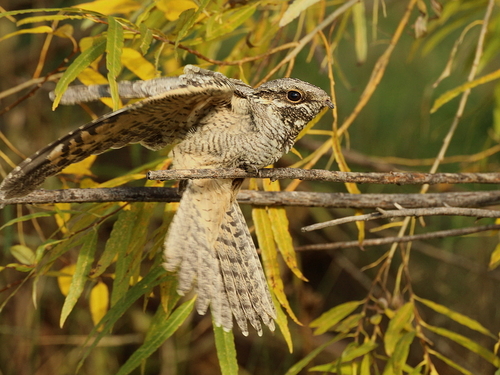 Eurasian Nightjar
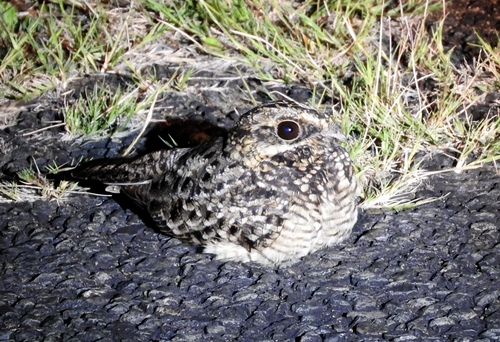 Swamp Nightjar
In short
The most reliable field mark to separate Eurasian Nightjar from Swamp Nightjar is the presence of white patches on the wings and tail of adult male Eurasian Nightjars, which Swamp Nightjars lack. Juvenile and female Eurasian Nightjars, as well as all Swamp Nightjars, do not show these white markings, so separation relies on subtler differences in plumage and structure. Eurasian Nightjar is generally larger, with a greyer and more streaked appearance, while Swamp Nightjar is found only in Africa and is typically darker and less contrasting. Both species are nocturnal and cryptic, making field identification challenging, especially outside of adult male plumage.
Identification tips
- White wing and tail patches (adult male Eurasian Nightjar only): In flight, look for bold white patches on the outer primaries and white tips to the outer tail feathers. Swamp Nightjar never shows these marks. Females and juveniles of both species lack them, so this mark is diagnostic only for adult males.
- Overall size and structure: Eurasian Nightjar is larger and longer-winged, with a more buoyant, moth-like flight. Swamp Nightjar is smaller and more compact, but size can be hard to judge without direct comparison.
- Upperpart coloration: Eurasian Nightjar is generally paler and more greyish-brown with prominent dark streaking and a buff hindneck collar. Swamp Nightjar is darker and less contrasting, with less obvious streaking and collar.
- Wing spotting (perched): Eurasian Nightjar shows buff spotting on the closed wing, which may be less distinct or absent in Swamp Nightjar.
- Juvenile confusion: Juvenile Eurasian Nightjars resemble adult females and lack white patches, so cannot be separated from Swamp Nightjar by this mark. Focus on overall color and streaking.
- Tail pattern: Only adult male Eurasian Nightjar shows white tips to the outer tail feathers. Females and juveniles of both species have plain tails.
- Flight style: Eurasian Nightjar's flight is described as very buoyant and silent, with long, pointed wings. Swamp Nightjar may appear less elongated in flight.
- Habitat and range: In Europe or Asia, the bird is Eurasian Nightjar. In Africa, both species are possible, especially during Eurasian Nightjar's wintering period. Swamp Nightjar does not occur outside Africa.
- Perched appearance: Both species are cryptic and difficult to see when perched. Eurasian Nightjar may look paler and more streaked; Swamp Nightjar is darker and more uniform.
- Vocalization: Eurasian Nightjar males produce a long churring trill at dusk and dawn. Swamp Nightjar's song is not described here, so do not rely on voice unless familiar with both species.
- Sex differences: Only male Eurasian Nightjar shows white in the wings and tail. Females and juveniles of both species are similar and best separated by subtle plumage and structure.
- Seasonal context: White wing and tail patches are only visible after the first prebasic molt, so very young Eurasian Nightjars may lack them. Consider time of year and age when using this mark.
- Confusion with other nightjars: In Africa, Eurasian Nightjar may overlap with other Caprimulgus species; always check for white markings and overall coloration.
- Lighting conditions: Both species are most active at dusk and dawn, making color and pattern hard to judge. Use structure and wing/tail pattern when possible.
- Behavioral cues: Both species may be located by their flight at dusk or by listening for the Eurasian Nightjar's churring song. Swamp Nightjar's vocalizations are not described, so use caution.
Size
Eurasian Nightjar is notably larger, measuring 24.5–28 cm in length with a 52–59 cm wingspan. Males weigh 51–101 g and females 67–95 g. Swamp Nightjar is smaller, but precise measurements are not provided in the available sources. In the field, Eurasian Nightjar will usually appear longer-winged and bulkier, especially in flight, compared to the more compact Swamp Nightjar.
Plumage
For adult males, Eurasian Nightjar shows bold white patches on the outer primaries (three feathers) and white tips to the two outer tail feathers, which are visible in flight and sometimes when perched. Females and juveniles of Eurasian Nightjar lack these white marks and resemble Swamp Nightjar more closely. Eurasian Nightjar adults and immatures have greyish-brown upperparts with dark streaking, a pale buff hindneck collar, and buff spotting on the closed wing. Swamp Nightjar, by contrast, is generally darker overall, with less prominent streaking and a less obvious hindneck collar. Both species are highly cryptic when perched, but Eurasian Nightjar tends to look paler and more streaked, while Swamp Nightjar appears more uniformly dark and less patterned. Juvenile Eurasian Nightjars resemble adult females and lack the white wing and tail patches, so age must be considered when using this mark.
Behaviour
Both species are crepuscular and nocturnal, often seen at dusk or dawn in buoyant, silent flight. Eurasian Nightjar is noted for its very buoyant, moth-like flight on long, pointed wings, which may appear more pronounced than in Swamp Nightjar. Both species are difficult to spot when perched due to their cryptic plumage and tendency to sit motionless along branches or on the ground.
Habitat
Eurasian Nightjar breeds across most of Europe and the Palearctic, extending to Mongolia and Northwestern China, and winters in Africa. Swamp Nightjar is resident in Africa and does not occur in Eurasia. Habitat overlap is possible only in Africa during Eurasian Nightjar's wintering period, but Swamp Nightjar is more restricted to African habitats. If observed in Europe or Asia, the bird is Eurasian Nightjar by default.
Voice
Eurasian Nightjar males sing a long, sustained churring trill, often from a perch at dawn or dusk, with occasional bubbling trills and wing-clapping displays. Both sexes give a short 'cuick, cuick' call in flight and various alarm and nest calls. Swamp Nightjar's vocalizations are not described in the available sources, so vocal differences cannot be reliably used for separation with current information.