

Eurasian Jay vs Rook
Garrulus glandarius versus Corvus frugilegus
Play a quiz with Eurasian Jay and Rook
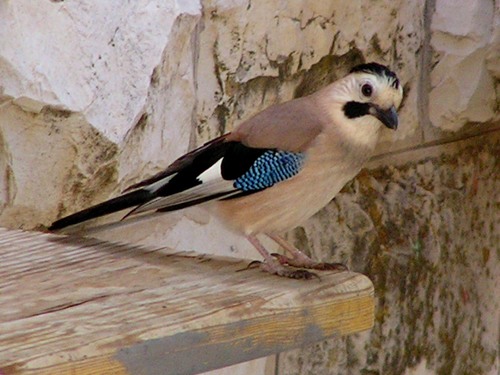 Eurasian Jay
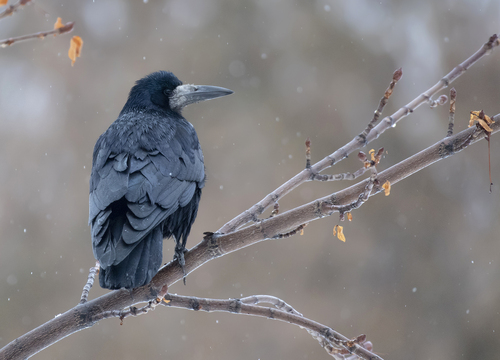 Rook
In short
The most reliable field mark to separate Eurasian Jay from Rook is the Jay’s striking blue-and-black barred wing panel, visible on perched and flying birds of all ages, versus the Rook’s entirely black plumage with a purplish-blue sheen and, in adults, a distinctive bare whitish patch at the base of the bill. Juvenile Rooks lack the bare patch and can be confused with other all-black corvids, but never show the Jay’s pinkish-brown body or blue wing. Rooks are much larger, lankier, and more gregarious, while Jays are smaller, stockier, and favor woodland cover. If you see a pinkish-brown bird with a blue wing flash, it’s a Jay; if it’s all black and crow-like, especially with a pale bare face, it’s a Rook.
Identification tips
- Blue wing panel (all ages, all seasons): Only Eurasian Jay shows a bright blue patch with fine black bars on the upperwing, visible both when perched and in flight. Rook never shows blue or any color other than black.
- Overall color (all ages): Eurasian Jay is pinkish-brown with a white throat and black moustache; Rook is all black with a purplish or bluish sheen (adults and juveniles).
- Facial features (adults): Adult Rooks have a bare whitish patch of skin at the base of the bill and around the eye, making the bill look longer and the head more domed. Eurasian Jays always have feathered faces with a black moustache and streaked crown.
- Juvenile confusion: Juvenile Rooks lack the bare facial patch and can resemble crows, but are still all black and never show brown or blue. Jays of all ages retain their pinkish-brown and blue coloration.
- Tail color: Eurasian Jay has a black tail contrasting with the brown body; Rook’s tail is black, matching the rest of the plumage.
- White rump (Jay): In flight, Eurasian Jay shows a white rump; Rook does not.
- Size and structure: Rooks are much larger, longer-winged, and lankier than Jays, with a heavier bill. Jays are compact and medium-sized.
- Wing shape in flight: Rooks have proportionally longer, narrower wings than crows or Jays, giving them a more languid, gliding flight. Jays have shorter, rounded wings and a more bounding, direct flight.
- Leg feathering: Rooks have shaggier, laxer feathering around the legs than crows, but this is not a useful mark versus Jay.
- Bill color: Rook’s bill is grey-black; Jay’s bill is dark but less massive.
- Behavior: Rooks are usually in flocks, often noisy and conspicuous in open fields. Jays are solitary or in pairs, shy, and stick to woodland or wooded parks.
- Habitat: Jays are woodland birds, rarely venturing into open fields; Rooks prefer open farmland and are rarely deep in woods.
- Acorn carrying (Jay): Jays may be seen carrying acorns, especially in autumn, a behavior not shown by Rooks.
- Perched posture: Rooks perch upright and look lanky; Jays are more horizontal and compact.
- Vocalization: Not diagnostic from the notes, but Jays are known for harsh screeches, while Rooks have typical crow-like cawing.
Size
Rook is significantly larger and heavier than Eurasian Jay. Rooks measure 44–46 cm in length with an 81–99 cm wingspan and average 453.5 g in mass [wikidata], making them much bulkier than the Jay, which is 34–35 cm long with a 52–58 cm wingspan [wikipedia]. In the field, Rooks appear lanky and long-winged, while Jays are compact and medium-sized for a corvid.
Plumage
-
Juvenile/immature birds: Juvenile Rooks are all black with a slight greenish gloss and brownish-black on the hind neck, back, and underparts. They lack the adult's bare whitish facial patch, making them superficially similar to crows, but still never show any blue or brown tones. Eurasian Jay of all ages shows pinkish-brown plumage, a white throat bordered by a black moustache, a white rump, and—most distinctively—a bright blue panel with fine black bars on the upper wing. This blue wing patch is present in all plumages and is diagnostic.
-
Adults: Adult Rooks are glossy black with a purplish or bluish sheen in sunlight. Their most distinctive feature is the bare whitish skin at the base of the bill and around the eye, which is never shown by Jays. Jays retain their pinkish-brown body, blue-and-black wing panel, and black tail throughout adulthood. The Jay’s head is streaked whitish with black, and the tail is black, contrasting with the body.
-
In flight: Jays show a white rump and a flash of blue on the upperwing; Rooks are all black and show proportionally longer, narrower wings than crows, but no color contrast.
Behaviour
Rooks are highly gregarious, often seen in large, noisy flocks in open fields or perched together in trees, especially near rookeries. They walk with a purposeful, striding gait and often forage on the ground. Eurasian Jays are more secretive, typically seen alone or in pairs, moving through woodland or flying between trees. Jays are acorn hoarders and may be seen carrying acorns in their bills. Jays are more likely to be encountered in wooded areas, often giving themselves away with a flash of blue as they fly between cover.
Habitat
Eurasian Jays are woodland specialists, preferring mixed or oak-rich forests but increasingly venturing into parks and gardens with mature trees. They are rarely seen in open fields. Rooks, in contrast, favor open countryside, farmland, and pastures, often nesting colonially in tall trees near fields. Rooks are rarely found deep in woodland and are much more likely to be seen in open or semi-open landscapes.