
Eurasian Jackdaw vs Common Raven
Coloeus monedula versus Corvus corax
Play a quiz with Eurasian Jackdaw and Common Raven
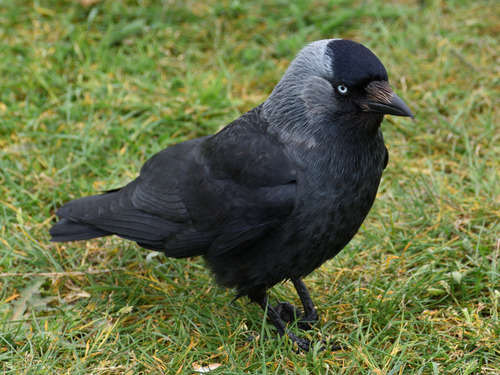 Eurasian Jackdaw
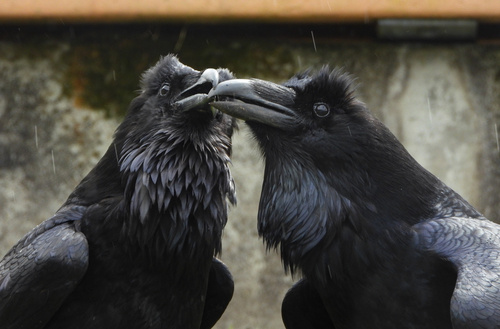 Common Raven
In short
The most reliable field mark to separate Eurasian Jackdaw from Common Raven is overall size and structure: the Jackdaw is much smaller, with a short, stubby bill and a distinctive pale grey nape and silvery iris (in adults), while the Raven is massive, all-black, with a heavy, long bill and shaggy throat. In flight, Jackdaws show fast, deep wingbeats and a compact, short-necked profile, whereas Ravens soar with broad wings and a wedge-shaped tail. Juvenile Jackdaws are duller and lack the adult's sharp pale nape, but still remain much smaller and paler-eyed than any Raven. If you see a medium-sized corvid with a strikingly pale nape and silvery eye, it's a Jackdaw; a huge, all-black bird with a wedge tail and deep croak is a Raven.
Identification tips
- Size is decisive: If the bird is anywhere near the size of a crow or pigeon, it's a Jackdaw; if it dwarfs crows and looks huge, it's a Raven. This applies to all ages and seasons.
- Bill structure: Jackdaws have a short, stubby bill; Ravens have a long, thick, arched bill with prominent bristles. Bill size is obvious even at a distance in good light.
- Nape and neck color: Adult Jackdaws have a pale grey to silvery nape and cheeks, contrasting with the black cap and throat. Ravens are uniformly black with no pale on the nape at any age.
- Eye color: Adult Jackdaws have striking silvery or whitish irises; juveniles have blue or brownish eyes. Ravens of all ages have dark brown or blue-grey eyes, never pale.
- Throat feathers: Ravens show shaggy, elongated throat feathers, especially when calling or displaying. Jackdaws have a smooth throat.
- Tail shape in flight: Jackdaws have a short, squared or slightly rounded tail; Ravens have a long, wedge-shaped tail, especially visible when soaring or gliding.
- Wing shape and flight style: Jackdaws fly with rapid, deep wingbeats and compact, tight flocks; their wings are proportionately narrower and less fingered. Ravens have broad wings with splayed primaries ('fingers'), soar and glide with little flapping, and rarely flock tightly.
- Plumage sheen: Both are glossy, but Jackdaws may show purple or blue sheen on the crown and a green-blue sheen on the throat and tail. Ravens are glossy black all over, with no pale areas.
- Juvenile confusion: Young Jackdaws are duller and less sharply marked, but still show some nape contrast and paler eyes. Young Ravens are dull, all-black, and larger than any Jackdaw.
- Legs and feet: Both have black legs, not a useful separator.
- Habitat context: Jackdaws are common in towns, cities, and farmland; Ravens prefer wild, open, or mountainous areas. In urban settings, a large corvid is almost certainly a Jackdaw.
- Social behavior: Jackdaws are highly social, often in noisy, tight flocks. Ravens are usually alone or in pairs, sometimes in loose groups.
- Vocalizations: Jackdaws give sharp, high-pitched 'jack' calls; Ravens give deep, resonant croaks. If you hear a deep croak, it's a Raven.
- Perched posture: Jackdaws appear upright and compact; Ravens are bulkier, with a heavier bill and shaggier throat.
- Seasonal wear: Fading of the pale nape in Jackdaws (especially males) can reduce contrast before molt, but the size and bill remain diagnostic.
Size
Size is the most immediate separator: the Common Raven is a giant among passerines, averaging around 65.7 cm in length and 947 g in mass [wikidata], while the Eurasian Jackdaw is much smaller, typically 34–39 cm in length and about 240 g [wikipedia]. The Raven's bill is proportionally much larger and heavier, and its wingspan and bulk are in a different league. Even at a distance or in flight, the Jackdaw appears compact, with a short neck and tail, while the Raven is long, heavy, and imposing.
Plumage
- Juvenile/immature birds: Young Jackdaws are dull sooty-black with a faint greenish sheen, brown feather bases, and a dark grey nape; their eyes are light blue, turning brownish before whitening at about one year. Juvenile Ravens are also duller than adults, with a blue-grey iris and a pinkish gape, but remain all-black without any pale on the nape or neck. Thus, even immature Jackdaws tend to show some contrast on the nape and paler eyes, while young Ravens are uniformly dark.
- Adults: Adult Jackdaws have a shiny black cap and throat with a purple or blue sheen, but the standout feature is the pale grey to silver nape and cheeks, and a silvery or whitish iris. Ravens are glossy black all over, with a shaggy throat, and a dark brown iris. The base of the neck feathers in Ravens is pale brownish-grey, but this is not visible in the field. Jackdaws have a short, black bill; Ravens have a massive, arched, black bill with long bristles. Both have black legs.
- Flight views: Jackdaws show uniform grey underwings and lack the fingered primaries and wedge-shaped tail of the Raven. Ravens have broad wings with splayed primaries and a long, wedge-shaped tail, especially obvious when soaring or gliding.
Behaviour
Jackdaws are agile, social, and often seen in tight flocks, flying with rapid, jerky wingbeats and making quick, tumbling maneuvers. On the ground, they strut briskly with an upright posture. Ravens are more solitary or seen in pairs, often soaring or gliding with little flapping, and can perform acrobatic flight but with a heavier, more stable style. Ravens rarely gather in tight flocks like Jackdaws, and their foraging is more often solitary or in loose groups.
Habitat
Both species are widespread, but Jackdaws are more likely in urban, farmland, and open woodland settings, often near human habitation. Ravens prefer wilder, open landscapes, mountains, cliffs, and remote areas, though they can be found near settlements in some regions. Seeing a corvid in a city or town is far more likely to be a Jackdaw, while a huge corvid in remote uplands or coastal cliffs is likely a Raven.
Voice
Jackdaws have a sharp, metallic 'jack' or 'kya' call, often repeated in chattering flocks. Ravens have a deep, resonant croak, much lower and more sonorous than any Jackdaw sound. The difference is striking: Jackdaws are high-pitched and social, Ravens are deep and solitary.