

Eurasian Jackdaw vs Carrion Crow
Coloeus monedula versus Corvus corone
Play a quiz with Eurasian Jackdaw and Carrion Crow
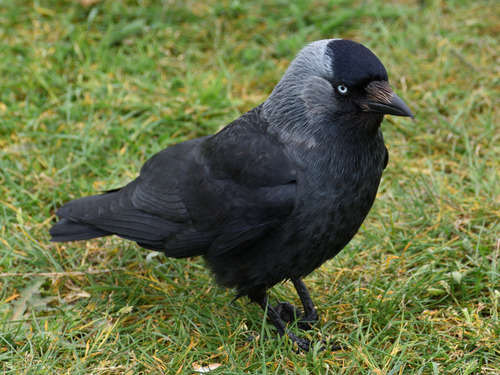 Eurasian Jackdaw
 Carrion Crow
In short
The most reliable way to separate Eurasian Jackdaw from Carrion Crow is the jackdaw’s pale silvery or whitish iris (adults) and contrasting pale grey nape and cheeks, which stand out even at a distance, while Carrion Crow is entirely black with a dark eye. Juvenile jackdaws have blue or brownish eyes, but still show a paler nape and smaller size. In flight, jackdaws are noticeably smaller, with shorter, more rounded wings and a brisk, jerky wingbeat, compared to the crow’s larger, broader wings and slower, steadier flight. Bill size and shape are also key: jackdaws have a short, stubby bill, while crows have a long, heavy bill. These features, along with differences in flocking and voice, allow confident separation in most field situations.
Identification tips
- Iris color: Adult jackdaws have striking pale silvery or whitish eyes, visible even at a distance; crows always have dark brown or black eyes. Juvenile jackdaws have blue or brownish eyes, but never as dark as adult crows.
- Nape and cheek color: Jackdaws show a contrasting pale grey to silvery nape and cheeks, sharply set off from the black crown and face. Crows are entirely black with no pale areas on the head or neck, regardless of age.
- Bill size and shape: Jackdaws have a short, stubby bill (about 75% the length of the rest of the head), while crows have a long, heavy, and more pointed bill. This is especially obvious in profile or when feeding.
- Overall size: Jackdaws are much smaller and more compact than crows. If both are present, the difference is obvious; jackdaws are about two-thirds the length and less than half the mass of crows.
- Wing and tail shape in flight: Jackdaws have shorter, more rounded wings and a shorter tail, with rapid, jerky wingbeats. Crows have broader wings, longer tails, and slower, steadier wingbeats. Jackdaws often fly in tight, coordinated flocks, while crows are more solitary or loosely grouped.
- Plumage gloss: Both species are glossy, but jackdaws may show a purple or blue sheen on the crown and secondaries, and a green-blue sheen on the throat, primaries, and tail. Crows have a green or purple gloss overall, but this is subtle and not usually a reliable field mark.
- Juvenile confusion: Young jackdaws are duller and less sharply marked than adults, with sooty black heads and brown feather bases, but still show a paler nape and blue or brownish eyes. Juvenile crows are all black but may appear browner and have blue eyes; they never show a pale nape or cheek.
- Flocking behavior: Jackdaws are highly social, often in large, noisy flocks, especially in flight. Crows are usually solitary or in pairs, though they may gather at food or roosts.
- Posture and gait: Jackdaws stand upright and strut briskly, while crows have a heavier, more deliberate walk and a bulkier, longer-necked appearance.
- Vocalizations: Jackdaws give high, sharp "kya" or "jack" calls, often in rapid series; crows give deep, guttural "kraa" or "caw" calls, slower and more resonant.
- Habitat context: Jackdaws are more likely to be seen around buildings, chimneys, and urban parks, often nesting in cavities. Crows use a wider range of habitats but are less tied to human structures.
- Seasonal variation: Jackdaw plumage is freshest and glossiest just after the late summer moult; worn birds may look duller, but the pale nape and eye remain. Crows do not show strong seasonal variation in field marks.
- Sex differences: Both species are essentially monomorphic in the field; sex cannot be reliably determined by plumage or structure.
- Pitfalls: At long range or in poor light, jackdaws can appear all dark and be mistaken for small crows, especially juveniles. Always look for the pale nape and eye, and use size and structure as supporting marks.
- When marks fail: In silhouette or poor light, rely on size, flocking, and flight style. If only the call is heard, the difference in pitch and rhythm is usually diagnostic.
Size
Carrion Crow is much larger and heavier than Eurasian Jackdaw. Adult crows measure 48–52 cm in length and weigh 400–600 g, with a wingspan of 84–100 cm. In contrast, jackdaws are only 34–39 cm long, weigh about 240 g, and have a proportionately shorter wingspan. This size difference is obvious when both species are seen together, but can be underestimated at a distance or with lone birds. Jackdaws also have a more compact, upright posture, while crows are bulkier and longer-necked.
Plumage
- Juveniles: Young jackdaws have duller, less sharply marked plumage than adults, with a sooty black head and brown feather bases sometimes visible, but still show a paler grey nape and cheeks. Their eyes are blue, turning brownish before whitening at about one year. Juvenile crows are all black but may appear browner overall, with blue eyes that darken to brown and then black as they age.
- Adults: Adult jackdaws have a distinctive pale grey to silvery nape and cheeks, black crown and face, and slate-grey underparts. Their eyes are pale silvery or whitish. Carrion Crows are entirely black with a green or purple sheen, black eyes, and no contrasting pale areas. Both species have black legs and bills, but the jackdaw’s bill is much shorter and stubbier.
- Flight: In flight, jackdaws show uniform dark wings and tail, but their smaller size, shorter wings, and rapid, jerky wingbeats are distinctive. Carrion Crows have broader wings, slower wingbeats, and a heavier, more direct flight. Neither species shows contrasting wing panels or trailing edges that would aid separation in immature plumages, but the jackdaw’s pale nape can sometimes be glimpsed even in flight.
Behaviour
Jackdaws are highly social, often seen in tight, noisy flocks, especially in flight or at roosts. They move with a brisk, upright strut on the ground and feed with heads held down or horizontally. Their flight is agile, with frequent glides, tumbles, and tight turns. Carrion Crows are more solitary or found in pairs, though they may gather in small groups at food sources or winter roosts. Crows walk with a slower, more deliberate gait and have a heavier, more powerful flight with slower wingbeats. Jackdaws are more likely to be seen in large, cohesive flocks, while crows are usually alone or loosely associated.
Habitat
Both species are widespread and adaptable, found in urban, rural, and woodland habitats. Jackdaws are especially common around human settlements, parks, and farmland, often nesting in buildings or chimneys. Carrion Crows use a wider range of habitats, including open countryside, woodlands, and urban areas, but are less tied to buildings than jackdaws. Where both occur, jackdaws are more likely to be seen in large flocks and in closer proximity to people.
Voice
Jackdaws have a sharp, high-pitched "kya" or "jack" call, often given in rapid series and easily heard in flight flocks. Carrion Crows have a deeper, guttural "kraa" or "caw," delivered in slower, more deliberate sequences, sometimes accompanied by bowing gestures. The difference in pitch and tone is usually obvious: jackdaw calls are higher and chattier, while crow calls are lower and more resonant.