

Motmot

Eurasian Eagle Owl vs Northern Hawk Owl

Bubo bubo versus Surnia ulula

Play a quiz with Eurasian Eagle Owl and Northern Hawk Owl
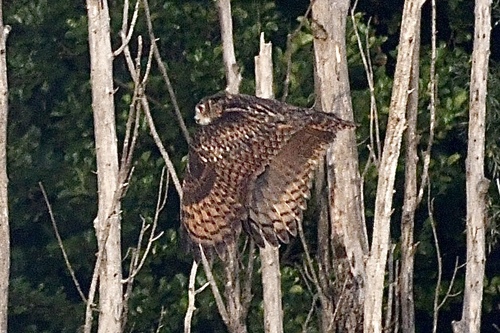
Eurasian Eagle Owl (Bubo bubo) Eurasian Eagle Owl
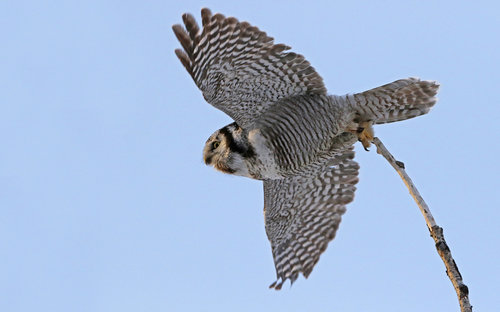
Northern Hawk Owl (Surnia ulula) Northern Hawk Owl

Media

Loading…

In short

The most reliable field mark to separate Eurasian Eagle Owl from Northern Hawk Owl is overall size and bulk: the eagle owl is truly massive, dwarfing any other owl in its range, while the hawk owl is medium-sized and slim. In flight or perched, the Northern Hawk Owl’s long, banded tail and hawk-like silhouette contrast sharply with the eagle owl’s broad wings, short tail, and heavy, barrel-shaped body. Juvenile hawk owls can be separated by their pointed tail tips, while adults have rounded tail tips. Plumage also differs: the eagle owl shows heavy dark streaking and a broad, powerful face with prominent ear tufts, while the hawk owl has a striking white face bordered in black and lacks ear tufts. These two are unlikely to be confused except at great distance or in poor light, but structural and plumage differences are clear with binoculars.

Identification tips

  1. Size is the single most reliable mark: Eurasian Eagle Owl is enormous, with a wingspan up to 1.7 m and a mass over 2.5 kg; Northern Hawk Owl is much smaller, with a wingspan under 85 cm and a mass around 300–340 g. Even at distance, the eagle owl’s bulk is striking.
  2. Ear tufts: Eagle Owl has large, obvious ear tufts that are visible when perched or in profile; Northern Hawk Owl lacks ear tufts entirely—its head is smoothly rounded.
  3. Tail shape and length: Hawk Owl has a long, narrow, strongly banded tail, often held straight and extending well beyond the wings when perched. Eagle Owl’s tail is short and broad, barely projecting beyond the folded wings.
  4. Juvenile tail tips: First-year Northern Hawk Owls have pointed tail tips; adults have rounded tips. Eagle Owl’s tail is always broad and rounded, regardless of age.
  5. Facial pattern: Hawk Owl has a striking white face bordered with a sharp black outline, yellow eyes, and a small, curved yellow bill. Eagle Owl’s face is broad, with orange eyes, a large bill, and lacks a sharply defined facial border.
  6. Plumage pattern: Eagle Owl is heavily streaked and mottled above, with a brown to rufous base and broad black streaks; underparts are streaked. Hawk Owl is dark brown above with off-white spots, white below with brown barring (not streaks), and a black V on the nape.
  7. Flight silhouette: Hawk Owl flies with long, narrow wings and a long tail, resembling a hawk. Eagle Owl’s flight is heavy, with broad, rounded wings and a short tail, more like a giant tawny or horned owl.
  8. Perched posture: Hawk Owl often sits upright on exposed perches, with a slim, elongated look. Eagle Owl appears squat, deep-chested, and massive, often hunched with feathers fluffed.
  9. Activity pattern: Hawk Owl is often seen hunting during the day, especially in winter or irruption years. Eagle Owl is mainly nocturnal or crepuscular, rarely seen in daylight.
  10. Habitat context: Eagle Owl prefers rocky cliffs, remote forests, and wild hills. Hawk Owl favors open boreal forests, bogs, and clearings, often near water or open ground.
  11. Eye color: Eagle Owl has deep orange eyes; Hawk Owl’s eyes are bright yellow.
  12. Bill size: Eagle Owl’s bill is large and powerful, suited to very large prey. Hawk Owl’s bill is small and delicate by comparison.
  13. Vocalization: Not diagnostic here, but eagle owl’s call is a deep, booming hoot; hawk owl’s call is higher-pitched, less resonant.
  14. Subspecies variation: While both species have subspecies with varying tones and barring, the basic differences—streaked vs. barred underparts, ear tufts, tail shape—are consistent.
  15. Common pitfalls: At great distance or in poor light, a perched hawk owl may appear larger than it is, but the lack of ear tufts and long tail are giveaways. Juvenile hawk owls’ pointed tail tips can be subtle but are unique among these two.

Size

Eurasian Eagle Owl is one of the largest owls in the world, with an average mass of 2686 g [wikidata] and a wingspan often exceeding 150 cm. Its body is thickset and powerful, with a large head and deep chest. In contrast, the Northern Hawk Owl is much lighter (males about 300 g, females about 340 g [wikipedia]), with a wingspan of 69–82 cm—barely half that of the eagle owl. Hawk owls are long and slim, with a body length of 35–45 cm, but their slender build and long tail make them appear even smaller and more agile. In any direct comparison, the eagle owl is far bulkier and more imposing.

Plumage

Juvenile Northern Hawk Owls have pointed tail tips, while adults have rounded tail tips—a subtle but useful mark if seen well. The hawk owl’s plumage is dark brown above with off-white spots, a white face bordered in black, and a white underbelly with brown barring. The tail is long and strongly banded. Eurasian Eagle Owl, by contrast, is heavily streaked and mottled brown to rufous above, with a paler or more rufous belly depending on subspecies, and broad black streaks on the upperparts, head, and chest. The eagle owl’s face is broad and rounded with prominent orange eyes and large, obvious ear tufts (not present in hawk owl). The underparts are streaked, not barred. Subspecies variation in both species affects tone and barring, but the overall pattern—streaked for eagle owl, barred for hawk owl—remains consistent. In flight, the hawk owl’s long, narrow tail and pointed wings contrast with the eagle owl’s broad, rounded wings and short tail.

Behaviour

Northern Hawk Owl is often active during the day and perches conspicuously atop trees or poles, scanning for prey in open areas. Its flight is direct and hawk-like, often gliding or flapping with quick, shallow wingbeats. Eurasian Eagle Owl is mainly crepuscular or nocturnal, roosting during the day in secluded spots and flying with deep, slow wingbeats. The eagle owl is more secretive and less likely to be seen in open daylight. Hawk owl’s diurnal habits and tendency to perch high and exposed are useful behavioral clues.

Habitat

Eurasian Eagle Owl occupies a wide range across Eurasia, favoring rocky outcrops, cliffs, and forested hills, often away from human disturbance. It is a bird of wild, rugged terrain. Northern Hawk Owl is a boreal species of northern forests, especially open coniferous woods, bogs, and forest edges. It is more likely to be seen in open, flat landscapes, sometimes near clearings or wetlands. While ranges can overlap in northern Eurasia, the eagle owl prefers more rugged and remote habitats.

Submit a better description

Use the same sections as the comparison. Your text is published immediately.

The most reliable field mark to separate Eurasian Eagle Owl from Northern Hawk Owl is overall size and bulk: the eagle owl is truly massive, dwarfing any other owl in its range, while the hawk owl is medium-sized and slim. In flight or perched, the Northern Hawk Owl’s long, banded tail and hawk-like silhouette contrast sharply with the eagle owl’s broad wings, short tail, and heavy, barrel-shaped body. Juvenile hawk owls can be separated by their pointed tail tips, while adults have rounded tail tips. Plumage also differs: the eagle owl shows heavy dark streaking and a broad, powerful face with prominent ear tufts, while the hawk owl has a striking white face bordered in black and lacks ear tufts. These two are unlikely to be confused except at great distance or in poor light, but structural and plumage differences are clear with binoculars.

  1. Size is the single most reliable mark: Eurasian Eagle Owl is enormous, with a wingspan up to 1.7 m and a mass over 2.5 kg; Northern Hawk Owl is much smaller, with a wingspan under 85 cm and a mass around 300–340 g. Even at distance, the eagle owl’s bulk is striking.
  2. Ear tufts: Eagle Owl has large, obvious ear tufts that are visible when perched or in profile; Northern Hawk Owl lacks ear tufts entirely—its head is smoothly rounded.
  3. Tail shape and length: Hawk Owl has a long, narrow, strongly banded tail, often held straight and extending well beyond the wings when perched. Eagle Owl’s tail is short and broad, barely projecting beyond the folded wings.
  4. Juvenile tail tips: First-year Northern Hawk Owls have pointed tail tips; adults have rounded tips. Eagle Owl’s tail is always broad and rounded, regardless of age.
  5. Facial pattern: Hawk Owl has a striking white face bordered with a sharp black outline, yellow eyes, and a small, curved yellow bill. Eagle Owl’s face is broad, with orange eyes, a large bill, and lacks a sharply defined facial border.
  6. Plumage pattern: Eagle Owl is heavily streaked and mottled above, with a brown to rufous base and broad black streaks; underparts are streaked. Hawk Owl is dark brown above with off-white spots, white below with brown barring (not streaks), and a black V on the nape.
  7. Flight silhouette: Hawk Owl flies with long, narrow wings and a long tail, resembling a hawk. Eagle Owl’s flight is heavy, with broad, rounded wings and a short tail, more like a giant tawny or horned owl.
  8. Perched posture: Hawk Owl often sits upright on exposed perches, with a slim, elongated look. Eagle Owl appears squat, deep-chested, and massive, often hunched with feathers fluffed.
  9. Activity pattern: Hawk Owl is often seen hunting during the day, especially in winter or irruption years. Eagle Owl is mainly nocturnal or crepuscular, rarely seen in daylight.
  10. Habitat context: Eagle Owl prefers rocky cliffs, remote forests, and wild hills. Hawk Owl favors open boreal forests, bogs, and clearings, often near water or open ground.
  11. Eye color: Eagle Owl has deep orange eyes; Hawk Owl’s eyes are bright yellow.
  12. Bill size: Eagle Owl’s bill is large and powerful, suited to very large prey. Hawk Owl’s bill is small and delicate by comparison.
  13. Vocalization: Not diagnostic here, but eagle owl’s call is a deep, booming hoot; hawk owl’s call is higher-pitched, less resonant.
  14. Subspecies variation: While both species have subspecies with varying tones and barring, the basic differences—streaked vs. barred underparts, ear tufts, tail shape—are consistent.
  15. Common pitfalls: At great distance or in poor light, a perched hawk owl may appear larger than it is, but the lack of ear tufts and long tail are giveaways. Juvenile hawk owls’ pointed tail tips can be subtle but are unique among these two.

Eurasian Eagle Owl is one of the largest owls in the world, with an average mass of 2686 g [wikidata] and a wingspan often exceeding 150 cm. Its body is thickset and powerful, with a large head and deep chest. In contrast, the Northern Hawk Owl is much lighter (males about 300 g, females about 340 g [wikipedia]), with a wingspan of 69–82 cm—barely half that of the eagle owl. Hawk owls are long and slim, with a body length of 35–45 cm, but their slender build and long tail make them appear even smaller and more agile. In any direct comparison, the eagle owl is far bulkier and more imposing.

Juvenile Northern Hawk Owls have pointed tail tips, while adults have rounded tail tips—a subtle but useful mark if seen well. The hawk owl’s plumage is dark brown above with off-white spots, a white face bordered in black, and a white underbelly with brown barring. The tail is long and strongly banded. Eurasian Eagle Owl, by contrast, is heavily streaked and mottled brown to rufous above, with a paler or more rufous belly depending on subspecies, and broad black streaks on the upperparts, head, and chest. The eagle owl’s face is broad and rounded with prominent orange eyes and large, obvious ear tufts (not present in hawk owl). The underparts are streaked, not barred. Subspecies variation in both species affects tone and barring, but the overall pattern—streaked for eagle owl, barred for hawk owl—remains consistent. In flight, the hawk owl’s long, narrow tail and pointed wings contrast with the eagle owl’s broad, rounded wings and short tail.

Northern Hawk Owl is often active during the day and perches conspicuously atop trees or poles, scanning for prey in open areas. Its flight is direct and hawk-like, often gliding or flapping with quick, shallow wingbeats. Eurasian Eagle Owl is mainly crepuscular or nocturnal, roosting during the day in secluded spots and flying with deep, slow wingbeats. The eagle owl is more secretive and less likely to be seen in open daylight. Hawk owl’s diurnal habits and tendency to perch high and exposed are useful behavioral clues.

Eurasian Eagle Owl occupies a wide range across Eurasia, favoring rocky outcrops, cliffs, and forested hills, often away from human disturbance. It is a bird of wild, rugged terrain. Northern Hawk Owl is a boreal species of northern forests, especially open coniferous woods, bogs, and forest edges. It is more likely to be seen in open, flat landscapes, sometimes near clearings or wetlands. While ranges can overlap in northern Eurasia, the eagle owl prefers more rugged and remote habitats.

Discard your changes?

You have unsaved edits. If you leave now, those changes will be lost.

Eurasian Eagle Owl · Northern Hawk Owl · My Tricky Birds