

Eurasian Curlew vs Black-tailed Godwit
Numenius arquata versus Limosa limosa
Play a quiz with Eurasian Curlew and Black-tailed Godwit
 Eurasian Curlew
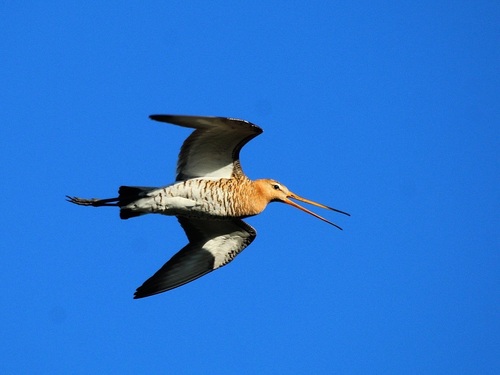 Black-tailed Godwit
In short
The most reliable field mark to separate Eurasian Curlew from Black-tailed Godwit is overall size and bill shape: the curlew is much larger and bulkier, with a very long, smoothly downcurved bill, while the godwit is slimmer, more upright, and has a long but straighter bill with only a slight upturn at the tip. In flight, Black-tailed Godwit shows a bold black-and-white wingbar and white rump with a black tail band, which the curlew lacks. Curlew is generally grey-brown above and below, with no strong wing pattern, and its legs and feet project well beyond the tail in flight. Both species can appear similar when feeding in muddy fields or estuaries, but careful attention to structure and flight pattern will separate them in all plumages.
Identification tips
- Flight pattern (all ages): Black-tailed Godwit shows a bold black-and-white wingbar and a white rump with a black tail band in flight; Eurasian Curlew lacks these, showing plain grey-brown wings and a white back only.
- Bill shape: Curlew's bill is much longer and smoothly downcurved throughout; godwit's bill is long but mostly straight with a slight upturn at the tip. This is visible both at rest and in flight.
- Size and bulk: Curlew is much larger and heavier, with a longer neck and more robust body. Godwit is slimmer, more upright, and stands taller on its legs, but is much lighter overall.
- Leg and foot projection in flight: Curlew's legs and feet extend well beyond the tail, forming a conspicuous 'point' in flight; godwit's legs are long but do not project as far.
- Plumage (breeding): Black-tailed Godwit in breeding plumage has a bright orange head, neck, and breast (especially in males); curlew is always streaked grey-brown and lacks any orange tones.
- Plumage (non-breeding): Godwit becomes uniform brown-grey above and below; curlew remains streaked and mottled. Juvenile godwits have a pale orange wash to the neck and breast, while curlew juveniles are duller and less robust.
- Bill color: Godwit shows a yellowish or pink base to the bill (especially in breeding), while curlew's bill is uniformly dark.
- Leg color: Godwit's legs are dark grey to black; curlew's are greyish-blue.
- Feeding behavior: Curlew often probes deeper and moves more slowly; godwit is more active and upright, often feeding in small groups.
- Habitat context: Curlew is more likely in upland or open grassland in breeding season; godwit prefers lowland wet grassland and estuaries, especially in winter.
- Voice: Curlew's loud, bubbling 'curloo-oo' is distinctive and diagnostic if heard; godwit's calls are less memorable.
- Sex differences: Both species are similar between sexes, but female curlews have the longest bills, and male godwits are brighter in breeding plumage.
- Pitfalls: In poor light or at long range, both can appear similar in size and color; rely on flight pattern and bill shape for confirmation.
- Comparison with Bar-tailed Godwit: Curlew may resemble bar-tailed godwit in flight, but bar-tailed is smaller, with a slightly upturned beak and legs not extending beyond the tail; black-tailed godwit is more upright and shows a stronger wingbar.
- Juvenile confusion: Young godwits can show a pale orange wash, but will always show the wingbar and tail band in flight, unlike curlew juveniles.
Size
Eurasian Curlew is significantly larger and heavier than Black-tailed Godwit. Curlew averages about 805.5 g in body mass, compared to 289.5 g for godwit [wikidata]. Curlew measures 50–60 cm in length with a wingspan of 89–106 cm, while godwit is 42 cm long with a 70–82 cm wingspan [wikipedia]. Curlew is bulkier, with a longer neck and much longer, more deeply curved bill. Godwit is more slender and upright, with longer legs relative to body size, but the curlew's feet project further beyond the tail in flight.
Plumage
Juvenile and adult Black-tailed Godwits of all ages show a distinctive black-and-white wingbar and a white rump with a black tail band in flight. This bold pattern is absent in Eurasian Curlew, which has plain greyish-brown upperwings and a white back but no contrasting wingbar or tail band. On the ground, godwit in breeding plumage has an orange head, neck, and breast (brighter in males), while curlew is always more subdued and streaked grey-brown. In winter, godwit becomes dull grey-brown above and below, but still shows a uniform look compared to the curlew's streaked and mottled pattern. Juvenile godwits have a pale orange wash to the neck and breast, while juvenile curlews are similar to adults but smaller and less robust. Bill color is also a clue: godwit has a yellowish or pink base to the bill (especially in breeding), while curlew's bill is uniformly dark. Leg color differs: godwit has dark grey to black legs, curlew has greyish-blue legs.
Behaviour
Both species probe mud or wet grass for invertebrates, but curlew often feeds in deeper water or wetter ground, using its longer bill to reach deeper prey. Curlew moves more slowly and deliberately, often pausing to scan, while godwit is more active and upright, sometimes feeding in small groups. In flight, godwit is faster and more direct, with rapid wingbeats and a distinctive white wingbar flashing, while curlew appears heavier and more labored, with slower, deeper wingbeats and no strong wing pattern.
Habitat
Both species use wet meadows, estuaries, and coastal mudflats, but Eurasian Curlew is more likely to be found in open grasslands, moorland, and upland pastures, especially in the breeding season. Black-tailed Godwit favors lowland wet grasslands and muddy estuaries, especially in migration and winter. In the UK and Ireland, curlew is more widespread but declining, while godwit is locally common in suitable habitat, especially in winter.
Voice
Curlew gives a loud, bubbling 'curloo-oo' call, often repeated in display or alarm. Godwit's calls are less distinctive in the field notes, but generally higher-pitched and less melodious than curlew. Voice is a useful clue if the curlew's call is heard, as it is unique among large waders.