

Eurasian Bullfinch vs Asian Rosy-Finch
Pyrrhula pyrrhula versus Leucosticte arctoa
Play a quiz with Eurasian Bullfinch and Asian Rosy-Finch
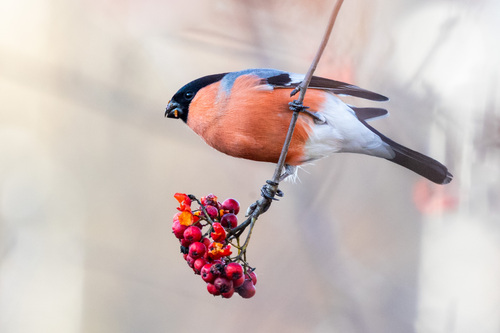 Eurasian Bullfinch
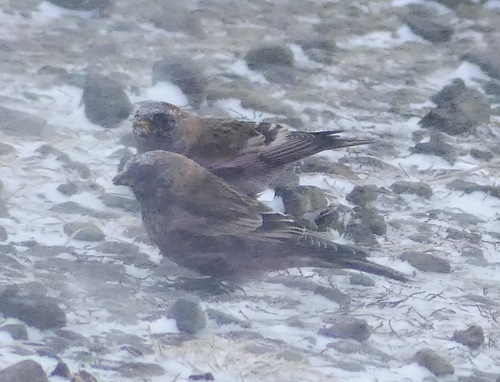 Asian Rosy-Finch
In short
The most reliable field mark between Eurasian Bullfinch and Asian Rosy-Finch is the presence of a bold white rump and wing bars on the bullfinch, especially visible in flight, versus the Asian Rosy-Finch’s lack of such contrasting white markings. Eurasian Bullfinch is a bulky, bull-headed bird with a black cap and face (adults), while Asian Rosy-Finch is a stout, dark brown finch with males showing black faces and pinkish suffusion on wings and flanks (except in some subspecies). Females and juveniles of both species are duller, but the bullfinch’s overall grey upperparts and white rump remain distinctive. Structure and bill shape also differ subtly, and context (Europe vs. East Asia, woodland vs. tundra/grassland) can help but should not be relied on alone.
Identification tips
- White rump and wing bars (all ages): Eurasian Bullfinch always shows a striking white rump and bold white wing bars in flight, regardless of age or sex. Asian Rosy-Finch never shows white in these areas—this is the single most reliable field mark.
- Adult male underparts: Bullfinch males have rich red underparts; Asian Rosy-Finch males have brown underparts with pinkish suffusion on wings and flanks (except Yakutian subspecies, which lack pink). If you see red below, it’s bullfinch; pinkish wings/flanks point to rosy-finch.
- Cap and face color: Adult bullfinch has a black cap and face; Asian Rosy-Finch males have a black face and throat, but females and immatures are paler. Juvenile bullfinch lacks the black cap, which can cause confusion—look for the white rump and wing bars instead.
- Female/immature confusion: Both species’ females/immatures are duller. Bullfinch females are grey-buff below and grey above, with white rump and wing bars. Asian Rosy-Finch females are paler brown, with no pink and no white wing/rump marks.
- Bill structure: Bullfinch has a very thick, short, bull-headed bill and a compact, bull-necked look. Asian Rosy-Finch’s bill is stout but appears slightly longer and less deep; overall head shape is less 'bull-headed.'
- Overall shape: Bullfinch is more compact and rounded, with a short neck and tail. Asian Rosy-Finch is also chunky but can appear longer-bodied and less thick-necked.
- Flight views: In flight, bullfinch flashes its white rump and wing bars; rosy-finch does not. Male rosy-finch may show pinkish tones in wings/flanks, but these are subtle and absent in females/immatures.
- Habitat context: Bullfinch is found in woodland, hedgerows, and gardens; Asian Rosy-Finch is in open tundra or grassland. If you’re in dense cover, suspect bullfinch; in open, treeless areas, suspect rosy-finch.
- Geographic range: Eurasian Bullfinch is widespread in Europe and western Asia; Asian Rosy-Finch is East Palearctic (Mongolia, Manchuria, Korea, Japan). Out-of-range records are rare—check the map if in doubt.
- Voice: If you hear a soft, mournful 'peeu' or 'pew', it’s bullfinch. Rosy-finch’s calls are not described here, so use voice only if the bullfinch’s note is clear.
- Yakutian subspecies caution: Some Asian Rosy-Finch males (Yakutian) lack pink and appear deeper brown, making them even more similar to bullfinch females/immatures. In these cases, rely on the absence of white in the wings/rump and habitat context.
- Seasonal plumage: Bullfinch males do not get duller in autumn, unlike some finches; their red underparts remain bright year-round. Asian Rosy-Finch males retain pinkish suffusion except in Yakutian subspecies.
- Group size: Bullfinch is usually seen in pairs or small groups; Asian Rosy-Finch can form larger flocks, especially in winter.
- Behavior: Bullfinch tends to stay within cover and is shy; rosy-finch is more likely to be seen feeding openly on the ground.
- When in doubt: If you cannot see the rump or wing bars clearly, focus on overall shape, bill structure, and habitat, but remember that only the bullfinch shows bold white in the wings and rump.
Size
Eurasian Bullfinch is slightly heavier (31.0g) than Asian Rosy-Finch (27.0g), but both are small, chunky finches and size is not a strong field separator. Bullfinch tends to appear more compact and bull-headed, with a short, thick neck and a noticeably thick, short bill. Asian Rosy-Finch is also stout but may appear a bit longer-bodied and less 'bull-headed' than bullfinch, though this is subtle and best used in combination with plumage marks.
Plumage
-
Juvenile/immature birds: Eurasian Bullfinch juveniles lack the adult’s black cap and face, showing greyish-brown tones instead, but still have the white rump and wing bars in flight. Asian Rosy-Finch juveniles are generally dull brown, lacking any white in the wings or rump, and females/immatures are paler on the face and throat than males, with no pink suffusion.
-
Adult males: Bullfinch males have a rich red chest and underparts, black cap and face, grey upperparts, white rump, and bold white wing bars. Asian Rosy-Finch males (except Yakutian subspecies) have a black face and throat, dark brown upperparts, and pinkish suffusion on wings and flanks, but no white in the wings or rump. Yakutian males lack pink and are overall deeper brown.
-
Adult females: Bullfinch females are grey-buff below, with grey upperparts and still show the white rump and wing bars. Asian Rosy-Finch females are paler brown, lack pink, and have a paler face and throat, but no white wing or rump markings.
Behaviour
Both species are generally unobtrusive and can be seen feeding low in vegetation or on the ground. Eurasian Bullfinch is often described as shy and quiet, moving in pairs or small groups, and tends to stay within cover, especially in woodland edges or hedgerows. Asian Rosy-Finch is more likely to be seen in open tundra or grassland, sometimes in larger flocks, and may appear more approachable in its open habitat. Flight of bullfinch is undulating and direct, often flashing the white rump; Asian Rosy-Finch’s flight is less distinctive in pattern but may show pinkish tones in males.
Habitat
Eurasian Bullfinch is found in woodland, forest edges, hedgerows, and gardens across Europe and parts of Asia. Asian Rosy-Finch inhabits open tundra and temperate grassland, breeding in Mongolia and the East Palearctic and wintering further east (Manchuria, Korea, Sakhalin, Japan). Overlap in range is minimal, and habitat context can be a strong clue: woodland/hedgerow for bullfinch, open grassland/tundra for rosy-finch.
Voice
Eurasian Bullfinch has a quiet, low, melancholy whistled 'peeu' or 'pew', with a weak, scratchy warbling song only audible at close range. Asian Rosy-Finch’s vocalizations are not described in the provided notes, so voice is only useful if the bullfinch’s soft, mournful whistle is heard. Do not rely on song for separation unless the bullfinch’s call is clearly recognized.