
Eurasian Blackbird vs Ring Ouzel
Turdus merula versus Turdus torquatus
Play a quiz with Eurasian Blackbird and Ring Ouzel
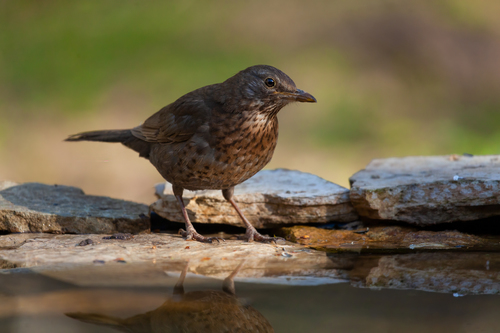 Eurasian Blackbird
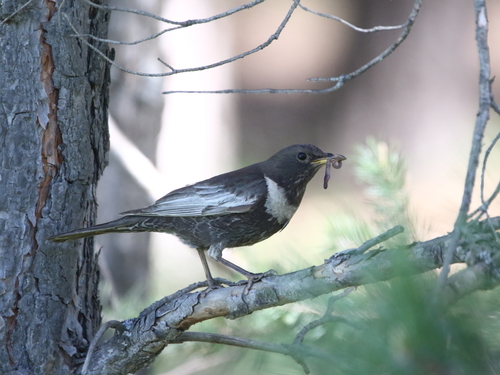 Ring Ouzel
In short
The most reliable field mark between Eurasian Blackbird and Ring Ouzel is the presence of a bold white breast crescent in adult Ring Ouzels, absent in all Eurasian Blackbirds. For immature birds, focus on the wing: juvenile and first-winter Ring Ouzels show a pale wing panel, while young Eurasian Blackbirds have uniformly brown wings without a pale panel. Adult male Eurasian Blackbirds are glossy black with a yellow eye-ring and bill, but lack any white on the breast. Both species are similar in size and shape, but Ring Ouzel is typically found in upland or mountainous habitats, while Eurasian Blackbird is a common lowland garden and woodland bird. In flight, the pale wing panel of young Ring Ouzels and the contrasting white breast crescent of adults are the quickest ways to separate them.
Identification tips
- White breast crescent: Adult Ring Ouzels always show a bold white crescent across the breast, visible both perched and in flight. No Eurasian Blackbird of any age or sex shows this mark.
- Pale wing panel (juvenile/first-winter): Juvenile and first-winter Ring Ouzels have a distinct pale panel on the wing (broad pale edges and tips to wing feathers), best seen in flight or when perched with wings closed. Juvenile Eurasian Blackbirds have uniformly brown wings with no pale panel.
- Glossy black vs. scaled black: Adult male Eurasian Blackbirds are glossy black all over, with no scaling or pale edges. Adult male Ring Ouzels are black but with narrow greyish scaling on the upperparts and belly, and pale-edged wings.
- Bill color and eye-ring: Adult male Eurasian Blackbirds have a bright orange-yellow bill and a yellow eye-ring, especially in spring and summer. Ring Ouzels have a yellow bill but lack the bright eye-ring. Female and young Blackbirds have duller bills.
- Female/juvenile confusion: Female and young Ring Ouzels are browner and less contrasting, but still show at least a faint breast crescent and a pale wing panel. Female Eurasian Blackbirds are sooty-brown with mottled breasts but never show a white crescent or pale wing panel.
- Breast pattern: Eurasian Blackbird females and juveniles may show some mottling or speckling on the breast, but never a sharply defined white crescent.
- Habitat: In lowland gardens, parks, or woodlands, a black thrush is almost always a Eurasian Blackbird. In upland, rocky, or moorland areas, especially during migration or breeding, check carefully for Ring Ouzel.
- Flight views: In flight, look for the pale wing panel in young Ring Ouzels and the white breast crescent in adults. Blackbirds in flight are uniform in color, with no pale wing panel or breast mark.
- Seasonal context: Ring Ouzels are mostly present in uplands during the breeding season and migrate through lower areas in spring and autumn. Eurasian Blackbirds are resident year-round in most areas.
- Structure: Both species have similar thrush structure (long tail, rounded head), so rely on plumage and habitat rather than shape.
- Bill color in young birds: First-year male Blackbirds have a dark bill and weak eye-ring, which can cause confusion with Ring Ouzel, but lack the pale wing panel and breast crescent.
- Leg color: Blackbirds have blackish-brown legs; Ring Ouzels have greyish-brown legs. This is subtle and rarely diagnostic at a distance.
- Voice: Not covered in detail here, but calls and song differ; in the field, visual marks are more reliable for quick separation.
- Moult timing: Adult Ring Ouzels undergo a complete moult after breeding; juveniles have a partial moult, but the pale wing panel persists in first-winter birds.
- Pitfalls: The main pitfall is confusing juvenile/first-winter Ring Ouzels (with faint breast crescent and pale wing panel) for female/juvenile Blackbirds (which lack both marks). Always check for the wing panel and breast crescent in young birds.
Size
Both species are medium-sized thrushes with similar proportions. Eurasian Blackbird measures 23.5–29 cm in length and weighs 80–125 g, while Ring Ouzel is 23–24 cm long and weighs 90–138 g. This means Ring Ouzel is slightly heavier on average, but the difference is subtle and not usually helpful in the field. Structure (long tail, rounded head, pointed wings) is broadly similar, so size alone is rarely diagnostic.
Plumage
- Juvenile/First-winter: Juvenile Ring Ouzels have a faint or absent breast crescent but always show a pale wing panel (broad pale edges and tips to wing feathers), which is lacking in juvenile Eurasian Blackbirds. Young Blackbirds are brown above with pale spots on the upperparts and a speckled breast, but their wings are uniformly brown with no pale panel.
- Adult males: Adult male Ring Ouzels are black with a conspicuous white breast crescent, narrow greyish scaling on the upperparts and belly, and a pale-edged wing panel. Adult male Eurasian Blackbirds are glossy black overall, with a yellow eye-ring and orange-yellow bill, but never show a white breast crescent or pale wing panel.
- Adult females: Female Ring Ouzels are browner than males, with a duller white breast band and pale fringes on the chin and throat. Female Eurasian Blackbirds are sooty-brown with a dull yellowish-brownish bill, brownish-white throat, and weak mottling on the breast, but lack any white breast crescent or pale wing panel.
- Bill and eye-ring: Adult male Blackbirds have a bright yellow or orange-yellow bill and a yellow eye-ring, which Ring Ouzels lack (their bill is yellow but lacks the bright eye-ring). First-year male Blackbirds have a dark bill and weak eye-ring.
Behaviour
Both species are typical thrushes in movement and feeding, but Eurasian Blackbird is more likely to be seen foraging alone or in pairs in gardens, parks, and woodlands, often running and pausing on lawns. Ring Ouzel is more often found in open upland terrain, feeding on the ground or in low shrubs, and is less confiding. Blackbirds are territorial year-round if food is available, while Ring Ouzels are more migratory and form loose flocks outside the breeding season. In flight, Blackbirds show fast, agile movement with bursts of rapid wingbeats, while Ring Ouzels may appear slightly more direct and less undulating.
Habitat
Eurasian Blackbird is widespread in lowland habitats: gardens, parks, woodlands, and urban areas. Ring Ouzel is a specialist of upland, mountainous, or moorland habitats, especially during the breeding season. If you see a 'black thrush' in a city park or lowland woodland, it's almost certainly a Eurasian Blackbird. In contrast, a similar bird in remote, rocky, or heather-dominated uplands is likely a Ring Ouzel.