
Eurasian Bittern vs Purple Heron
Botaurus stellaris versus Ardea purpurea
Play a quiz with Eurasian Bittern and Purple Heron
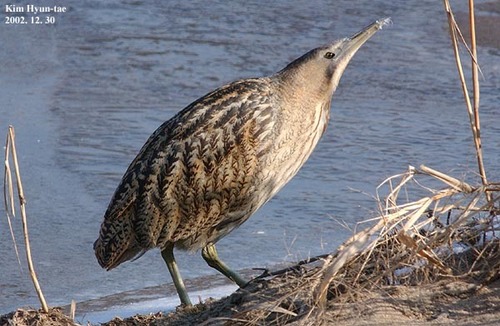 Eurasian Bittern
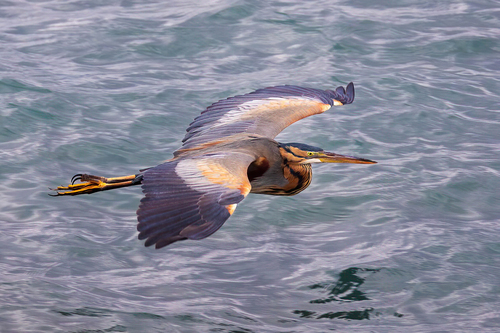 Purple Heron
In short
The most reliable field mark to separate Eurasian Bittern from Purple Heron is overall structure and plumage: Bitterns are thickset, heavily streaked and barred, with a cryptic buff-and-black pattern, while Purple Herons are slimmer, more elegant, and display a darker, reddish-brown and grey plumage. In flight, Bitterns show broad, rounded wings and a compact body, whereas Purple Herons look more elongated and slender, with a longer neck and legs trailing well behind. Juvenile Bitterns are paler and less distinctly marked but still lack the reddish and grey hues of Purple Heron. Both species can be secretive in reed beds, but their shape and coloration are distinctive when seen well.
Identification tips
- Overall Structure: Eurasian Bittern is thickset, with a short neck and compact body; Purple Heron is slender, with a long, snake-like neck and a more elongated appearance. This is often the quickest way to separate them, especially at a distance or in flight.
- Plumage Pattern: Bittern is buffy-brown with heavy black barring and streaking throughout, especially on the back, wings, and underparts. Purple Heron is darker, with reddish-brown and grey tones, and lacks the strong barring of Bittern.
- Head Markings: Bittern shows a yellowish-buff supercilium and a brownish-black moustachial stripe; Purple Heron has a black forehead/crown and a dark stripe down the back of the neck, ending in a slender crest.
- Neck Pattern: Bittern's neck is rusty-brown with faint barring and a buff throat with rusty-brown stripes; Purple Heron's neck is chestnut-buff with dark streaks and lines down the sides, and a paler front with streaked elongated feathers at the base.
- Bill and Legs: Bittern has a greenish-yellow bill and legs, with yellow soles; Purple Heron's bill is brownish-yellow (brighter in breeding adults), and legs are brown in front, yellowish behind.
- Flight Jizz: Bittern flies with broad, rounded wings and a compact body, neck extended at takeoff but quickly retracted; legs trail, but not as far as Purple Heron. Purple Heron flies with a more elongated shape, neck retracted, and legs extending well beyond the tail.
- Juvenile Plumage: Juvenile Bitterns are paler and less distinctly marked than adults but retain the overall barred/streaked look; Purple Heron juveniles (not detailed here) still show reddish and grey tones, never the cryptic buff-and-black of Bittern.
- Behavior When Disturbed: Bittern often freezes with bill pointed upwards, blending into reeds ('bitterning'); Purple Heron is more likely to slink away or fly off.
- Habitat Context: Both prefer reed beds, but Bittern is more strictly tied to dense reeds and is rarely seen in the open. Purple Heron may be seen walking on floating vegetation or bushes and is more likely to be seen in mixed heronries.
- Sociality: Bittern is usually solitary; Purple Heron may nest in colonies, sometimes with other herons.
- Leg Length in Flight: Purple Heron's legs trail conspicuously far beyond the tail; Bittern's legs trail but appear less exaggerated due to its bulkier body.
- Breast and Belly: Bittern's underparts are yellowish-buff with brown stripes; Purple Heron's breast is chestnut brown with some black, and belly/undertail coverts are black.
- Crest: Purple Heron has a slender, dangling crest (shorter than Grey Heron's); Bittern has elongated crown feathers that can be erected but lacks a true crest.
- Eye and Bare Skin: Bittern's eye is yellow, surrounded by greenish or bluish bare skin; Purple Heron's iris is yellow, with no mention of colored bare skin around the eye.
- Voice: If heard, Purple Heron's 'frarnk' is harsh and high-pitched but not diagnostic for Bittern separation; Bittern's booming call is not described here.
Size
Eurasian Bittern is the heavier and bulkier of the two, with an average body mass of about 2461.5 g [wikidata], and a length of 69–81 cm with a 100–130 cm wingspan [wikipedia]. Purple Heron, although longer (78–97 cm length, 120–152 cm wingspan), is much more slender, weighing only 0.5–1.35 kg [wikipedia]. In the field, Bittern appears robust and thick-necked, while Purple Heron is noticeably more gracile and 'snake-necked.'
Plumage
-
Juveniles: Juvenile Eurasian Bitterns are paler than adults, with less distinct markings, but still show the overall buff and black barred/streaked pattern. Juvenile Purple Herons are not described in detail here, but even young birds retain the reddish-brown and grey tones absent in Bittern.
-
Adults: Eurasian Bitterns have a cryptic plumage: black crown and nape, tawny-buff sides of head/neck with irregular black barring, and a mantle, scapulars, and back heavily barred and streaked with black. Underparts are yellowish-buff with brown stripes. The wings are pale rusty-brown, irregularly barred and mottled with black. Purple Herons are darker overall, with a black forehead/crown, dark stripe down the back of the neck, and a chestnut-buff neck with dark streaks. The mantle is oily brown, upperparts/tail are brownish grey, and the breast is chestnut brown with some black. The underparts are darker, especially the belly and undertail. Bill and legs are also different in tone: Bittern's are greenish-yellow, Purple Heron's are brownish-yellow (bill) and brown/yellowish (legs).
Behaviour
Eurasian Bittern is extremely secretive, usually solitary, and prefers to skulk in dense reed beds, often freezing with its bill pointed upwards ('bitterning') to blend in. It walks slowly and deliberately, rarely flying except when necessary, and then with broad, rounded wings and a retracted neck after takeoff. Purple Heron is also secretive and prefers reed beds, but is more likely to be seen walking on floating vegetation or even over bushes, using its long toes. Its flight is slow, with neck retracted and legs trailing far behind, and it appears more elongated and less robust than Bittern. Purple Heron seldom perches in trees, preferring terrestrial or reedbed sites.
Habitat
Both species favor reed beds and wetlands, but Eurasian Bittern is more strictly tied to dense, tall reeds and is rarely seen in the open except in severe weather. Purple Heron also breeds in reed beds and wetlands but may use canebrakes or low bushes near large lakes or extensive wetlands. In mixed heronries, Purple Heron may nest with other herons, while Bitterns are usually solitary nesters.
Voice
Vocalizations are not diagnostic for separation in the field based on these notes. Purple Heron's call is a harsh, quieter, and more high-pitched 'frarnk' compared to Grey Heron, but Bittern's booming call is not described here. Both are generally quiet and secretive.