

Emerald-spotted Wood-Dove vs Tambourine Dove
Turtur chalcospilos versus Turtur tympanistria
Play a quiz with Emerald-spotted Wood-Dove and Tambourine Dove
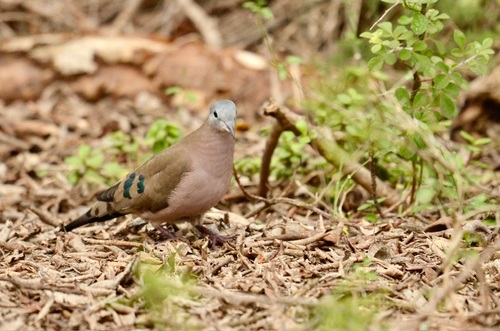 Emerald-spotted Wood-Dove
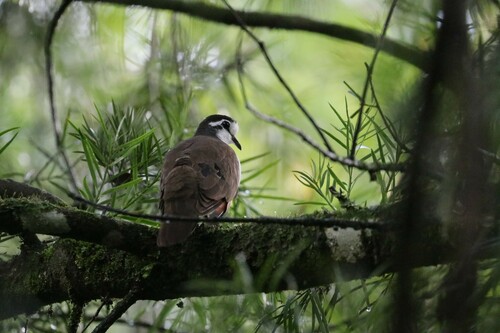 Tambourine Dove
In short
The most reliable field mark between Emerald-spotted Wood-Dove and Tambourine Dove is the color and pattern of the wing spots and underwing in flight: Emerald-spotted shows green metallic patches on the folded wing and lacks chestnut in the underwing, while Tambourine Dove has large dark purple patches on the folded wing and shows chestnut underwings in flight. Juveniles of both can be confusing, but the Tambourine is always paler below and has chestnut feather fringes. Structurally, Tambourine Dove is slightly larger and longer, with a whiter face and underparts in adult males, while Emerald-spotted is more uniformly pinkish below and lacks strong facial contrast. Habitat preference also helps: Emerald-spotted favors open, drier woodland, while Tambourine is a bird of dense, moist woodlands and thickets.
Identification tips
- In flight, check the underwing color: Tambourine Dove always shows chestnut primary flight feathers and underwings, while Emerald-spotted Wood-Dove lacks chestnut and has more uniform, pale underwings. This works for all ages and is the most reliable separation.
- Folded wing spots: Emerald-spotted shows green metallic patches on the folded wing; Tambourine Dove shows large dark purple patches. Green vs purple is subtle in poor light but diagnostic in good conditions.
- Juvenile/immature plumage: Juvenile Tambourine Doves have chestnut fringes to the feathers on the back, breast, and flanks, and are always paler below than Emerald-spotted. Emerald-spotted juveniles have buff fringes and dull green wing spots, but not chestnut.
- Facial pattern (adult males): Tambourine Dove has a striking white face with a black spot behind the eye; Emerald-spotted has a more uniform bluish-grey crown and lacks the white facial contrast.
- Underparts color: Emerald-spotted is mauve-pink below, fading to white on the belly; Tambourine Dove (male) is white below, female is white only on the belly with pale grey-brown breast and face.
- Crown color: Emerald-spotted has a bluish-grey crown; Tambourine Dove male has a grey crown, female has grey-brown, lacking blue-grey.
- Bill color: Emerald-spotted has a blackish bill with a red base; Tambourine Dove's bill is purple. This is subtle and hard to see at a distance.
- Eye ring and feet: Tambourine Dove has purple-red eye ring and feet, which may be visible at close range; Emerald-spotted's are not described as distinctive.
- Tail pattern: Emerald-spotted has blackish bands on the lower back and tail; Tambourine Dove's undertail is brown, with no mention of banding.
- Habitat context: In dense, moist woodland or lush gardens, expect Tambourine Dove; in open, drier woodland, Emerald-spotted is more likely.
- Behavior when flushed: Tambourine Dove tends to flush from dense cover and flies low and fast; Emerald-spotted may be seen foraging more openly or in small flocks at waterholes.
- Vocalizations: If heard, Emerald-spotted gives a complex, multi-part cooing sequence; Tambourine Dove repeats a simple 'du-du-du-du-du'.
- Sex differences: Both species are slightly duller in the female, but the contrast is stronger in Tambourine Dove, where the female lacks the white face and is more uniformly pale grey-brown.
- Size: Tambourine Dove is slightly larger and heavier, but this is not a reliable field mark unless both are seen together.
- Plumage variation: Emerald-spotted shows some geographical variation, but differences are clinal and not useful for separation from Tambourine Dove.
Size
Tambourine Dove is slightly larger and heavier (67g vs 56g) and about 2 cm longer (22 cm vs 20 cm) than Emerald-spotted Wood-Dove [wikidata]. Both are small, plump pigeons, but the difference is subtle and not always obvious in the field unless seen side by side. Structure is otherwise similar, with no strong differences in tail or bill shape noted.
Plumage
- Juvenile/immature: Both species have duller versions of adult wing spots, but Tambourine Dove juveniles show chestnut fringes to the feathers of the back, breast, and flanks, and are paler below than Emerald-spotted at all ages. Emerald-spotted immatures have duller green wing spots and buff fringes, but not chestnut.
- Adult male: Emerald-spotted has green metallic wing spots, a bluish-grey crown fading to pinkish-grey on the throat, and mauve-pink underparts; Tambourine has large dark purple wing patches, a white face with a black spot behind the eye, white underparts, and a grey crown.
- Adult female: Both are duller, but Tambourine female is white only on the belly, with pale grey-brown face and breast, and lacks the blue-grey crown of Emerald-spotted.
- In flight: Tambourine Dove shows chestnut primary flight feathers and underwings, while Emerald-spotted does not—this is a key separation point for all ages. Both have pale grey-brown upperparts, but the underwing color is diagnostic.
Behaviour
Both species are usually solitary or in small groups and forage on the ground for seeds. Tambourine Dove is shyer and more likely to be flushed from dense cover, flying low and fast; Emerald-spotted is less gregarious but may form flocks at waterholes. Both build flimsy stick nests and share incubation duties, but Tambourine Dove's nest is usually lower in dense thickets, while Emerald-spotted nests in trees or shrubs.
Habitat
Emerald-spotted Wood-Dove prefers open, drier deciduous woodland and second growth, avoiding evergreen rainforest and semidesert. Tambourine Dove is a bird of thick, moist woodlands, dense gardens, and plantations, and is absent from drier areas. If you find a small Turtur dove in dense, moist forest or lush gardens, it's much more likely to be Tambourine; in open, dry woodland, Emerald-spotted is expected.
Voice
Emerald-spotted Wood-Dove has a three-part call: two soft long coos, then a series of slow descending coos for about 10 seconds, ending with 4 seconds of rapid, fading coos. Tambourine Dove gives a persistently repeated 'du-du-du-du-du'. The difference is clear if the bird is vocalizing, but both can be quiet when flushed.
Emerald-spotted Wood-Dove · Tambourine Dove · My Tricky Birds