

Egyptian Vulture vs White-backed Vulture
Neophron percnopterus versus Gyps africanus
Play a quiz with Egyptian Vulture and White-backed Vulture
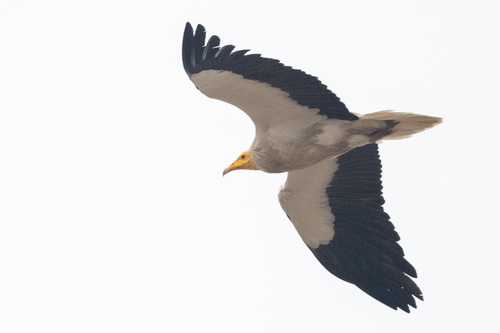 Egyptian Vulture
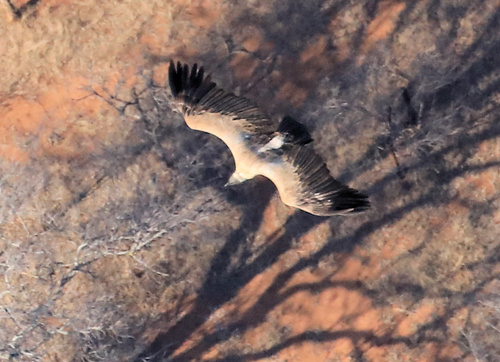 White-backed Vulture
In short
The most reliable field mark is the underwing and tail shape in flight: Egyptian Vulture (all ages) shows a strongly contrasting white body and coverts with black flight feathers and a wedge-shaped tail, while White-backed Vulture is overall much darker with only a pale back and lacks a wedge-shaped tail. Juvenile Egyptian Vultures are dark brown but still show a smaller, more pointed-winged profile and wedge tail, unlike the bulkier, broad-winged White-backed Vulture. Structure is key: Egyptian Vulture is much smaller and more slender, with a long, slim bill and pointed wings, while White-backed is a heavy, broad-winged vulture with a short tail and thick neck. Perched, Egyptian Vulture's bare yellow face and pink legs contrast with the White-backed's downy head and white neck ruff. Age-related confusion is most likely with juvenile birds, but flight shape and underwing pattern remain the best separation clues.
Identification tips
- Underwing pattern in flight (all ages): Egyptian Vulture shows a striking contrast between white coverts/body and black flight feathers; White-backed Vulture is uniformly dark below except for a pale back, with no sharp underwing contrast.
- Tail shape: Egyptian Vulture has a long, wedge-shaped tail visible both perched and in flight; White-backed Vulture's tail is short and squared.
- Wing shape: Egyptian Vulture's wings are pointed and relatively narrow; White-backed Vulture has very broad, paddle-shaped wings with rounded tips.
- Size and bulk: Egyptian Vulture is much smaller, lighter, and more slender; White-backed is heavy, bulky, and imposing, especially when perched.
- Head and face: Egyptian Vulture has a bare yellow face and throat (adults), with a long, slim bill; White-backed has a downy, unfeathered head, a white neck ruff, and a stouter bill.
- Leg color: Egyptian Vulture adults have pink legs; White-backed Vulture's legs are not noted as pink and are less conspicuous.
- Plumage color (adults): Egyptian Vulture is white (often rusty-stained) with black flight feathers; White-backed is dark brown with only the back being whitish.
- Juvenile confusion: Juvenile Egyptian Vultures are dark but remain smaller, with pointed wings and wedge tail; juvenile White-backed Vultures are also dark but are much larger, with broad wings and short tail.
- Perched jizz: Egyptian Vulture appears slim, with a long neck and wedge tail; White-backed Vulture is hunched, thick-necked, and heavy-bodied.
- Flight style: Egyptian Vulture soars with agility and buoyancy, often alone or in pairs; White-backed Vulture soars in large groups, with a heavier, steadier flight.
- Social behavior: White-backed Vultures gather in large numbers at carcasses; Egyptian Vultures are more solitary or in pairs, rarely in large groups.
- Habitat: Egyptian Vulture is likely in arid, open, or rocky areas, sometimes near people; White-backed is in African savannahs with large mammals.
- Geographic range: Egyptian Vulture is found from Iberia to India and parts of Africa; White-backed is only in sub-Saharan Africa.
- Bill shape: Egyptian Vulture's bill is long and slender; White-backed's is shorter and more robust.
- Facial skin: Only Egyptian Vulture has extensive bare yellow skin on the face and throat (adults); White-backed has a downy head and white ruff.
Size
Egyptian Vulture is much smaller and lighter (about 2 kg body mass) compared to the White-backed Vulture, which is a true heavyweight (4.2–7.2 kg, per Wikipedia). White-backed Vulture is also longer (78–98 cm vs. Egyptian Vulture's smaller size) and has a much broader wingspan (1.96–2.25 m). In the field, White-backed appears massive and bulky, while Egyptian Vulture is noticeably daintier and more agile, with a slim silhouette.
Plumage
-
Juvenile/immature birds: Juvenile Egyptian Vultures are blackish or chocolate brown with black and white patches, but retain the species' small size, pointed wings, and wedge-shaped tail. Juvenile White-backed Vultures are also largely dark, but are much bulkier, with broader wings and a short, squared tail. Underwing contrast is always greater in Egyptian Vulture, even in young birds.
-
Adults: Adult Egyptian Vultures are white overall with black flight feathers, often stained rusty or brownish from soil, and have a bare yellow face and pink legs. The underwing is strikingly white with black primaries and secondaries. White-backed Vulture adults are dark brown overall, with only the back being whitish; the rest of the plumage, including the underwing, is much darker. White-backed has a white neck ruff and a downy, unfeathered head, but lacks the bare yellow face of Egyptian Vulture.
-
Tail: Egyptian Vulture's tail is wedge-shaped and longer, while White-backed's tail is short and squared off.
-
Bill and face: Egyptian Vulture has a long, slender bill and bare yellow facial skin; White-backed has a stouter bill and a downy head with a white ruff.
Behaviour
Egyptian Vultures often soar singly or in pairs, using thermals and showing agile, buoyant flight with pointed wings and a distinctive wedge tail. White-backed Vultures are highly social, often seen circling in large groups and feeding en masse at carcasses. Their flight is heavier, with broad wings and a more labored soaring style. Egyptian Vultures may be seen walking on the ground, sometimes using tools, while White-backed Vultures are more likely to be seen in large gatherings at kills.
Habitat
Egyptian Vulture has a broad range from Iberia and North Africa to India and West Asia, favoring open country, cliffs, and arid regions, often near human settlements. White-backed Vulture is strictly sub-Saharan African, found in wooded savannahs and open plains, especially where large mammals are present. White-backed is the most common vulture in Africa (though now declining), while Egyptian Vulture is much scarcer and more localized in Africa.