

Egyptian Vulture vs European Honey-buzzard
Neophron percnopterus versus Pernis apivorus
Play a quiz with Egyptian Vulture and European Honey-buzzard
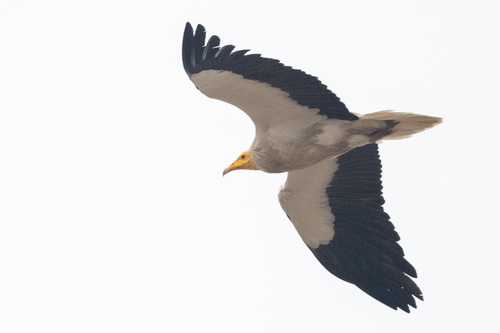 Egyptian Vulture
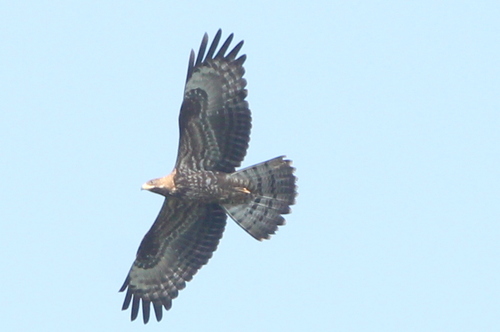 European Honey-buzzard
In short
The most reliable field mark between Egyptian Vulture and European Honey-buzzard is the vulture’s striking black-and-white underwing pattern and wedge-shaped tail, especially obvious in flight. Juvenile Egyptian Vultures are dark brown, while all ages of Honey-buzzard show barred tails and lack the vulture’s pointed wings and wedge tail. Structurally, Egyptian Vulture is bulkier with a small head and long, slender bill, while Honey-buzzard is long-necked, small-headed, and soars on flat, straight wings. Both can appear pale at a distance, but their flight profiles and wing patterns are distinct when seen well.
Identification tips
- Flight silhouette: Egyptian Vulture has pointed wings and a wedge-shaped tail; Honey-buzzard has long, straight wings held flat and a long, rounded tail with a squared-off tip.
- Underwing pattern: Adult Egyptian Vulture shows striking black flight feathers contrasting with white coverts; Honey-buzzard’s underwing is more uniform, with subtle barring and no sharp contrast.
- Tail pattern: Honey-buzzard’s tail is long and shows two narrow dark bars and a broad subterminal bar (all ages); Egyptian Vulture’s tail is wedge-shaped and lacks strong barring.
- Head and bill: Egyptian Vulture has a small, bare yellow face and a long, slender, hooked bill; Honey-buzzard’s head is feathered, small, and projects forward in flight.
- Leg color: Adult Egyptian Vulture has pink legs, juveniles grey; Honey-buzzard’s legs are not as conspicuous.
- Plumage by age: Juvenile Egyptian Vulture is dark brown with patchy black and white, never resembling the barred, buzzard-like juvenile Honey-buzzard.
- Facial skin: Only Egyptian Vulture has bare, yellow facial skin extending to the throat; Honey-buzzard’s face is fully feathered.
- Soaring style: Egyptian Vulture soars with wings slightly raised and often glides with wings in a shallow V; Honey-buzzard soars on flat wings, often with a slight downward kink at the wrist.
- Perched posture: Egyptian Vulture appears hunched with a long neck and hackled throat feathers; Honey-buzzard is more upright and slim.
- Habitat context: Egyptian Vulture is rarely in woodland; Honey-buzzard is rarely far from forest.
- Sex differences: Honey-buzzard sexes differ (male blue-grey head, female brown); Egyptian Vulture sexes are similar except for slightly deeper orange facial skin in breeding males.
- Bill color: Egyptian Vulture’s bill is black (nominate) or pale/yellowish (Indian ssp.); Honey-buzzard’s bill is always dark and less prominent.
- Ground behavior: Honey-buzzard may be seen digging on the forest floor; Egyptian Vulture is more likely at carcasses or perched on rocks.
- Vocalization: Only Honey-buzzard gives a clear 'peee-lu' call, but both are usually silent.
- Size impression: Egyptian Vulture is much heavier and bulkier; Honey-buzzard is lighter and more graceful in flight.
Size
Egyptian Vulture is substantially heavier (about 1977 g) and bulkier than European Honey-buzzard (which is much lighter, at 440–1050 g [wikipedia]). The vulture’s body is stockier, with a heavier bill and longer legs, while Honey-buzzard is more slender, with a longer wingspan (130–150 cm) and a more elongated silhouette in flight. The vulture’s size is more comparable to a small eagle, while Honey-buzzard is closer to a large buzzard or kite.
Plumage
-
Juvenile/immature birds: Juvenile Egyptian Vultures are blackish or chocolate brown overall, with black and white patches, lacking the adult’s white body and black flight feathers. This can cause confusion with dark raptors, but the vulture’s structure (small head, wedge tail, long legs) remains distinctive. Juvenile Honey-buzzards resemble Common Buzzard in plumage, with brown upperparts and a barred tail (usually two narrow dark bars and a broad subterminal bar), but never show the vulture’s wedge tail or pointed wings.
-
Adults: Adult Egyptian Vultures are white with black flight feathers, but often appear rusty or dirty due to soil staining. Their underwings are sharply patterned black-and-white, and the tail is wedge-shaped. Honey-buzzards are variable brownish above and below, with a longer, barred tail and no strong underwing contrast; males have a blue-grey head, females brown, and both have a more uniform appearance in flight. The vulture’s face is bare and yellow, while Honey-buzzard has a feathered head and no bare skin.
Behaviour
Egyptian Vulture is often seen soaring high in thermals during the warmest part of the day, with a distinctive, buoyant flight and frequent gliding. It is a scavenger, typically found in open country, cliffs, or near human habitation. Honey-buzzard is more secretive, spending much time in or over woodland, and is most conspicuous during migration or spring display, when it soars on flat wings and may perform wing-clapping. On the ground, Honey-buzzard excavates wasp nests, while Egyptian Vulture is rarely seen foraging on the ground except at carcasses.
Habitat
Egyptian Vulture favors open landscapes, rocky areas, and cliffs, often near settlements or farmland, and is rarely found deep in woodland. European Honey-buzzard breeds in extensive woodlands and forests, and is much more likely to be seen over or near trees. If you see a pale raptor soaring over dense forest, Honey-buzzard is more likely; in open, arid, or rocky areas, especially near human activity, Egyptian Vulture is the better bet.
Voice
Honey-buzzard gives a clear 'peee-lu' call, especially in display, but is generally silent. Egyptian Vulture is mostly silent and does not have a distinctive call in the field. Voice is rarely useful for separation.