

Egyptian Goose vs Wood Duck
Alopochen aegyptiaca versus Aix sponsa
Play a quiz with Egyptian Goose and Wood Duck
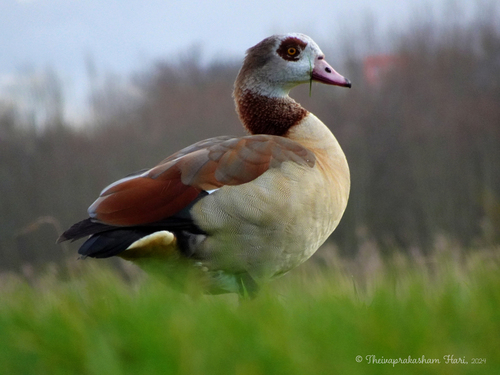 Egyptian Goose
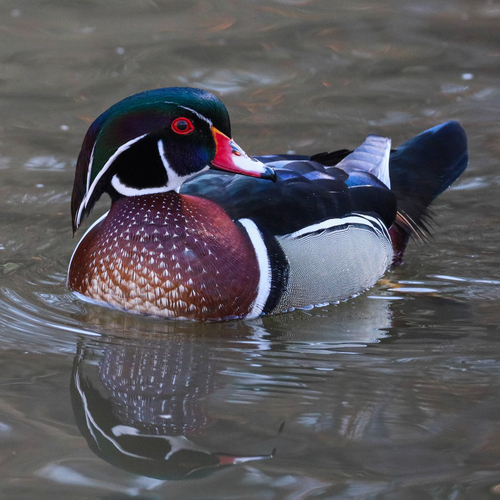 Wood Duck
In short
The most reliable field mark between Egyptian Goose and Wood Duck is overall size and structure: Egyptian Goose is much larger, heavier-bodied, and goose-like, while Wood Duck is a compact, crested duck. In flight, adult Egyptian Geese show extensive white on the upperwing, usually hidden at rest, while Wood Ducks have a blue-green speculum with a white trailing edge. Adult male Wood Ducks are unmistakably colorful with iridescent plumage and a crested head, while Egyptian Geese are more uniform brownish or grayish with a dark eye patch and chest spot. Females and immatures are trickier, but the size, head shape, and wing pattern remain key. Voice and habitat can also help, but size and structure are the most immediate clues.
Identification tips
- Size and Structure: Egyptian Goose is much larger and heavier than Wood Duck. If the bird looks goose-sized, with a thick neck and heavy body, it's Egyptian Goose. Wood Duck is compact, duck-sized, and has a shorter neck.
- Head Shape and Crest: Wood Duck (both sexes) has a noticeable crest, giving the head a peaked look. Egyptian Goose has a smooth, rounded head with no crest.
- Adult Male Plumage: Male Wood Duck is extremely colorful with iridescent green, purple, and chestnut, a white neck flare, and red eyes—never matched by Egyptian Goose. Egyptian Goose is always brownish or grayish, with a dark eye patch and chest spot.
- Female/Immature Plumage: Female and immature Wood Ducks are brownish with a white eye-ring and throat, and a crested head. Egyptian Goose (all ages/sexes) has a dark eye patch and chest spot, and lacks a crest or white eye-ring.
- Upperwing Pattern in Flight: Egyptian Goose (all ages) shows a large white area on the upperwing, visible in flight or when agitated. Wood Duck (all ages) shows a blue-green speculum with a white trailing edge—never a large white wing patch.
- Perched/Wing Coverts: At rest, Egyptian Goose's white wing patch is hidden by coverts and not visible unless the bird is displaying or in flight. Wood Duck's speculum is also mostly hidden at rest, but the crested head and compact shape remain distinctive.
- Bill Shape and Color: Egyptian Goose has a relatively heavy, goose-like bill, while Wood Duck has a shorter, more delicate duck bill. Male Wood Duck has a red bill; Egyptian Goose's bill is pinkish but larger and less contrasting.
- Leg Color and Posture: Egyptian Goose often stands upright on long, pale legs and walks on land more than Wood Duck. Wood Duck sits lower and is less likely to be seen walking far from water.
- Voice: Egyptian Goose is loud and harsh, especially the female. Wood Duck is higher-pitched and more musical, with distinctive whistles and squeals.
- Habitat Context: Egyptian Goose is usually in open parkland, lakes, or grassy areas, often grazing. Wood Duck is almost always in wooded wetlands, forested ponds, or rivers, and frequently perches in trees.
- Behavior: Egyptian Goose is aggressive and territorial, sometimes chasing other birds in flight. Wood Duck is more secretive and agile, often seen perching or flying quickly through trees.
- Sexual Dimorphism: Wood Duck shows strong sexual dimorphism (male vs. female), while Egyptian Goose sexes are similar in plumage, differing mainly in size.
- Plumage Tone Variation: Egyptian Goose varies in brown/gray tone, but not by age or sex. Wood Duck females and immatures are always brownish with a white eye-ring.
- Local Abundance: In North America, Wood Duck is common; Egyptian Goose is rare or feral. In Europe, Egyptian Goose is increasingly common in parks, Wood Duck is rare or ornamental.
- Quiz Pitfall: Immature Wood Ducks and female Wood Ducks can be confused with Egyptian Goose at a distance, but the size, head shape, and presence/absence of crest and eye-ring are reliable separators.
Size
Egyptian Goose is substantially larger and heavier than Wood Duck. Egyptian Goose measures 63–73 cm (25–29 in) in length and weighs 1,500–2,348 g (3.3–5.2 lbs) [wikipedia], while Wood Duck is only 47–54 cm (19–21 in) long and weighs 454–862 g (16–30 oz) [wikipedia]. In the field, Egyptian Goose looks bulky and goose-like, with a large body and thick neck, whereas Wood Duck is noticeably smaller, more compact, and duck-shaped. The difference is obvious in direct comparison or with nearby waterfowl for scale.
Plumage
-
Juvenile/Immature/Non-breeding: Egyptian Goose does not have age-specific upperwing patterns; both young and adults show a large white area on the wing, but this is usually hidden at rest and only visible in flight or when the bird is agitated. Wood Duck immatures and females show a blue-green speculum with a white trailing edge, and both sexes have crested heads. Female and immature Wood Ducks are brownish with a white eye-ring and throat, lacking the bold chest spot and eye patch of Egyptian Goose.
-
Adult breeding: Male Wood Duck is extremely colorful with iridescent green, purple, and chestnut plumage, a white neck flare, and red eyes—completely unlike the more subdued, brownish or grayish Egyptian Goose. Female Wood Duck is more subtle but still has a crested head and white eye-ring. Egyptian Goose adults are variable in tone but always have a dark eye patch and chest spot, and lack any iridescence or crest. In flight, the Egyptian Goose's white wing patch is diagnostic for all ages and sexes, while Wood Duck always shows the blue-green speculum with a white border.
Behaviour
Egyptian Goose is heavy and goose-like in flight, with slow, strong wingbeats and a tendency to display white wing patches when alarmed or aggressive. It is often seen walking on land, grazing, or swimming with a horizontal posture. Wood Duck is agile and quick, perching in trees and flying with rapid, shallow wingbeats. Wood Ducks are more likely to be seen perched in trees or on nest boxes, and their flight is lighter and more duck-like. Egyptian Goose is aggressive and territorial, especially during breeding, and may chase intruders in aerial 'dogfights.'
Habitat
Egyptian Goose is native to Africa but has established feral populations in Europe and elsewhere, often in parklands, lakes, and open water with grassy margins. It prefers open habitats and is frequently seen grazing on land. Wood Duck is native to North America and prefers wooded swamps, forested ponds, and rivers, often perching or nesting in trees. Wood Ducks are closely tied to forested wetlands and are less likely to be seen in open, grassy areas away from cover. Habitat context is a strong clue: Egyptian Goose in open parkland, Wood Duck in wooded wetlands.
Voice
Egyptian Goose vocalizations are sexually dimorphic: males give a hoarse, subdued quack or a loud, breathy call in rapid sequence, while females are much noisier with a raucous quack, especially when aggressive. Wood Duck males produce a rising whistle ('jeeeeee'), and females give a drawn-out, rising squeal ('do weep do weep') when flushed, plus a sharp alarm call ('cr-r-ek'). Wood Duck calls are higher-pitched and more musical, while Egyptian Goose is louder, harsher, and more goose-like.