

Eastern Subalpine Warbler vs Dartford Warbler
Curruca cantillans versus Curruca undata
Play a quiz with Eastern Subalpine Warbler and Dartford Warbler
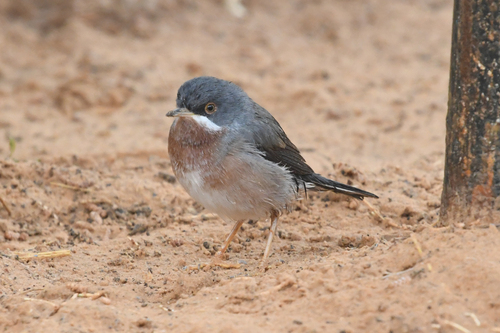 Eastern Subalpine Warbler
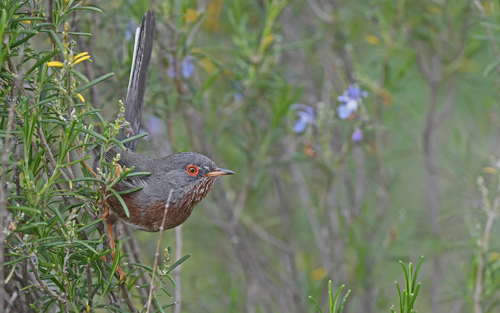 Dartford Warbler
In short
The most reliable field mark to separate Eastern Subalpine Warbler from Dartford Warbler is the sharply demarcated, brick-red throat and breast (with a white belly) and prominent white submoustachial stripe on adult male Eastern Subalpine, versus the more uniformly dull reddish underparts and spotted white throat of Dartford. Dartford Warbler also stands out by its distinctly long, thin tail and overall more muted, blended coloration. Females and immatures of both can be tricky, but Dartford’s longer tail, red eye, and less contrasting underparts are helpful. Both are small, southern European warblers, but their structure, face pattern, and underpart contrast are key in the field.
Identification tips
- Tail Length and Shape: Dartford Warbler has a much longer, thinner tail than Eastern Subalpine Warbler. This is the single most consistent structural difference in all ages and sexes; Dartford often cocks or fans its tail, while Subalpine’s tail is shorter and less expressive.
- Adult Male Underparts: Eastern Subalpine shows brick-red restricted to the throat and breast, sharply set off from a white belly and paler flanks. Dartford’s reddish underparts are duller, less sharply demarcated, and extend further down the body, with a dirty white belly patch.
- Face Pattern (Adult Male): Subalpine males have a blackish mask on the lores and ear-coverts and a broad white submoustachial stripe (moustache). Dartford lacks a strong mask and has no bold white stripe, but does show a red eye and a less defined face.
- Throat Markings: Dartford Warbler (both sexes) shows white spots or speckles on the reddish throat; Subalpine lacks these, with a clean, unspotted brick-red throat in males.
- Eye Color: Dartford Warbler has a distinctive red eye and red eye-ring, visible at close range. Subalpine’s eye is less striking and does not show a red ring.
- Upperparts Color: Subalpine males are deeper blue-grey above, while Dartford is grey-brown or sometimes bluish-grey, but always duller and more blended with the rest of the plumage.
- Female and Immature Pitfalls: Both species’ females are browner above and paler below, but Dartford is overall duller and less contrasting, with a less marked face and longer tail. Subalpine females may show a pink flush below and a more contrasting face pattern.
- Jizz and Posture: Dartford’s longer tail gives it a more elongated, sometimes top-heavy look, especially when perched or moving through low vegetation. Subalpine is more compact and active, with a shorter tail and less skulking behavior.
- Habitat Context: If seen in classic heathland or gorse, especially in western Europe, Dartford is more likely. Subalpine prefers bushy, shrubby slopes in southern Europe, often away from pure heath.
- Flight Behavior: Dartford tends to fly low and quickly between bushes, often dropping into cover. Subalpine is more likely to flit openly between shrubs.
- Underpart Contrast: Subalpine’s underparts show a sharp boundary between brick-red breast and white belly, while Dartford’s underparts transition more gradually and are less cleanly separated.
- Bill Shape: Both have thin, pointed bills, so this is not a useful separator.
- Vocalization: Subalpine’s song is described as fast and rattling (like Lesser Whitethroat), but Dartford’s song is not detailed here; use voice only with caution.
- Seasonal Movement: Dartford is resident in much of its range and may be seen year-round, while Subalpine is migratory and more likely in southern Europe during the breeding season.
- Juvenile Plumage: No distinctive upperwing or flight pattern differences are described for juveniles, so rely on structure and face pattern for immatures.
Size
Both species are small warblers, but Dartford Warbler is slightly larger and noticeably longer-tailed. Dartford averages about 13 cm in length, with a long, thin tail that is proportionally longer than Eastern Subalpine Warbler’s. The Subalpine Warbler is compact and short-tailed by comparison, giving a different overall shape and jizz, especially when perched or in flight. Bill shape is similar (thin, pointed), so tail length and body proportions are more useful for size and structure.
Plumage
No distinctive juvenile or immature upperwing pattern is described for either species, so focus is on adult and female/immature plumage.
- Adult Male Eastern Subalpine Warbler: Deep blue-grey upperparts, blackish mask on lores and ear-coverts, brick-red throat and breast sharply set off from a white belly, paler flanks, and a broad white submoustachial stripe. The reddish is confined to the throat and breast, not extending onto the belly or flanks.
- Adult Male Dartford Warbler: Grey-brown upperparts (sometimes bluish- or brownish-grey), dull reddish-brown underparts that are less sharply demarcated and more extensive, dirty white patch on the belly, and a reddish throat with white spots. The face lacks a strong white submoustachial stripe but shows a red eye and a less defined mask.
- Females and Juveniles: Both are browner above and paler below, but Dartford females are duller, with a browner-grey back and paler, less marked underparts. Both sexes of Dartford show white throat spots, but these are smaller and less distinct in females. Subalpine females are greyer on the head and may show a pink flush below, with a more contrasting face pattern than Dartford.
- Tail: Dartford’s tail is much longer and thinner, often held cocked, and is a key structural mark in all plumages.
Behaviour
Dartford Warbler is more likely to be seen skimming low over heath or perched with its long tail cocked, often flicking or fanning it. It tends to skulk in dense, low vegetation but may sing from exposed perches. Eastern Subalpine Warbler is also a bush-dweller but is generally more active and less skulking, often seen flitting through low shrubs and showing a more compact, energetic jizz. Both are insectivorous, but Dartford’s behavior is more secretive and tail-focused.
Habitat
Eastern Subalpine Warbler breeds in the southernmost parts of Europe, favoring dry, open country with bushes or low shrub for nesting, often on hillsides. Dartford Warbler is found in the warmer parts of western Europe and northwestern Africa, with a strong preference for heathland, gorse, and dry scrub, especially in western and southern Europe. While both overlap in Mediterranean-type habitats, Dartford is more strictly associated with heath and gorse, and is resident in much of its range, whereas Subalpine is more migratory and favors bushier, less open habitats.
Voice
Eastern Subalpine Warbler’s song is fast and rattling, similar to Lesser Whitethroat, but specific details are not provided for direct comparison. Dartford Warbler’s vocalizations are not described in the notes, so voice is not reliably diagnostic based on the available information.
Eastern Subalpine Warbler · Dartford Warbler · My Tricky Birds