

Eastern Orphean Warbler vs Rüppell's Warbler
Curruca crassirostris versus Curruca ruppeli
Play a quiz with Eastern Orphean Warbler and Rüppell's Warbler
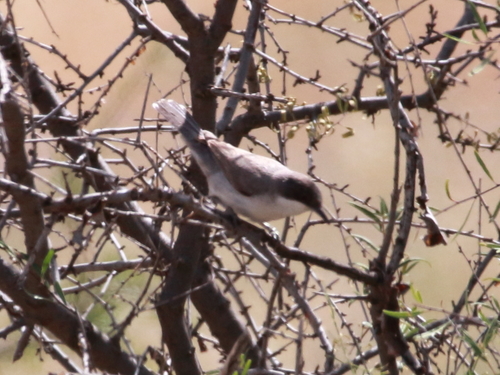 Eastern Orphean Warbler
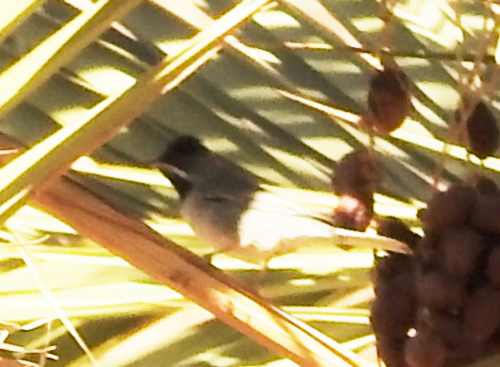 Rüppell's Warbler
In short
The most reliable field mark to separate Eastern Orphean Warbler from Rüppell's Warbler is the male's head and throat pattern: male Rüppell's shows a black head and throat sharply divided by a white 'moustache' (malar streak), while male Eastern Orphean has a dark grey head with a black mask and white throat, lacking the crisp malar division. Both species have plain grey backs and pointed bills, but iris color and leg color differ: Eastern Orphean males have a white iris and black legs, while Rüppell's has red eyes and brown legs. Females and immatures are trickier, but Rüppell's is generally slimmer and paler below, with a greyer head and a less contrasting throat. Both breed in overlapping regions, but Eastern Orphean is larger and has a richer, more varied song.
Identification tips
- Male head and throat pattern: Male Rüppell's Warbler shows a black head and throat sharply divided by a white malar streak ('moustache'), while male Eastern Orphean Warbler has a dark grey head with a black eye mask and a white throat, lacking the crisp malar division. This is the single most reliable mark in adult males.
- Iris color: Adult male Eastern Orphean Warbler has a white iris, while Rüppell's Warbler has red eyes. Females and immatures of Eastern Orphean have dark irises, so this mark is best for adult males.
- Leg color: Eastern Orphean Warbler has black legs, while Rüppell's Warbler has brown legs. This can be subtle but is useful in good light.
- Bill structure: Both have long, pointed bills, but Eastern Orphean's bill may appear slightly heavier, matching its larger size.
- Size and structure: Eastern Orphean Warbler is distinctly larger and bulkier than Rüppell's, which is slimmer and more delicate. This is especially apparent when seen side-by-side or with experience.
- Back color: Both have plain grey backs, but females and immatures of both species may show a brownish tinge. This is not a strong separator.
- Underparts: Male Rüppell's is paler grey below, while female and immature Eastern Orphean Warblers have reddish underparts. Rüppell's females are paler and greyer below.
- Head color in females/immatures: Female and immature Eastern Orphean Warblers have a paler head, while female Rüppell's have a grey head and pale throat, lacking strong contrast.
- Eye mask: Male Eastern Orphean Warbler shows a black eye mask, while Rüppell's male has a black head and throat with a white malar, not a mask.
- Song: Eastern Orphean's song is rich and varied, with warbling and scolding notes; Rüppell's is a slower, deeper rattle. Use song for confirmation if visual marks are ambiguous.
- Habitat and range: Both can occur in the same region, but Eastern Orphean is more widespread and may be found further east and south.
- No distinctive wing pattern: Neither species shows a unique juvenile or immature upperwing pattern, so do not rely on flight feather markings for separation.
- Perched vs. in flight: Both species are most easily separated when perched and the head/throat pattern is visible. In flight, size and structure may help, but are less reliable than plumage.
- Pitfalls: Females and immatures are easily confused due to similar back and underpart tones; focus on iris color (if visible), size, and subtle head/throat differences.
- Context: If seen in Greece or western Turkey, both are possible; further east, Rüppell's becomes less likely and Eastern Orphean more likely.
Size
Eastern Orphean Warbler is noticeably larger, at 15–16 cm in length, making it one of the largest typical warblers. Rüppell's Warbler is similar in size to Sardinian Warbler but slimmer, and is distinctly smaller than Eastern Orphean. This size difference can be apparent in direct comparison or with experience, especially in the field when perched or in flight.
Plumage
Adult male Eastern Orphean Warbler has a plain grey back, dark grey head with a black eye mask, white throat, and a white iris. In contrast, male Rüppell's Warbler has a black head and throat separated by a sharp white malar streak, with a plain grey back and paler grey underparts, plus red eyes. Female and immature Eastern Orphean Warblers have a paler head, brownish-tinged grey back, and reddish underparts, with a dark iris. Female Rüppell's are greyer-headed with a pale throat and brownish-tinged grey back, but lack the strong head pattern of males. No distinctive juvenile or immature upperwing patterns are noted for either species, so separation relies on head, iris, and throat features across all ages.
Behaviour
Both species are typical Curruca warblers and behave similarly, foraging in open woodland and shrubbery. Eastern Orphean Warbler may appear bulkier and more robust in posture, while Rüppell's is slimmer and more agile. No striking behavioral differences are noted that are diagnostic in the field.
Habitat
Both species breed in southeastern Europe and the eastern Mediterranean, with some overlap in Greece and Turkey. Eastern Orphean Warbler has a broader breeding range, extending through the Balkans, the Caucasus, and into Central Asia, and winters in sub-Saharan Africa. Rüppell's Warbler breeds mainly in Greece, Turkey, and nearby islands, wintering in northeast Africa. Both favor open deciduous woodland and shrubland, so habitat is not a strong separator where ranges overlap.
Voice
Eastern Orphean Warbler has a rich, varied warbling song with scolding notes, approaching the Nightingale in complexity and variety. Rüppell's Warbler's song is a slower, deeper rattle, less varied than Eastern Orphean and deeper than Sardinian Warbler. Song can be helpful for separation if heard well, with Eastern Orphean being more melodious and complex.
Eastern Orphean Warbler · Rüppell's Warbler · My Tricky Birds