

Eastern Meadowlark vs Chihuahuan Meadowlark
Sturnella magna versus Sturnella lilianae
Play a quiz with Eastern Meadowlark and Chihuahuan Meadowlark
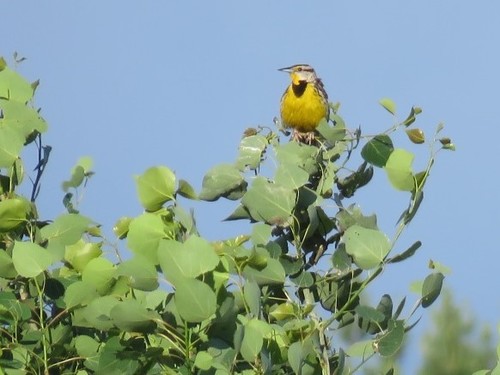 Eastern Meadowlark
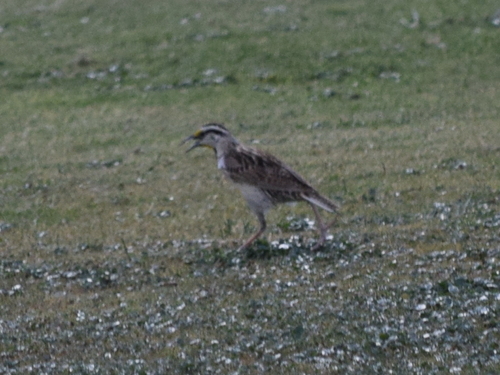 Chihuahuan Meadowlark
In short
The most reliable field mark between Eastern Meadowlark and Chihuahuan Meadowlark is the color and pattern of the flanks and head, especially in adults: Eastern Meadowlark shows more yellow-brown tones on the flanks and more distinct head striping, while Chihuahuan Meadowlark has whiter flanks with fine streaks and a unique head pattern with a dark yellow supercilium. Juveniles of both are similar, but Chihuahuan Meadowlark juveniles lack the black breast 'V' and appear buffier overall. Tail pattern in flight is also useful: Chihuahuan Meadowlark has more white in the outer tail feathers. Both are very similar in size and structure, so careful attention to subtle plumage and head details is essential. Habitat and range overlap is limited but can help in some regions.
Identification tips
- Flank color and streaking (adults): Eastern Meadowlark usually shows more yellow-brown on the flanks with bold black streaks, while Chihuahuan Meadowlark has whiter flanks with finer, thin brown streaks. This is most reliable on perched birds in good light.
- Head pattern (adults): Eastern Meadowlark's head is striped with light brown and black, giving a more contrasting, streaked look. Chihuahuan Meadowlark has a dark brown crown with a pale central stripe, a dark yellow supercilium from bill to eye (becoming whitish behind), and a dark line from eye to nape, creating a more patterned but less sharply streaked appearance.
- Tail pattern in flight: Chihuahuan Meadowlark shows more white in the outer tail feathers (four pairs mostly white, inner two pairs brown and barred), which may be visible in flight or when the tail is spread. Eastern Meadowlark's tail is less extensively white, with more brown and black streaking overall.
- Juvenile plumage: Juvenile Chihuahuan Meadowlark is buffier overall, with less distinct barring above and paler yellow below. Crucially, juveniles lack the black 'V' on the breast, instead showing brownish mottling. Eastern Meadowlark juveniles are similar but typically have more distinct head striping and may show a faint or partial 'V'.
- Breast 'V': Both adults have a black 'V' on the breast, but this is missing in juvenile Chihuahuan Meadowlark. If you see a juvenile with a mottled breast and no 'V', favor Chihuahuan.
- Bill color (juveniles): Juvenile Chihuahuan Meadowlark has a pinkish buff bill, legs, and feet, while adults have a black or dusky maxilla and bluish gray mandible. Eastern Meadowlark's bill is long and pointed but less is said about color in juveniles.
- Upperparts: Both species have brown upperparts with black streaks, but Chihuahuan Meadowlark's back and scapular feathers have white edges, which may give a slightly paler, more patterned look.
- Supercilium: Chihuahuan Meadowlark's supercilium is dark yellow from bill to eye, then whitish behind, while Eastern Meadowlark's head stripes are more uniform and less sharply divided.
- Leg color: Chihuahuan Meadowlark adults have dusky pinkish legs and feet, but this is subtle and rarely diagnostic in the field.
- Habitat and range: If you are in the Chihuahuan Desert region of the southwestern US or northern Mexico, Chihuahuan Meadowlark is more likely. In the eastern US, Eastern Meadowlark is expected. In overlap zones, rely on plumage.
- Sex differences: Both species are sexually monomorphic in plumage, but females are smaller. This is not useful for field ID.
- Seasonal changes: Eastern Meadowlark in nonbreeding plumage has more yellow-brown on the flanks and more distinct head striping, which can help in fall and winter.
- Song: Not diagnostic between these two based on available notes; do not rely on voice unless you have local experience or recordings.
- Flock behavior: Both species may feed in flocks in winter, so group size or behavior is not a separator.
- When in doubt: Focus on flank color, head pattern, and tail pattern in flight or when the tail is spread. Juvenile breast pattern is also a key clue.
Size
Both species are very similar in size and structure, with only minor differences: Eastern Meadowlark ranges from 19–28 cm in length and 76–150 g in mass, while Chihuahuan Meadowlark is about 25 cm long and weighs 77–130 g. Females are smaller in both species, but this is not a reliable field mark. Overall, size is not a useful separator in the field.
Plumage
Adult Eastern Meadowlark has yellow underparts with a black 'V' on the breast, white flanks with black streaks, and a head with distinct light brown and black striping. In nonbreeding plumage, the flanks are more yellow-brown and the head striping becomes more pronounced. Chihuahuan Meadowlark adults also have a yellow underbody and a black 'V', but their flanks and undertail coverts are whiter with thin dark brown streaks, and the head pattern is unique: a dark brown crown with a pale central stripe, a dark yellow supercilium from bill to eye (whitish behind), and a dark line from eye to nape. The outer tail feathers are mostly white in Chihuahuan, while the inner two pairs are brown and barred. Juveniles of both species are duller and buffier, but Chihuahuan Meadowlark juveniles lack the black 'V' and instead show brownish mottling on the breast. Their upperparts are less distinctly barred and their yellow is paler. Both species share a long, pointed bill and similar brown, streaked upperparts, but the subtle differences in flank color, head pattern, and tail are key.
Behaviour
Both species forage on the ground or in low vegetation, probing with their bills for insects and seeds. They often feed in flocks in winter. Behavioral differences are not emphasized in the available notes and are not reliable for field separation.
Habitat
Eastern Meadowlark is widespread in eastern North America and prefers open farmland, grasslands, and fields with tall grasses, especially in the east. Chihuahuan Meadowlark is found in the southwestern United States and northern Mexico, favoring grasslands and open country in the Chihuahuan Desert region. While there is some overlap in the southwestern US, Eastern Meadowlark is rare there. Habitat can be a supporting clue, but is not diagnostic where ranges overlap.
Voice
No specific vocalization details are provided for Chihuahuan Meadowlark. Eastern Meadowlark's song is described as pure, melancholy whistles, simpler than the western meadowlark. Since Chihuahuan Meadowlark was only recently split and its song is not described here, voice is not a reliable separator based on these notes.
Eastern Meadowlark · Chihuahuan Meadowlark · My Tricky Birds