

Eastern Marsh Harrier vs Hen Harrier
Circus spilonotus versus Circus cyaneus
Play a quiz with Eastern Marsh Harrier and Hen Harrier
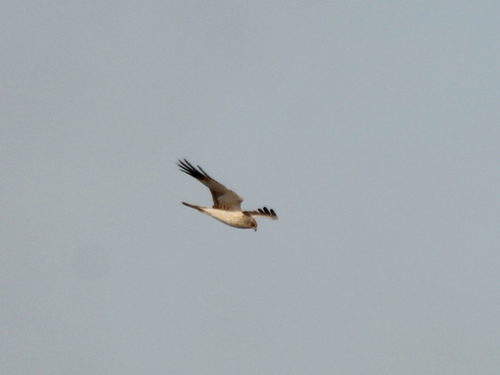 Eastern Marsh Harrier
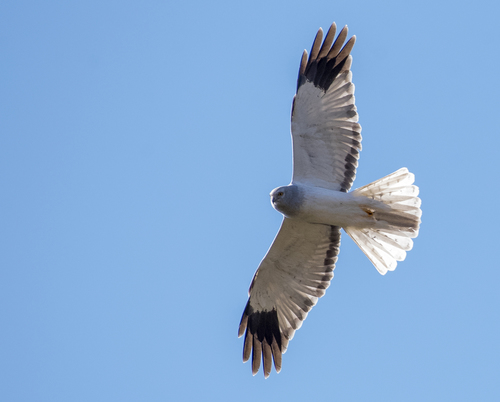 Hen Harrier
In short
The most reliable field mark to separate Eastern Marsh Harrier from Hen Harrier is the plumage pattern in flight, especially in juveniles and females: Eastern Marsh Harrier juveniles show a pale patch on the underwing, while Hen Harrier juveniles and females ("ringtails") have more uniform dark brown underwings with less distinct pale areas. Adult males of both species are grey above with black wingtips and a white rump, but Eastern Marsh Harrier males have a distinctive white leading edge to the wing and more extensive blackish on the head and wing coverts. Females of both species are brown, but Eastern Marsh Harrier females tend to have buff streaking on the head and underparts, while Hen Harrier females show buff underparts with brown barring. Both species fly low over open ground with wings held in a shallow V, but subtle differences in structure and plumage help with identification.
Identification tips
- Juvenile underwing pattern: Juvenile Eastern Marsh Harrier shows a pale patch on the underwing, while juvenile Hen Harrier has more uniform dark brown underwings with less distinct pale areas. This is a key mark in flight for immature birds.
- Female upper tail coverts: Female Hen Harrier has white upper tail coverts ('ringtail'), often more obvious than the paler, less contrasting rump of female Eastern Marsh Harrier.
- Adult male head and wing: Adult male Eastern Marsh Harrier has a blackish head, breast, back, and wing-coverts with pale streaks, and a white leading edge to the wing. Hen Harrier male has a grey head and upper breast, and lacks the strong white leading edge.
- Adult male underparts: Eastern Marsh Harrier male is mostly white below, while Hen Harrier male is white below except for a grey upper breast.
- Adult male upperwing: Eastern Marsh Harrier male has a grey wing with black wingtips and a white front edge; Hen Harrier male's upperwing is grey with black wingtips but lacks the strong white leading edge.
- Female and juvenile underparts: Female Eastern Marsh Harrier is dark brown with buff streaking on the head and underparts; Hen Harrier female is brown above with buff underparts and brown barring.
- Juvenile head color: Juvenile Eastern Marsh Harrier has buff on the head, while Hen Harrier juvenile is more uniformly brown.
- Rump patch: Both species have a white rump, but it is usually more noticeable on Hen Harrier, especially in females and juveniles.
- Tail pattern: Female Eastern Marsh Harrier's tail has dark bars; Hen Harrier female's tail is also barred but often appears paler at the base due to the white upper tail coverts.
- Size and structure: Eastern Marsh Harrier is larger and bulkier, with a longer wingspan and often appears heavier in flight. Hen Harrier is more slender and slightly smaller.
- Flight jizz: Both species fly with wings held in a shallow V, but Eastern Marsh Harrier may appear more ponderous and heavier-winged, while Hen Harrier is more buoyant and agile.
- Vocalizations: Hen Harrier is more likely to be heard calling, especially females during food passes and alarm; Eastern Marsh Harrier is usually silent except for a mewing call at roosts.
- Habitat: Not reliable for separation where both occur, but check local status—Hen Harrier is more widespread in Eurasia, Eastern Marsh Harrier in East Asia.
- Season and location: In areas of overlap, consider the time of year and migration patterns; Hen Harrier is migratory in much of its range, while Eastern Marsh Harrier may be more resident in some regions.
- Beware of overlap: Adult males are most similar; focus on head and wing pattern. Juveniles and females are best separated by underwing and rump pattern in flight.
Size
Hen Harrier is slightly smaller overall, with a length of 41–52 cm and a wingspan of 97–122 cm, while Eastern Marsh Harrier is larger at 48–58 cm long and a wingspan of 113–137 cm. Hen Harrier average adult mass is about 436.5 g (males smaller, females larger), while no direct mass is given for Eastern Marsh Harrier, but females are usually larger than males in both species. In the field, this size difference can be subtle, but Eastern Marsh Harrier often appears bulkier and longer-winged, especially in flight.
Plumage
Juvenile and female plumage is the main pitfall. Juvenile Eastern Marsh Harrier is dark brown overall with buff on the head and a pale patch on the underwing, which can be a key mark in flight. Juvenile Hen Harrier is also brown but lacks a distinct pale underwing patch, instead showing more uniform dark brown secondaries and less-barred belly. Female Eastern Marsh Harrier is dark brown above with buff streaking on the head and underparts, a whitish rump, and a tail with dark bars. Female Hen Harrier is brown above with white upper tail coverts (the classic 'ringtail'), buff underparts with brown barring, and a white rump patch that is often more obvious than in Eastern Marsh Harrier. Adult males of both species are superficially similar: both are grey above with black wingtips and a white rump, but Eastern Marsh Harrier males have a blackish head, breast, back, and wing-coverts with pale streaks, a white leading edge to the wing, and a mostly white underbody, while Hen Harrier males have a grey upper breast, white below, and a more uniform grey upperwing without the strong white leading edge.
Behaviour
Both species hunt by flying low over open ground with wings held in a shallow V. Their hunting style and flight jizz are very similar, making behavior alone unreliable for separation. Both can be seen quartering over marshes, grasslands, or fields, and both use ground nests in reedbeds or open country. Hen Harrier is noted for being very vocal while hunting, which may help in some contexts.
Habitat
Habitat overlap is extensive: both species breed and hunt in open areas such as marshes, grasslands, and reedbeds. Hen Harrier is more widespread across Eurasia and migratory, moving south in winter, while Eastern Marsh Harrier is more restricted to East Asia. In areas where both occur, habitat is not a reliable separator.
Voice
Both species are generally silent in the field, but Eastern Marsh Harrier has a mewing call, most often at roost sites. Hen Harrier is more vocal, especially the female, who gives a whistled 'piih-eh' when receiving food and a rapid 'chit-it-it-it-it-et-it' as an alarm; the male calls 'chek-chek-chek' and a bouncing 'chuk-uk-uk-uk' during display. However, calls are rarely diagnostic unless heard well and in the right context.