
Eastern Chanting-Goshawk vs Gabar Goshawk
Melierax poliopterus versus Micronisus gabar
Play a quiz with Eastern Chanting-Goshawk and Gabar Goshawk
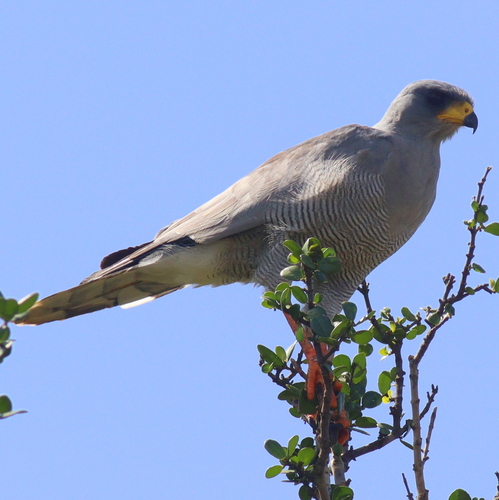 Eastern Chanting-Goshawk
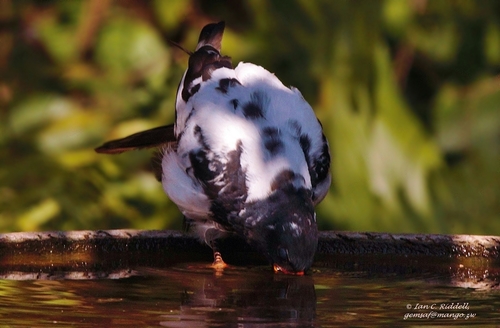 Gabar Goshawk
In short
The most reliable field mark between Eastern Chanting-Goshawk and Gabar Goshawk is size and structure: the Eastern Chanting-Goshawk is much larger, with a heavier build, broader wings, and a shorter, graduated tail, while the Gabar Goshawk is small, slim, and long-tailed. Juvenile plumages can be confusing, but the Eastern Chanting-Goshawk juvenile has less barring on the undertail coverts and rump, and longer legs than Gabar. In flight, the Eastern Chanting-Goshawk shows a striking white belly and wing linings with dark wingtips, while Gabar (in pale morph) is more evenly barred below and has a conspicuous white rump. Perched, leg and cere color, tail shape, and overall bulk help. Gabar is often solitary or in pairs, while Eastern Chanting-Goshawk may be seen in groups.
Identification tips
- Size and bulk: Eastern Chanting-Goshawk is much larger and heavier than Gabar Goshawk. If you see a robust, almost buzzard-sized raptor, it's Eastern Chanting-Goshawk; a small, slim hawk is Gabar.
- Tail shape and length: Eastern Chanting-Goshawk has a shorter, graduated tail (central feathers longer than outer), while Gabar has a longer, more even tail. In flight or perched, look for the tail's proportions to the body.
- Leg length and color: Both have long legs, but Eastern Chanting-Goshawk's are especially long and orange-red in adults (yellow in Gabar adults). Juvenile Eastern Chanting-Goshawk legs are longer than juvenile Gabar's. Gabar's legs are yellow in immatures, red in adults.
- Cere color: Adult Eastern Chanting-Goshawk has a yellow cere, Gabar adult has a red cere. Juvenile Gabar has a yellow cere, so this is not always reliable for age.
- Plumage below in flight (adult): Eastern Chanting-Goshawk shows a white belly and wing linings with dark wingtips, giving a striking contrast. Gabar (pale morph) is more evenly barred below, with no such sharp contrast.
- White rump: Gabar Goshawk (both adult and juvenile, pale morph) has a conspicuous white rump, visible in flight and often when perched. Eastern Chanting-Goshawk has a white or lightly barred rump in juveniles, but it's less prominent and not as cleanly white as Gabar's.
- Undertail coverts (juvenile): Juvenile Eastern Chanting-Goshawk has faint or no barring on the undertail coverts, while juvenile Gabar has more heavily barred undertail coverts. This is a key mark for separating young birds.
- Barring on belly and chest (juvenile): Juvenile Eastern Chanting-Goshawk has brown streaks on the throat and breast, and brown bars on the belly coverts, but the overall pattern is neater than Gabar's, which is browner and messier below.
- Dark morph: Only Gabar Goshawk has a near-black morph; any all-dark small goshawk is Gabar.
- Wing shape and flight style: Eastern Chanting-Goshawk has broader wings and shallow, straight-arm wingbeats, often gliding with flat or slightly C-shaped wings. Gabar is more accipiter-like, with faster, more agile flight and narrower wings.
- Social behavior: Groups of chanting goshawks (more than 2–3 birds together) are almost always Eastern Chanting-Goshawk. Gabar is usually solitary or in pairs.
- Perch preference: Eastern Chanting-Goshawk often perches on exposed rocks or mountaintops; Gabar prefers the crowns of thorny trees, especially acacias.
- Habitat: In very open, dry, or rocky country, especially in East Africa, Eastern Chanting-Goshawk is more likely. In wooded or thorny acacia areas, especially outside East Africa, Gabar is more likely.
- Voice: If you hear melodious piping or repeated 'pereu-pereu' calls, it's Eastern Chanting-Goshawk. Gabar's calls are not described here.
- Pitfalls: Juvenile Eastern Chanting-Goshawk can be confused with juvenile Dark Chanting-Goshawk, but compared to Gabar, the longer legs, less barring on undertail coverts, and larger size are key. When in doubt, use a combination of size, tail shape, leg color, and rump pattern.
Size
Eastern Chanting-Goshawk is vastly larger: body mass averages 735g, with a length of 49–55 cm and a wingspan of 96–110 cm. Gabar Goshawk is much smaller, averaging 165g, with a length of 28–36 cm and a wingspan of about 63 cm. The difference is immediately obvious if seen together or with scale: Eastern Chanting-Goshawk is a large, robust raptor, while Gabar is a small, slim accipiter-like hawk. Female Gabar can approach the smallest male Eastern Chanting-Goshawk in size, but the overlap is minimal.
Plumage
Juvenile Eastern Chanting-Goshawk is dull brown above with a pale supercilium, white underparts with brown streaks on the throat and breast, brown bars on the belly coverts, and faint or no barring on the undertail coverts. The rump is white, sometimes partially barred or unmarked, and the tail is brown with widely spaced darker bars. Juvenile Gabar Goshawk (pale morph) is browner overall, with untidier barring on the chest, yellow cere and legs, and a conspicuous white rump. The undertail coverts are more heavily barred than in Eastern Chanting-Goshawk. Adult Eastern Chanting-Goshawk is overall pale grey with white belly and wing linings, dark wingtips, and a blackish tail above with white below and grey bars; legs are orange-red, cere yellow. Adult Gabar Goshawk (pale morph) is grey above, white and grey barred below, with a white rump and dark grey, barred tail; legs and cere are red. The dark morph Gabar is almost entirely black, which is never matched by Eastern Chanting-Goshawk. In flight, Eastern Chanting-Goshawk appears white below with grey head and dark wingtips, while Gabar is more evenly barred and shows a striking white rump.
Behaviour
Eastern Chanting-Goshawk is often seen in groups, sometimes up to 16, and frequently hunts cooperatively, rationing prey among group members. It perches conspicuously on mountaintops or rocky outcrops and hunts by swooping down from exposed perches, often after lizards. Its flight is characterized by shallow, straight-arm wingbeats and glides with flat or slightly C-shaped wings. Gabar Goshawk is usually solitary or in pairs, especially during breeding, and is more secretive. It hunts small birds by flushing them from trees in persistent, energetic pursuits, or by swooping from a perch. Gabar is noted for its destructive raids on weaver nests and for using spider webs in nest construction.
Habitat
Eastern Chanting-Goshawk prefers semidesert, dry bush, and wooded grassland up to 2000 m, typically in East Africa (southern Ethiopia, Djibouti, western Somalia, eastern Kenya, northeastern Tanzania, and adjacent Uganda). Gabar Goshawk is more widespread in Africa and Arabia, and is not as closely tied to open, arid habitats; it is often found in wooded areas, especially thorny acacia, and is less likely to be seen in large groups or in very open terrain.
Voice
Eastern Chanting-Goshawk gives a melodious piping call ('rhee-opee-opee-opee') and a short, low-pitched 'kleee-yeu', with calls slightly higher-pitched than the similar Dark Chanting-Goshawk. During nesting, it gives a repeated 'pereu-pereu-pereu-repee-repee-repee'. Gabar Goshawk's vocalizations are not described in the provided notes, so are not diagnostic here.