
Eastern Black-eared Wheatear vs Pied Wheatear
Oenanthe melanoleuca versus Oenanthe pleschanka
Play a quiz with Eastern Black-eared Wheatear and Pied Wheatear
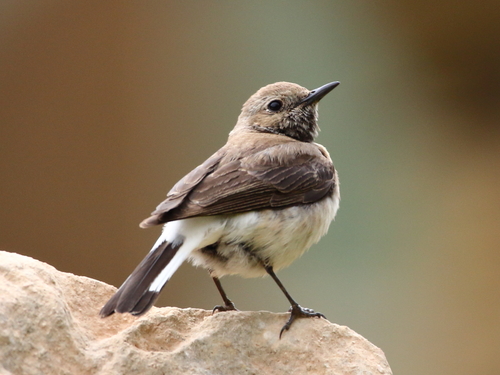 Eastern Black-eared Wheatear
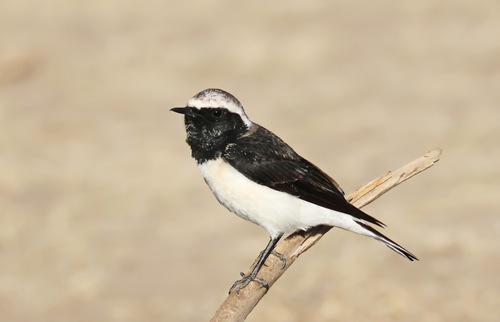 Pied Wheatear
In short
The most reliable field mark between Eastern Black-eared Wheatear and Pied Wheatear is the pattern and extent of black on the face and throat in adult males, and the tail pattern in all plumages. Adult male Eastern Black-eared Wheatear is strikingly black-and-white with a whiter crown and upperparts, and a black mask that reaches just above the bill base; black-throated individuals show more extensive and sharply demarcated black on the throat and face than Pied. Pied Wheatear males have a pale brown-tinged crown and nape, a narrower black mask, and a distinctive tail pattern with an inverted black 'T'—the black on the tail tip is more extensive, especially on the outer feathers. Females and immatures are trickier, but Eastern Black-eared is colder and duller overall, while Pied is browner with a sandy buff wash to the head. In flight, both show much white in the tail, but Pied's black 'T' is diagnostic if seen well. Structure and size are very similar and not reliably separable in the field.
Identification tips
- Tail pattern (all ages): Pied Wheatear shows an inverted black 'T' in the tail: central feathers are black with white bases, outer feathers are white with black tips (outermost with more black). Eastern Black-eared Wheatear has a mostly white tail except for the central pair, with white often reaching the tip of the inner web. This is the best mark in flight or on perched birds with fanned tails.
- Adult male crown and upperparts: Eastern Black-eared Wheatear males have a white or nearly white crown, forehead, and mantle, with little to no buff; Pied Wheatear males have a pale brown-tinged crown and nape, and mantle/scapulars are black with buff tips. Use this in spring and early summer.
- Black mask and throat: Eastern Black-eared Wheatear males have a black mask that reaches just above the bill base, and black-throated birds show more extensive, sharply bordered black on the face and throat. Pied Wheatear's black mask is narrower, does not reach as far above the bill, and the black on the throat is less extensive and more blended.
- Female/immature overall tone: Female and immature Eastern Black-eared Wheatear are colder gray-brown and duller; Pied Wheatear females are browner, with a sandy buff wash to the head. This is subtle and best used in combination with tail pattern.
- Juvenile upperparts: Pied Wheatear juveniles are brown above with pale centers near feather tips, giving a speckled look; Eastern Black-eared Wheatear immatures are less speckled, more uniform gray-brown.
- Underparts: Eastern Black-eared Wheatear males have white underparts tinged with buff; Pied Wheatear males have creamy-buff underparts, especially on the belly and lower breast. This is subtle and variable.
- Seasonal changes: In autumn and winter, Eastern Black-eared Wheatear becomes buffier on the head, mantle, and underparts, but remains colder and less sandy than Pied. Pied Wheatear's buff tones become more pronounced as feather tips wear off.
- Rump and lower back: Both species have white lower backs, but Pied Wheatear females show less white on the rump than Northern Wheatear; this is not a strong separator between these two.
- Wing pattern: Both have black wings with pale tips/edges in fresh plumage; not reliably separable in the field.
- Bill, legs, and structure: Both are slender, upright, with similar bills and legs; not useful for separation.
- Voice: Pied Wheatear gives a harsh 'zack zack' call and a variable, musical song; Eastern Black-eared Wheatear's voice is not described here, so do not rely on vocalizations.
- Habitat and range: Where both occur, habitat is not a separator; check range maps for likely species but do not rely on this in overlap zones.
- Behavior: Both species behave similarly—upright, tail-flicking, ground-feeding, and perching on rocks; not diagnostic.
- Sexual dimorphism: Female and immature plumages are more challenging; rely on tail pattern and overall tone rather than face/throat pattern.
- Pitfalls: Beware of overlap with Western Black-eared Wheatear, which is not covered here; always check tail pattern and face/throat contrast for best results.
Size
Both species are small, slender wheatears with similar proportions. Pied Wheatear is about 14–14.6 cm in length, and Eastern Black-eared Wheatear is comparable (precise measurements not given, but both are typical small wheatears). Females Pied are slightly smaller than males, but this is not a useful field mark. Bill, legs, and overall jizz are very similar and not diagnostic.
Plumage
Juveniles and first-winter birds: Pied Wheatear juveniles are brown above with pale centers near feather tips, giving a speckled appearance; Eastern Black-eared Wheatear females and immatures are colder gray-brown, less speckled, and duller. In both, the tail pattern is key: Pied Wheatear of all ages shows an inverted black 'T'—the central tail feathers are black with white bases, the rest are white with black tips (outermost with more black). Eastern Black-eared Wheatear has a mostly white tail except for the central pair, and the white often extends to the tip of the inner web, making the tail appear whiter overall.
Adult breeding males: Eastern Black-eared Wheatear is crisp black-and-white, with a white or nearly white crown, mantle, and upperparts, and a black mask that extends just above the bill; the throat may be black or white, but black-throated birds have more extensive, sharply bordered black. Pied Wheatear males have a pale brown-tinged crown and nape, black mask and throat, but the mask is narrower and does not reach as far above the bill; mantle and scapulars are black with buff tips, and the underparts are creamy-buff.
Females: Eastern Black-eared is colder and duller, with less sandy or buff tones than Pied, which is browner and has a sandy buff wash to the head. Both have white lower backs, but Pied female shows less white on the rump than Northern Wheatear, and the tail pattern remains diagnostic.
Behaviour
Both species are typical wheatears: upright, ground-feeding, tail-flicking, and often perching on rocks or low shrubs. Males of both species sing from prominent perches or in song flight. No behavioral difference is reliably diagnostic in the field.
Habitat
Eastern Black-eared Wheatear breeds in southeastern Europe and the Middle East, favoring open, rocky, or stony habitats with sparse vegetation. Pied Wheatear breeds further east, from southeastern Europe through central Asia to Mongolia, and also prefers open, stony, sparsely vegetated regions. Both can occur in similar habitats where their ranges overlap, so habitat is not a reliable separator.
Voice
Pied Wheatear gives a harsh 'zack zack' call and a low-pitched, musical, variable song with lark-like and whistling notes, often delivered from a perch or in flight. Eastern Black-eared Wheatear's vocalizations are not described in the provided notes, so voice is not a reliable separator based on this information.
Eastern Black-eared Wheatear · Pied Wheatear · My Tricky Birds