
Motmot

Dusky Long-tailed Cuckoo vs Golden Greenbul

Cercococcyx mechowi versus Calyptocichla serinus

Play a quiz with Dusky Long-tailed Cuckoo and Golden Greenbul

Dusky Long-tailed Cuckoo (Cercococcyx mechowi) Dusky Long-tailed Cuckoo
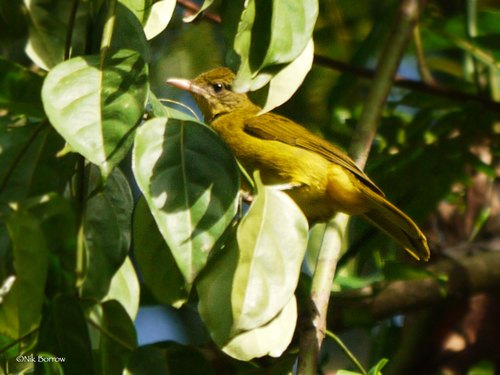
Golden Greenbul (Calyptocichla serinus) Golden Greenbul

Media

Loading…

In short

The most reliable field mark to separate Dusky Long-tailed Cuckoo from Golden Greenbul is the cuckoo’s long, graduated tail and heavily barred white underparts, versus the greenbul’s short-tailed, unmarked olive-and-yellow look. Juvenile cuckoos show rufous barring on the upperparts and a blackish throat, which the greenbul never shows at any age. Structurally, the cuckoo is longer, slimmer, and has a dark, slightly decurved bill, while the greenbul is more compact with a long, slender, pinkish-brown bill. In flight or perched, the cuckoo’s tail and barring stand out, while the greenbul’s bright yellow belly and white throat are unique among greenbuls but never barred. Both species can be found in Central African forests, but the cuckoo prefers dense undergrowth and is often in mid-canopy, while the greenbul is more typical of general rainforest habitats.

Identification tips

  1. Tail shape and length: Dusky Long-tailed Cuckoo always has a long, graduated tail, easily visible both perched and in flight. Golden Greenbul’s tail is much shorter and not graduated. This is the single most reliable field mark at any age.
  2. Underpart pattern: Adult and juvenile cuckoos show strong blackish barring on white underparts, while greenbul is always clean yellow below with a white throat and never any barring.
  3. Juvenile plumage: Young cuckoos have rufous bars on the upperparts and a blackish throat. Juvenile greenbuls look like adults: plain olive above, yellow below, white throat.
  4. Bill color and shape: Cuckoo’s bill is greenish-black, slightly decurved and robust; greenbul’s is long, slender, and pinkish-brown—noticeably paler and more delicate.
  5. Upperpart color: Cuckoo is dark brown with a sooty-grey wash and purple-blue iridescence; greenbul is plain olive above with no iridescence or barring.
  6. Wing pattern: Cuckoo’s wings are dark brown with buff and white spots (best seen at close range or in good light). Greenbul’s wings are plain olive, no spots or panels.
  7. Ventral color: Cuckoo has a buff vent; greenbul’s vent is not distinctly colored from the rest of the underparts.
  8. Eye and leg color: Cuckoo has dark brown eyes and yellow feet; these are subtle and rarely diagnostic in the field, but may help at close range. Greenbul’s soft part colors are not distinctive.
  9. Posture and jizz: Cuckoo is longer, slimmer, and often perches upright with tail drooping. Greenbul is more compact, with a typical small songbird stance.
  10. Flight style: Cuckoo’s flight is more direct and gliding, with the long tail trailing. Greenbul’s flight is more fluttery and short-burst, typical of small passerines.
  11. Habitat context: If seen in dense, tangled undergrowth or liana-rich forest, cuckoo is more likely. Greenbul is more generalist in forest use.
  12. Vocalization: If you hear a 'hu hee wheeu' or an accelerating/descending series of notes, it is the cuckoo. Greenbul’s calls are not described here but do not match this pattern.
  13. Brood parasitism: If you observe a bird being fed by a smaller host, it is likely the cuckoo.
  14. Sex and season: Both species are similar year-round and between sexes; no seasonal or sexual dimorphism to confuse matters.
  15. Pitfalls: In poor light, the greenbul’s yellow belly and white throat may seem paler, but the absence of barring and the short tail should still separate it from the cuckoo.

Size

Dusky Long-tailed Cuckoo is larger and longer (about 33 cm in length, 50–61 g) [wikipedia], with a noticeably long, graduated tail. Golden Greenbul is smaller and more compact, with a typical greenbul shape and no tail extension. The greenbul’s bill is long and slender, but the rest of its proportions are more typical of a small passerine, lacking the elongated jizz of the cuckoo.

Plumage

Juvenile Dusky Long-tailed Cuckoo is distinct with rufous bars on the upperparts and a blackish throat; adults of both sexes have dark brown upperparts with a sooty-grey wash and purple-blue iridescence, dark brown wings with buff and white spots, and strikingly white underparts barred with blackish-brown, plus a buff vent. The tail is long, graduated, and dark. In contrast, Golden Greenbul of all ages has unmarked olive upperparts, tail, and wings, a bright yellow belly, and a white throat—never any barring or rufous tones. The greenbul’s bill is pinkish-brown and slender, while the cuckoo’s is greenish-black and more robust. The cuckoo’s eyes are dark brown, and its feet are yellow; the greenbul’s soft part colors are less distinctive in the field.

Behaviour

Dusky Long-tailed Cuckoo is often seen in the undergrowth or mid-canopy, sometimes joining mixed-species flocks, and may call from treetops. It is a brood parasite and tends to be secretive, moving through dense vegetation. Golden Greenbul is more typical of greenbul behavior, foraging in the lower to mid-levels of rainforest, often in pairs or small groups, and is not a brood parasite. The cuckoo’s longer tail and more upright posture when perched can be a behavioral clue.

Habitat

Both species occur in Central African forests, but Dusky Long-tailed Cuckoo prefers dense undergrowth, liana-rich areas, tall secondary forests, and riverine forests, often in more tangled or shaded spots. Golden Greenbul is a generalist within African tropical rainforest, not specifically tied to dense undergrowth, and is more likely encountered in a wider range of forest types.

Voice

Dusky Long-tailed Cuckoo gives a distinctive series of notes: a 'hu hee wheeu' and a sequence that accelerates, then slows and descends. Golden Greenbul’s voice is not described in the notes, but it does not share the cuckoo’s distinctive call pattern. If you hear the accelerating and descending series, it is diagnostic for the cuckoo.

Submit a better description

Use the same sections as the comparison. Your text is published immediately.

The most reliable field mark to separate Dusky Long-tailed Cuckoo from Golden Greenbul is the cuckoo’s long, graduated tail and heavily barred white underparts, versus the greenbul’s short-tailed, unmarked olive-and-yellow look. Juvenile cuckoos show rufous barring on the upperparts and a blackish throat, which the greenbul never shows at any age. Structurally, the cuckoo is longer, slimmer, and has a dark, slightly decurved bill, while the greenbul is more compact with a long, slender, pinkish-brown bill. In flight or perched, the cuckoo’s tail and barring stand out, while the greenbul’s bright yellow belly and white throat are unique among greenbuls but never barred. Both species can be found in Central African forests, but the cuckoo prefers dense undergrowth and is often in mid-canopy, while the greenbul is more typical of general rainforest habitats.

  1. Tail shape and length: Dusky Long-tailed Cuckoo always has a long, graduated tail, easily visible both perched and in flight. Golden Greenbul’s tail is much shorter and not graduated. This is the single most reliable field mark at any age.
  2. Underpart pattern: Adult and juvenile cuckoos show strong blackish barring on white underparts, while greenbul is always clean yellow below with a white throat and never any barring.
  3. Juvenile plumage: Young cuckoos have rufous bars on the upperparts and a blackish throat. Juvenile greenbuls look like adults: plain olive above, yellow below, white throat.
  4. Bill color and shape: Cuckoo’s bill is greenish-black, slightly decurved and robust; greenbul’s is long, slender, and pinkish-brown—noticeably paler and more delicate.
  5. Upperpart color: Cuckoo is dark brown with a sooty-grey wash and purple-blue iridescence; greenbul is plain olive above with no iridescence or barring.
  6. Wing pattern: Cuckoo’s wings are dark brown with buff and white spots (best seen at close range or in good light). Greenbul’s wings are plain olive, no spots or panels.
  7. Ventral color: Cuckoo has a buff vent; greenbul’s vent is not distinctly colored from the rest of the underparts.
  8. Eye and leg color: Cuckoo has dark brown eyes and yellow feet; these are subtle and rarely diagnostic in the field, but may help at close range. Greenbul’s soft part colors are not distinctive.
  9. Posture and jizz: Cuckoo is longer, slimmer, and often perches upright with tail drooping. Greenbul is more compact, with a typical small songbird stance.
  10. Flight style: Cuckoo’s flight is more direct and gliding, with the long tail trailing. Greenbul’s flight is more fluttery and short-burst, typical of small passerines.
  11. Habitat context: If seen in dense, tangled undergrowth or liana-rich forest, cuckoo is more likely. Greenbul is more generalist in forest use.
  12. Vocalization: If you hear a 'hu hee wheeu' or an accelerating/descending series of notes, it is the cuckoo. Greenbul’s calls are not described here but do not match this pattern.
  13. Brood parasitism: If you observe a bird being fed by a smaller host, it is likely the cuckoo.
  14. Sex and season: Both species are similar year-round and between sexes; no seasonal or sexual dimorphism to confuse matters.
  15. Pitfalls: In poor light, the greenbul’s yellow belly and white throat may seem paler, but the absence of barring and the short tail should still separate it from the cuckoo.

Dusky Long-tailed Cuckoo is larger and longer (about 33 cm in length, 50–61 g) [wikipedia], with a noticeably long, graduated tail. Golden Greenbul is smaller and more compact, with a typical greenbul shape and no tail extension. The greenbul’s bill is long and slender, but the rest of its proportions are more typical of a small passerine, lacking the elongated jizz of the cuckoo.

Juvenile Dusky Long-tailed Cuckoo is distinct with rufous bars on the upperparts and a blackish throat; adults of both sexes have dark brown upperparts with a sooty-grey wash and purple-blue iridescence, dark brown wings with buff and white spots, and strikingly white underparts barred with blackish-brown, plus a buff vent. The tail is long, graduated, and dark. In contrast, Golden Greenbul of all ages has unmarked olive upperparts, tail, and wings, a bright yellow belly, and a white throat—never any barring or rufous tones. The greenbul’s bill is pinkish-brown and slender, while the cuckoo’s is greenish-black and more robust. The cuckoo’s eyes are dark brown, and its feet are yellow; the greenbul’s soft part colors are less distinctive in the field.

Dusky Long-tailed Cuckoo is often seen in the undergrowth or mid-canopy, sometimes joining mixed-species flocks, and may call from treetops. It is a brood parasite and tends to be secretive, moving through dense vegetation. Golden Greenbul is more typical of greenbul behavior, foraging in the lower to mid-levels of rainforest, often in pairs or small groups, and is not a brood parasite. The cuckoo’s longer tail and more upright posture when perched can be a behavioral clue.

Both species occur in Central African forests, but Dusky Long-tailed Cuckoo prefers dense undergrowth, liana-rich areas, tall secondary forests, and riverine forests, often in more tangled or shaded spots. Golden Greenbul is a generalist within African tropical rainforest, not specifically tied to dense undergrowth, and is more likely encountered in a wider range of forest types.

Dusky Long-tailed Cuckoo gives a distinctive series of notes: a 'hu hee wheeu' and a sequence that accelerates, then slows and descends. Golden Greenbul’s voice is not described in the notes, but it does not share the cuckoo’s distinctive call pattern. If you hear the accelerating and descending series, it is diagnostic for the cuckoo.

Discard your changes?

You have unsaved edits. If you leave now, those changes will be lost.

Dusky Long-tailed Cuckoo · Golden Greenbul · My Tricky Birds