

Dunn's Lark vs Arabian Lark
Eremalauda dunni versus Eremalauda eremodites
Play a quiz with Dunn's Lark and Arabian Lark
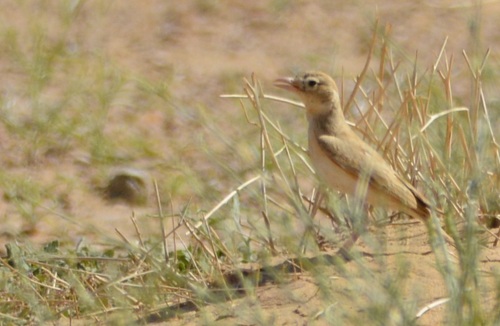 Dunn's Lark
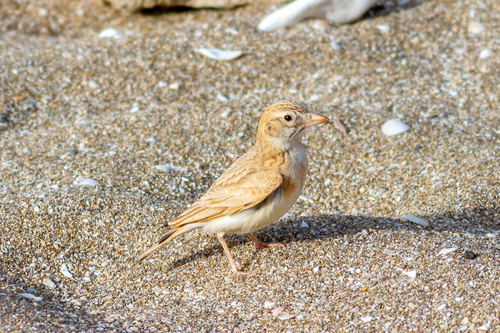 Arabian Lark
In short
The most reliable field mark between Dunn's Lark and Arabian Lark is the upperpart streaking: Dunn's Lark shows clear dark streaks on its sandy-brown upperparts and breast, while Arabian Lark is much plainer above with only faint pale patterning below. Both species are stocky, large-billed desert larks with similar structure, but Dunn's Lark has a more contrasting facial pattern and a tail with rusty-brown central feathers, while Arabian Lark's outer tail feathers are blackish and stand out in flight. Bill color and shape are similar but Arabian Lark's is especially bulbous and uniformly pink. Both are best separated by a combination of upperpart streaking, tail pattern in flight, and subtle differences in facial markings.
Identification tips
- Upperpart streaking: Dunn's Lark shows prominent dark streaks on its sandy-brown upperparts and breast, while Arabian Lark is much plainer above with only faint pale patterning below. This is the most reliable visual cue in all plumages.
- Facial pattern: Dunn's Lark has a pale supercilium, a pale eye-ring, and a bold face with both dark moustachial and malar stripes plus a dark mark under the eye. Arabian Lark has a dark moustache-like stripe but otherwise a plainer face, lacking the strong supercilium and malar contrast.
- Tail pattern in flight: Dunn's Lark has a short, broad tail with rusty-brown central feathers and pale outer feathers above; the underside is black. Arabian Lark's outermost tail feathers are blackish and this contrast is most obvious in flight, but it lacks the rusty-brown central feathers of Dunn's.
- Bill shape and color: Both have large, heavy, pinkish bills, but Arabian Lark's is especially bulbous and uniformly pink, while Dunn's may show a more yellowish or pale pinkish tone.
- Underpart streaking: Dunn's Lark has dark streaks on the breast; Arabian Lark's underparts are paler with only faint pale patterning.
- Jizz and movement: Arabian Lark often moves in short bursts, running and stopping abruptly; Dunn's Lark is more likely to be seen feeding in flocks outside the breeding season.
- Song: Dunn's Lark gives a scratchy warbling song with short whistles; Arabian Lark's song is gentler and more burbling, with a low rattle and soft two-note whistle as calls. Use with caution unless familiar with both.
- Tail length and shape: Both have short, broad tails, but the color pattern is more useful than shape for separation.
- Plumage wear: Dunn's Lark's dark markings become fainter and the plumage duller as it wears after molt; Arabian Lark remains plain throughout.
- Habitat and range: If observed within their normal ranges, range can be a strong clue, but beware of vagrancy or misidentification in overlapping regions.
- Group size: Dunn's Lark is more likely to be seen in flocks outside breeding season; Arabian Lark is usually solitary or in pairs when breeding.
- Feeding behavior: Both dig for seeds and insects, but Arabian Lark's abrupt running and stopping may stand out.
- Tail pattern pitfall: In flight, both can show blackish in the tail, but only Dunn's Lark has rusty-brown central feathers; Arabian Lark's tail is blackish only at the edges.
- Facial pattern pitfall: The dark moustache is present in both, but only Dunn's Lark combines it with a strong supercilium and malar stripe.
- Bill color pitfall: Both bills are pinkish, but Arabian Lark's is more swollen and uniformly colored; use in combination with other marks.
Size
Both species are similar in size and structure, being stocky larks with large heads and broad wings. Dunn's Lark is 14–15 cm long with a wingspan of 25–30 cm [wikipedia]; no distinct size difference is noted for Arabian Lark, and both are described as small passerines. Bill size is large and heavy in both, but Arabian Lark's is described as especially bulbous and swollen.
Plumage
- Juvenile/immature plumage: No age-specific upperwing or flight pattern differences are described for either species, so focus is on overall body and tail pattern.
- Adult plumage: Dunn's Lark has pale sandy-brown upperparts with prominent dark streaks, a pale supercilium, and a bold facial pattern with dark moustachial and malar stripes, plus a dark mark under the eye. Its tail is short and broad, black below, with rusty-brown central feathers and pale outer feathers above. Arabian Lark is much plainer above, with sandy-brown upperparts lacking strong streaks, a paler underside with faint pale patterning, and a dark moustache-like stripe on the face. Its outermost tail feathers are blackish, especially obvious in flight, but lacks the rusty-brown central tail feathers of Dunn's. Bill is pinkish and swollen in both, but Arabian Lark's is especially uniform in color.
Behaviour
Both species feed on the ground, often digging with their bills. Dunn's Lark typically feeds in flocks outside the breeding season, while Arabian Lark is usually seen alone or in pairs when breeding, forming only small groups otherwise. Arabian Lark moves in short bursts, running and stopping abruptly, which may help distinguish it from the more flock-oriented Dunn's Lark. Both species sing from the ground or in flight, with display flights described for both.
Habitat
Both are desert larks, but their ranges do not overlap: Dunn's Lark is found across the Sahara from Mauritania to central Sudan, while Arabian Lark ranges from Syria and Jordan through Saudi Arabia to Oman. Both inhabit arid, open desert environments. Habitat alone will not separate them within their respective ranges, but is useful for ruling out vagrancy.
Voice
Dunn's Lark has a scratchy warbling song with short whistling phrases, while Arabian Lark's song is a series of gentle burbling phrases, with calls including a low rattle and a soft two-note whistle. Both sing from the ground or in flight. The difference in song quality (scratchy vs. gentle burbling) may help, but is subtle and not always diagnostic without experience.