

Double-toothed Kite vs Plumbeous Kite
Harpagus bidentatus versus Ictinia plumbea
Play a quiz with Double-toothed Kite and Plumbeous Kite
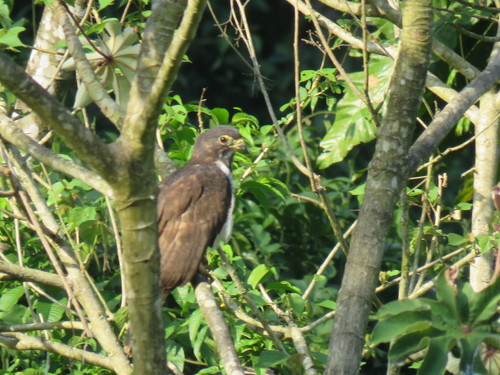 Double-toothed Kite
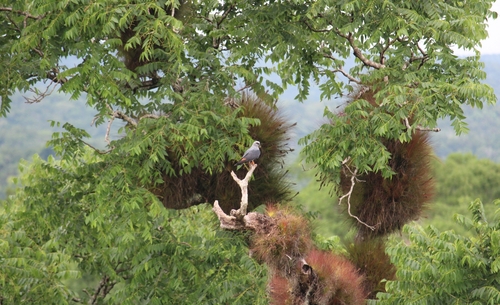 Plumbeous Kite
In short
Immature Double-toothed Kites show deep brown upperparts and bold vertical streaks below, while immature Plumbeous Kites have white-streaked gray upperparts and dark-streaked whitish underparts. In adults, the most reliable field mark is the rufous primary patch visible in flight on Plumbeous Kite, which Double-toothed Kite lacks. Double-toothed Kites have a distinctive dark gray head with a white throat and central dark stripe, and a more rufous-toned underbody, while Plumbeous Kites are more uniformly slate-gray with a paler head and underparts. Plumbeous Kite is noticeably heavier and has longer, more pointed wings, contributing to a different flight profile. Both species have red eyes and banded tails, but tail banding details and leg color differ.
Identification tips
- Immature plumage: Immature Double-toothed Kite has deep brown upperparts and bold vertical brown streaks on whitish to buff underparts. Immature Plumbeous Kite is gray above with white streaks and whitish below with dark streaks, lacking the rich brown and strong vertical streaking of Double-toothed. Use this for any streaky, brownish young raptor.
- Adult flight pattern: In flight, adult Plumbeous Kite shows a rufous patch at the base of the primaries, visible from below—Double-toothed Kite never shows this. This mark is reliable for adults and older immatures.
- Head and throat: Double-toothed Kite has a dark gray head with a white throat and a distinct central dark stripe. Plumbeous Kite's head is paler gray, blending smoothly into the underparts, and lacks a strong throat stripe.
- Underparts color: Double-toothed Kite adults have a rufous breast and belly with gray and whitish barring (sometimes extensive), while Plumbeous Kite is more uniformly slate-gray with paler, less rufous underparts.
- Tail pattern: Both species have banded tails, but Double-toothed Kite's tail is blackish with three grayish bands and a gray tip, while Plumbeous Kite's tail is short, black, and shows 2–3 white bands from below.
- Leg and cere color: Double-toothed Kite has yellow legs and a greenish yellow cere; Plumbeous Kite has orange legs.
- Eye color: Both have red eyes as adults, so this is not a separator.
- Bill shape: Double-toothed Kite has a 'double-toothed' bill with notches on the maxilla, but this is subtle and rarely visible in the field.
- Wing shape and flight style: Plumbeous Kite has long, pointed wings and a buoyant, kite-like flight, often soaring. Double-toothed Kite is more compact, with shorter wings and a more accipiter-like flight, often flapping and gliding.
- Size and structure: Plumbeous Kite is larger and heavier (247 g vs 195 g), with a longer body and wingspan, and appears more streamlined. Double-toothed Kite is smaller and more compact.
- Perched posture: Double-toothed Kite often perches upright in the midstory, sometimes following monkeys. Plumbeous Kite may perch more openly and is more likely to be seen soaring.
- Habitat: Double-toothed Kite is more strictly a forest species, while Plumbeous Kite uses a wider range of wooded habitats, including edges and open areas.
- Voice: If you hear a whistled 'si-see-oo,' it is Plumbeous Kite. Lack of vocalization is not diagnostic for Double-toothed.
- Seasonality: Plumbeous Kite is migratory in the north of its range, so out-of-season records in those areas may favor Double-toothed Kite.
- Common pitfalls: Immature Plumbeous Kite can appear streaky below, but the streaking is never as bold or brown-toned as in immature Double-toothed. Adult Double-toothed's rufous underparts and throat stripe are not matched by Plumbeous. Always check for the rufous primary patch in flight for Plumbeous, and the throat pattern for Double-toothed.
Size
Plumbeous Kite is the larger and heavier of the two, with a body mass averaging 247 g compared to Double-toothed Kite's 195 g. Plumbeous Kite measures 34–37.5 cm in length, while Double-toothed Kite is slightly smaller at 29–35 cm. The wingspan of Double-toothed Kite is 60–72 cm, but Plumbeous Kite's longer, pointed wings make it appear more streamlined and kite-like in flight. Double-toothed Kite is more compact overall, with a proportionally shorter tail and less pronounced wing projection.
Plumage
Immature birds are the most easily separated: Immature Double-toothed Kites have deep brown upperparts and bold vertical brown streaks on whitish to buff underparts, giving a strong contrast and a streaky look below. Immature Plumbeous Kites, by contrast, show white-streaked gray upperparts and dark-streaked whitish underparts, lacking the rich brown tones and vertical streaking of Double-toothed. In adults, Double-toothed Kite shows a dark gray head, white throat with a central dark stripe, and rufous breast and belly with gray and whitish barring (more extensive in some subspecies). The tail is blackish with three grayish bands and a gray tip. Plumbeous Kite adults are more uniformly slate-gray, with a paler head and underparts, and a short black tail with 2–3 white bands visible from below. A key adult mark is the rufous primary patch in flight on Plumbeous Kite, which is absent in Double-toothed. Both species have red eyes, but Double-toothed Kite has a greenish yellow cere and yellow legs/feet, while Plumbeous Kite's legs are orange.
Behaviour
Both species are agile, insect-eating raptors, but Plumbeous Kite often soars and glides on long, pointed wings, giving a buoyant, kite-like flight. Double-toothed Kite is more likely to be seen perched quietly in the midstory or following troops of monkeys to catch disturbed prey, and its flight is more accipiter-like with bursts of flapping and gliding. Plumbeous Kite frequently catches insects on the wing, sometimes sallying out from a perch, and is more likely to be seen in open airspace.
Habitat
Both species overlap broadly in range and can be found from Mexico through much of northern and eastern South America. Double-toothed Kite prefers forested habitats, especially interior and edge, and is often associated with monkey troops. Plumbeous Kite is more flexible, occurring in a wider range of wooded habitats, including forest edges, open woodlands, and sometimes near water. Plumbeous Kite is also migratory in the northern part of its range, while Double-toothed Kite is resident throughout.
Voice
Plumbeous Kite gives a distinctive whistled call, described as 'si-see-oo.' No specific vocalization is noted for Double-toothed Kite in these sources, so voice is only a reliable separator if the Plumbeous Kite's call is heard.