

Double-banded Courser vs Temminck's Courser
Smutsornis africanus versus Cursorius temminckii
Play a quiz with Double-banded Courser and Temminck's Courser
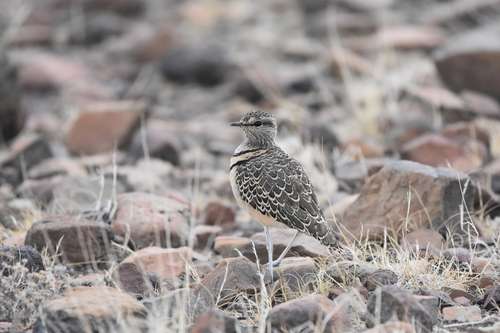 Double-banded Courser
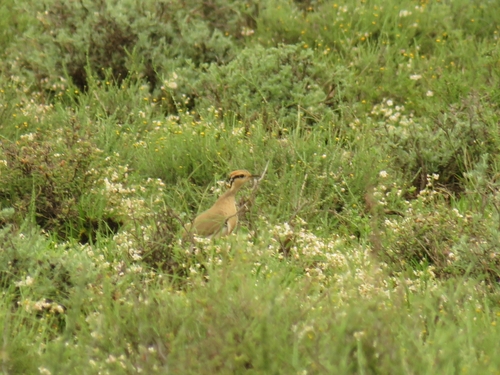 Temminck's Courser
In short
The most reliable field mark to separate Double-banded Courser from Temminck's Courser is the presence of two bold black breast bands on the Double-banded, which are absent in Temminck's. Double-banded Courser also shows a pale, streaked crown and a distinctive facial pattern with a black stripe through the eye, while Temminck's Courser lacks these features and is generally plainer. Both species favor open, dry habitats, but Double-banded Courser is more associated with stony or gravelly ground, while Temminck's is often found in recently burnt grassland. Size is similar, but Temminck's Courser is slightly heavier on average. Immature and flight marks are not detailed in the sources, so focus on adult plumage and structure.
Identification tips
- Double breast bands (Double-banded Courser only): Look for two narrow, black bands across the buffy chest; Temminck's Courser does not show any breast bands. This is the most reliable field mark for adults.
- Head pattern: Double-banded Courser has a pale crown streaked with brown and black, and a bold black line running from the bill through the eye to the nape. Temminck's Courser lacks these strong head markings and is generally plainer.
- Facial stripe: The black facial stripe of Double-banded Courser is distinctive; Temminck's Courser has a less contrasting face.
- Upperparts: Double-banded Courser shows sandy brown upperparts with dark-centered feathers and broad pale edges, creating a scaly effect. Temminck's Courser's upperparts are more uniform and less patterned.
- Underparts: Double-banded Courser's underparts are buff/white with dark flecks and the double band; Temminck's Courser is plainer below.
- Bill color: Both have short, dark bills, not a strong separator.
- Leg color: Both have pale legs and feet; not a reliable field mark.
- Habitat: If seen in stony, gravelly semi-desert with tufty grass or thorn scrub, Double-banded Courser is more likely. If in recently burnt grassland or savannah, especially near charred ground, suspect Temminck's Courser.
- Behavior: Double-banded Courser may be seen running in pairs, especially during breeding. Temminck's Courser is often solitary or in small groups, especially in post-burn areas.
- Breeding context: If you see a bird near a single, well-camouflaged egg in burnt grass, it's likely Temminck's Courser, which specializes in this nesting strategy.
- No strong size difference: Both are similar in size; Temminck's Courser averages 71g, but this is not a practical field mark.
- No known age-specific flight marks: There is no information on juvenile or immature wing patterns for either species, so do not rely on flight views of young birds for separation.
- Plumage pitfalls: In poor light or at distance, the breast bands of Double-banded Courser may appear faint or be obscured by posture; always try for a clear side or front view.
- Sexes similar: Both species have little or no sexual dimorphism, so all field marks apply to both sexes.
- Geographic overlap: Both species can occur in the same general region, so always use plumage and habitat together for identification.
Size
Temminck's Courser averages about 71 grams in body mass [wikidata], while no direct measurement is given for Double-banded Courser, but both are medium-sized coursers and appear similar in size in the field. There is no strong size difference likely to be useful for separation with binoculars.
Plumage
For adults, Double-banded Courser is immediately distinguished by its two narrow, black breast bands across a buffy chest, a pale crown streaked with brown and black, and a bold black line running from the bill through the eye to the nape. The back and wing coverts are sandy brown with dark centers and broad pale edges, giving a scaly look. Temminck's Courser lacks the double breast bands and instead has a more uniform, plain appearance with no mention of bold head or breast markings. The sources do not provide details on juvenile or immature wing patterns for either species, so these cannot be used for separation. In summary, focus on the breast bands and head pattern for Double-banded Courser; Temminck's is plainer and lacks these features.
Behaviour
Both species feed by running and picking insects from the ground, but Double-banded Courser is described as chasing prey by running and jabbing, often in pairs. Temminck's Courser is notable for nesting in burnt areas, laying dark ash-black eggs among charred grass, which may influence where and when you encounter them. Both are ground-dwelling and wary, but Double-banded Courser may be more likely to be seen in pairs during the breeding season.
Habitat
Double-banded Courser is typically found in flat, stony or gravelly semi-desert with sparse tufty grass or thorn scrub, favoring firm sandy soils. Temminck's Courser, while also a bird of open country, is especially associated with recently burnt savannah and grassland, often seen where fire has cleared vegetation. Both occur in sub-Saharan Africa, but Double-banded Courser's habitat is more arid and stony, while Temminck's is more tied to post-burn grassland.
Double-banded Courser · Temminck's Courser · My Tricky Birds