

Dot-winged Antwren vs Chestnut-backed Antbird
Microrhopias quixensis versus Poliocrania exsul
Play a quiz with Dot-winged Antwren and Chestnut-backed Antbird
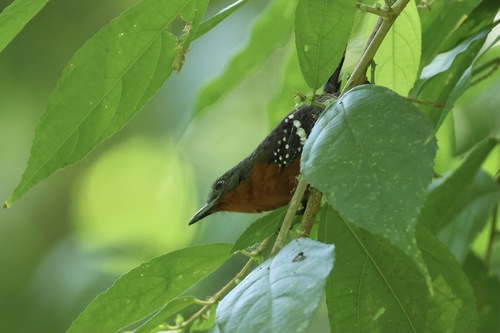 Dot-winged Antwren
 Chestnut-backed Antbird
In short
The most reliable field mark between Dot-winged Antwren and Chestnut-backed Antbird is overall size and body structure: Dot-winged Antwren is much smaller and slimmer, with a long, graduated tail and prominent white spots on the wings and tail, while Chestnut-backed Antbird is larger, heavier-bodied, and richly chestnut above with a blue bare eye-ring. In all plumages, Dot-winged Antwren shows strong white markings on the wing coverts and tail, especially in flight, whereas Chestnut-backed Antbird is deep chestnut above with only some white on the wing coverts in certain subspecies. Sexes differ in both, but the antwren female is rufous below with a dark throat, while the antbird female is brown below with a duller dark throat. If you see a small, active bird with bold white wing spots, it's the antwren; a larger, rounder bird with a blue eye-ring and chestnut upperparts is the antbird.
Identification tips
- Size and Build: Dot-winged Antwren is much smaller and slimmer than Chestnut-backed Antbird. If the bird appears tiny and delicate, especially in a mixed flock, it's likely the antwren. The antbird is noticeably bulkier and rounder.
- Tail Shape and Length: Dot-winged Antwren has a long, graduated tail with white tips (especially obvious in flight or when fanned). Chestnut-backed Antbird has a shorter, more even tail, uniformly chestnut with little or no white.
- Wing Pattern (All Ages): Dot-winged Antwren always shows bold white spots on the greater wing coverts and sometimes on other coverts. These are large and obvious, especially when the bird flicks its wings or in flight. Chestnut-backed Antbird may show some white tips on wing coverts in certain subspecies (notably males of P. e. cassini and P. e. maculifer), but these are smaller, less extensive, and never as striking as the antwren's. Most antbird subspecies lack obvious white in the wing.
- Upperparts Color: Dot-winged Antwren (male) is mostly black above; female is blackish gray. Chestnut-backed Antbird (both sexes) is deep chestnut above, including the wings and tail. This rich chestnut is never present in the antwren.
- Underparts (Sex Differences): Female Dot-winged Antwren has rufous-chestnut underparts with a black throat, creating a sharp contrast. Female Chestnut-backed Antbird is brown below with a duller blackish throat, lacking the bright rufous of the antwren.
- Eye-ring: Chestnut-backed Antbird of both sexes has a pale blue bare skin patch around the eye, visible at close range. Dot-winged Antwren lacks any bare blue skin around the eye.
- Bill and Face: Both have dark bills, but the antbird's bill appears heavier and the face rounder due to the blue eye-ring and head shape.
- Behavior: Dot-winged Antwren is more active, flicking wings and tail to flash white spots, and often joins mixed flocks. Chestnut-backed Antbird is slower, more secretive, and usually forages alone or in pairs near the ground.
- Habitat Preference: Dot-winged Antwren is more likely at forest edge, second growth, or mid-levels; Chestnut-backed Antbird is tied to dense, humid understory, often near the ground.
- Subspecies Variation: Some Dot-winged Antwren subspecies have more or less white on wings/tail or slightly different rufous shades below, but all show some white and a long tail. Some Chestnut-backed Antbird subspecies have white-tipped wing coverts (males), but never the bold white of the antwren, and always retain chestnut upperparts.
- Sexual Dimorphism: Both species are sexually dimorphic, but the antwren's female is much brighter below (rufous-chestnut) than the antbird's (brown). Male antwren is all black with white spots; male antbird is chestnut above and blackish below.
- Flight View: In flight, Dot-winged Antwren flashes white in the wings and tail; Chestnut-backed Antbird appears mostly chestnut with little or no white, except for small covert tips in some males.
- Mixed Flock Context: If seen with other small antwrens or tanagers in a fast-moving flock, suspect Dot-winged Antwren. If alone or with mate in dense thicket, suspect Chestnut-backed Antbird.
- Potential Pitfall: Do not rely solely on the presence of white in the wing, as some antbird subspecies show small white covert tips. Focus on overall size, tail shape, and the extent of chestnut above.
- When in Doubt: If you see a blue bare eye-ring, it's Chestnut-backed Antbird. If you see a small bird with a long, white-tipped tail and bold white wing spots, it's Dot-winged Antwren.
Size
Dot-winged Antwren is significantly smaller and lighter, with a body mass of about 7.9 g and a length of 10–12.5 cm [wikidata, wikipedia]. Chestnut-backed Antbird is much larger and bulkier, weighing around 29 g and measuring 14–15 cm [wikipedia]. In the field, the antwren appears dainty and slim, while the antbird is noticeably more robust and round-bodied. This size gap is often apparent even at a distance or in mixed flocks.
Plumage
No age-specific juvenile or immature wing patterns are described for either species, so focus on adult and sex differences. Dot-winged Antwren (male) is mostly black with large white tips on the greater wing coverts and white on the tail, visible both perched and in flight. The female is blackish gray above, black-throated, and rufous-chestnut below, with the same white wing and tail pattern as the male. Subspecies vary in the amount and size of white on wings and tail and in the shade of rufous below in females, but all show some white spots. Chestnut-backed Antbird (both sexes) is deep chestnut above (head, back, wings, and tail), with a slate-black head and underparts in males and duller blackish head/throat with brown underparts in females. Both sexes have a pale blue bare eye-ring, absent in the antwren. Some antbird subspecies have white-tipped wing coverts (notably P. e. cassini and P. e. maculifer males), but never the bold, extensive white of the antwren, and their upperparts remain chestnut. Female antbirds never show the sharp rufous/black contrast of female antwrens. The antwren's long, graduated tail with white tips is unique; the antbird's tail is shorter and uniformly chestnut.
Behaviour
Dot-winged Antwren is more active and agile, often foraging in pairs or small groups, flicking its tail and wings to reveal white spots. It moves quickly through lower and mid-levels of forest, often in mixed flocks. Chestnut-backed Antbird is more secretive, typically foraging near the ground or in dense understory, moving slowly and deliberately. It is less likely to join mixed flocks and is often detected by its song or calls rather than by movement.
Habitat
Both species occur in Central and northern South America, but Dot-winged Antwren has a broader range, including Mexico and more of South America. In overlapping areas, Dot-winged Antwren favors forest edges, second growth, and lower to mid-levels of humid forest, while Chestnut-backed Antbird is more strictly tied to dense, humid forest understory, especially near the ground. If you find the bird foraging high or at forest edge, it's more likely the antwren; if deep in dark, tangled understory, it's probably the antbird.
Dot-winged Antwren · Chestnut-backed Antbird · My Tricky Birds