

Dideric Cuckoo vs African Palm Swift
Chrysococcyx caprius versus Cypsiurus parvus
Play a quiz with Dideric Cuckoo and African Palm Swift
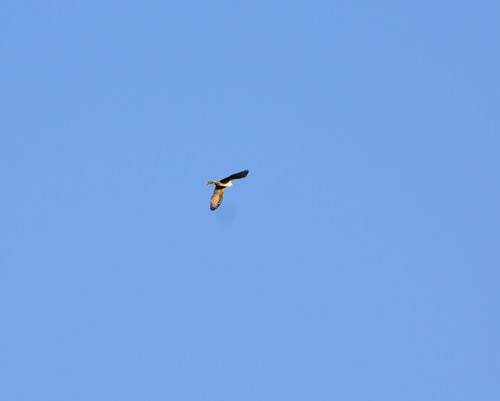 Dideric Cuckoo
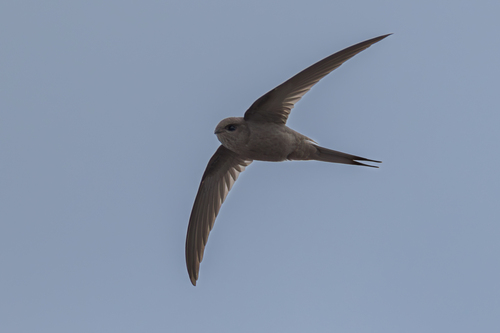 African Palm Swift
In short
The most reliable way to separate Dideric Cuckoo from African Palm Swift is by structure and flight style: the cuckoo has a compact, short-winged, and short-tailed look with a strong, direct flight, while the swift is slender with long, sickle-shaped wings and a deeply forked tail, rarely perching and almost always seen in rapid, agile flight. Juvenile Dideric Cuckoos show a white wing-bar and coppery tones above, unlike any palm swift. Adult cuckoos are glossy green with white underparts and a broken white eye-stripe, while palm swifts are uniformly pale brown and lack any strong markings. The cuckoo is often solitary and vocal, whereas the swift is usually seen in fast-flying groups around palms. Size, structure, and flight behavior are the quickest field checks.
Identification tips
- Juvenile Dideric Cuckoo shows a white wing-bar, coppery upperparts, and brown-blotched flanks—none of these are present in palm swifts of any age.
- Adult Dideric Cuckoo has glossy green upperparts with coppery areas and a broken white eye-stripe, while palm swift is uniformly pale brown and lacks any strong facial or body pattern.
- Dideric Cuckoo’s wings show three to four white spots on the inner vanes of the remiges (adults), and the tail has white tips and spots. Palm swift’s wings and tail are plain brown with no white or coppery markings.
- African Palm Swift has extremely long, swept-back wings (crescent-shaped) and a long, deeply forked tail (usually held closed), giving a boomerang-like silhouette in flight. Dideric Cuckoo has shorter, more rounded wings and a shorter, less forked tail.
- Flight style is a key separator: swifts are almost always in rapid, agile, continuous flight, rarely perching except on vertical surfaces. Cuckoos perch frequently and fly in short, direct bursts.
- Bill shape differs: Dideric Cuckoo has a short, slightly decurved bill, while palm swift’s bill is tiny and barely noticeable, adapted for aerial insect feeding.
- Behavioral context matters: a bird seen clinging to a palm frond or flying continuously around palms is likely a swift; a solitary bird perched in a bush or tree, especially if calling, is likely a cuckoo.
- Vocalizations are diagnostic: the cuckoo’s repetitive, ringing call is unlike the swift’s shrill scream.
- Sex differences in cuckoo: females are more coppery above and have brownish underparts with coppery flank barring, but still show more pattern than any palm swift.
- Juvenile palm swifts differ from adults mainly in tail length, not in color or pattern; they remain plain brown and lack any wing-bar or coppery tones.
- Size and mass: Dideric Cuckoo is heavier and more robust (33g vs 14g), but length is only slightly greater; the difference is most obvious in the field by the cuckoo’s bulkier, more compact look.
- Palm swifts are often in groups, especially near palms, while cuckoos are usually solitary.
- If you see a bird foraging on the wing, especially near palms, and never perching except on palm fronds, it is almost certainly a swift.
- If you see a bird with a white wing-bar, coppery or green gloss, or a broken white eye-stripe, it is a Dideric Cuckoo.
- Habitat overlap is possible, but palm swifts are most abundant near palms, while cuckoos are more generalist in open woodland and savanna.
Size
Dideric Cuckoo is notably heavier (33g vs 14g) and slightly longer (18–20 cm vs 16 cm), but the difference in build is more striking than length alone: the cuckoo is compact and robust, while the palm swift is very slender with extremely long wings and a long, deeply forked tail (usually held closed). In the field, the swift appears much lighter and more delicate, with a body mass less than half that of the cuckoo.
Plumage
Juvenile Dideric Cuckoos are distinctive with a red bill, streaky throat, white wing-bar, coppery upperparts, and brown-blotched flanks. These marks are absent in all palm swifts. Adult male cuckoos are glossy green above with coppery patches, a broken white eye-stripe, and white underparts; females are more coppery and have brownish underparts with coppery flank barring. The cuckoo’s wings show three to four white spots on the inner vanes of the remiges, and the tail has white tips and spots. In contrast, African Palm Swift is uniformly pale brown with no strong pattern, both in adults and juveniles (the latter mainly have shorter tails). Swifts lack any wing-bars, coppery tones, or white tail tips. The cuckoo’s plumage is much more contrasting and patterned, while the swift is plain and unmarked.
Behaviour
Dideric Cuckoo is often seen perched in open woodland, savanna, or riverside bushes, and is usually solitary. It moves with short, direct flights between perches and is often noisy. African Palm Swift is almost always seen in continuous flight, rarely perching except to cling vertically to palm fronds. Swifts feed, drink, and even bathe on the wing, and are typically found in groups, flying rapidly and erratically, often high above or around palms.
Habitat
Dideric Cuckoo favors open woodland, savanna, and riverside thickets, and is generally solitary. It is a short-distance migrant, moving with the rains, and is not closely tied to any particular plant. African Palm Swift is strongly associated with oil palms and cultivated palms, but also occurs in wooded savannah, thornbush, and farmland. Swifts are most often seen in open country near palms, and their abundance may increase where palms are planted.
Voice
Dideric Cuckoo is very vocal, giving a persistent, loud 'deed-deed-deed-deed-er-ick' call, usually four clear notes followed by a twitter. African Palm Swift gives a loud, shrill scream, quite different in tone and structure from the cuckoo’s call. If you hear the distinctive cuckoo call, it is diagnostic.